
Don’t Celebrate Too Early? Nvidia’s Stake Doesn’t Fix Intel’s Biggest Problem

Shearing sheep
September 19, 2025
GoGPT Summarizes Articles
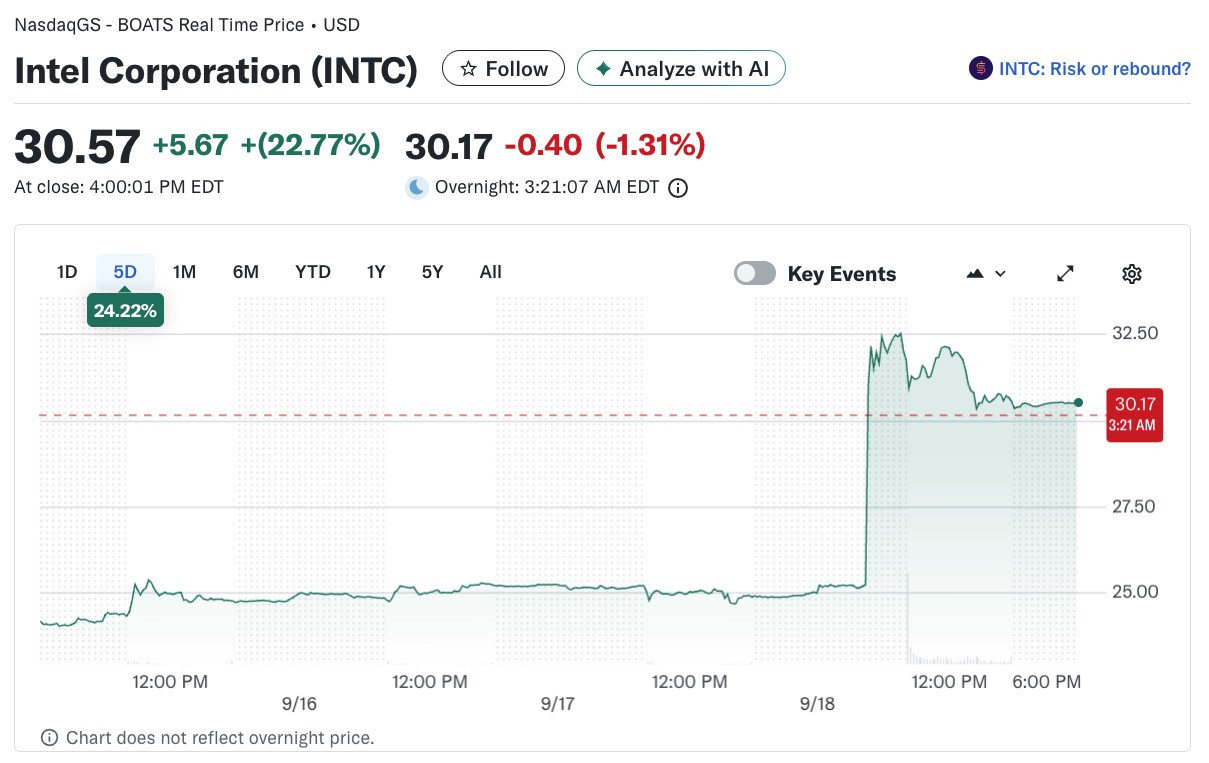
Intel’s stock made headlines on Thursday, jumping more than 30% intraday before settling with a gain of over 22% after Nvidia announced a $5 billion investment for around a 4% stake. For a company that has been fighting to regain its footing in the semiconductor industry, the news felt like a breakthrough moment. But while the market reacted with enthusiasm, the deal itself doesn’t address Intel’s deepest problem: its struggling foundry business.
The Nature of the Deal
The partnership focuses mainly on product collaboration. Nvidia plans to adopt Intel’s CPUs for its AI data center systems, while Intel will make use of Nvidia’s GPU technology in its consumer PC chips. This looks like a strategic fit: Nvidia’s dominance in graphics and Intel’s heritage in processors could bring fresh momentum to both companies in areas such as AI-powered PCs and servers.
However, the agreement carefully avoids any commitment around Intel’s manufacturing arm. During the announcement, Nvidia’s CEO Jensen Huang praised TSMC—the very company Intel is trying to challenge in advanced manufacturing—while sidestepping questions about whether Nvidia might one day use Intel’s fabs. That omission underscores a harsh reality: Nvidia trusts TSMC far more when it comes to building its most critical chips.
Intel’s Foundry Struggles
Intel has long prided itself on being both a designer and manufacturer of chips. In 2021, former CEO Pat Gelsinger doubled down on this model by launching Intel Foundry Services, hoping to open its fabs to external clients and compete directly with TSMC. The U.S. government, eager to reduce dependence on Asian chipmakers, backed this strategy.
But the financial results have been disastrous. Intel Foundry Services lost $7 billion in 2023, and those losses swelled to $13 billion in 2024. The company failed to secure the kind of anchor customers that are essential to make the economics of cutting-edge chipmaking viable. Instead of closing the gap with TSMC, Intel fell further behind, and investors punished the stock. Gelsinger himself was removed by the board late last year, a casualty of the mounting losses and missed promises.
This is why analysts view the foundry business as Intel’s biggest liability. Without a way to stem those losses—or attract customers willing to bet on Intel’s technology—the company risks dragging down its more profitable product divisions.
Why Nvidia Stayed Away
Given this backdrop, some on Wall Street expected Nvidia’s investment to include a manufacturing angle, especially since both Nvidia and Washington have reasons to diversify away from TSMC. But that didn’t happen. Huang praised Intel’s packaging capabilities, which could play a role in future products, but he gave no indication that Nvidia was ready to entrust its GPUs to Intel’s fabs.
The hesitance is understandable. TSMC is still years ahead in process technology, and Intel’s track record of delays hasn’t inspired confidence. There is also the issue of conflict of interest: as long as Intel designs its own chips, competitors like Nvidia will worry about giving it sensitive production orders. For now, Nvidia appears content to partner on products while leaving its most valuable chips in TSMC’s hands.
The Breakup Question
That brings us to the idea that refuses to go away: should Intel split itself into two companies, one focused on design and the other on manufacturing? Such a move could make cooperation with partners like Nvidia or AMD easier, since they wouldn’t have to worry about Intel competing against them in design. It could also give investors more clarity, allowing them to choose whether to bet on Intel’s products or on its fabs.
Splitting the company would not be simple. The fabs are unprofitable, capital-intensive, and tied up in complicated financing arrangements. But many believe this may be the only realistic path if Intel wants to attract external customers and government support on a larger scale. From Washington’s perspective, safeguarding domestic chip production is far more important than preserving Intel’s integrated structure.
Why Nvidia’s Money Still Matters
Even though the deal doesn’t touch manufacturing, Nvidia’s investment isn’t without significance. It boosts Intel’s credibility, shows that the company still has strategic value as a product partner, and might encourage other players to consider collaborations. It also signals that Intel still matters in the AI era, even if it has lost ground in the most profitable segments. In a best-case scenario, this kind of validation could make potential foundry customers more comfortable testing Intel’s services in the future.
The Bottom Line
For Intel, the Nvidia deal is good news—but it doesn’t solve the real issue. The company’s foundry arm is still losing billions, with profitability unlikely before 2027 at the earliest. Until that challenge is addressed, investors shouldn’t view the partnership as a turning point. Instead, it looks more like a short-term boost in confidence, not a long-term fix.
Intel’s future will ultimately hinge on whether it can make its foundry competitive—or whether it finally admits defeat and splits the company in two.
#Market Spotlight: The Stories Driving Today’s Trading