
APAC Market Wrap - 19 Sep

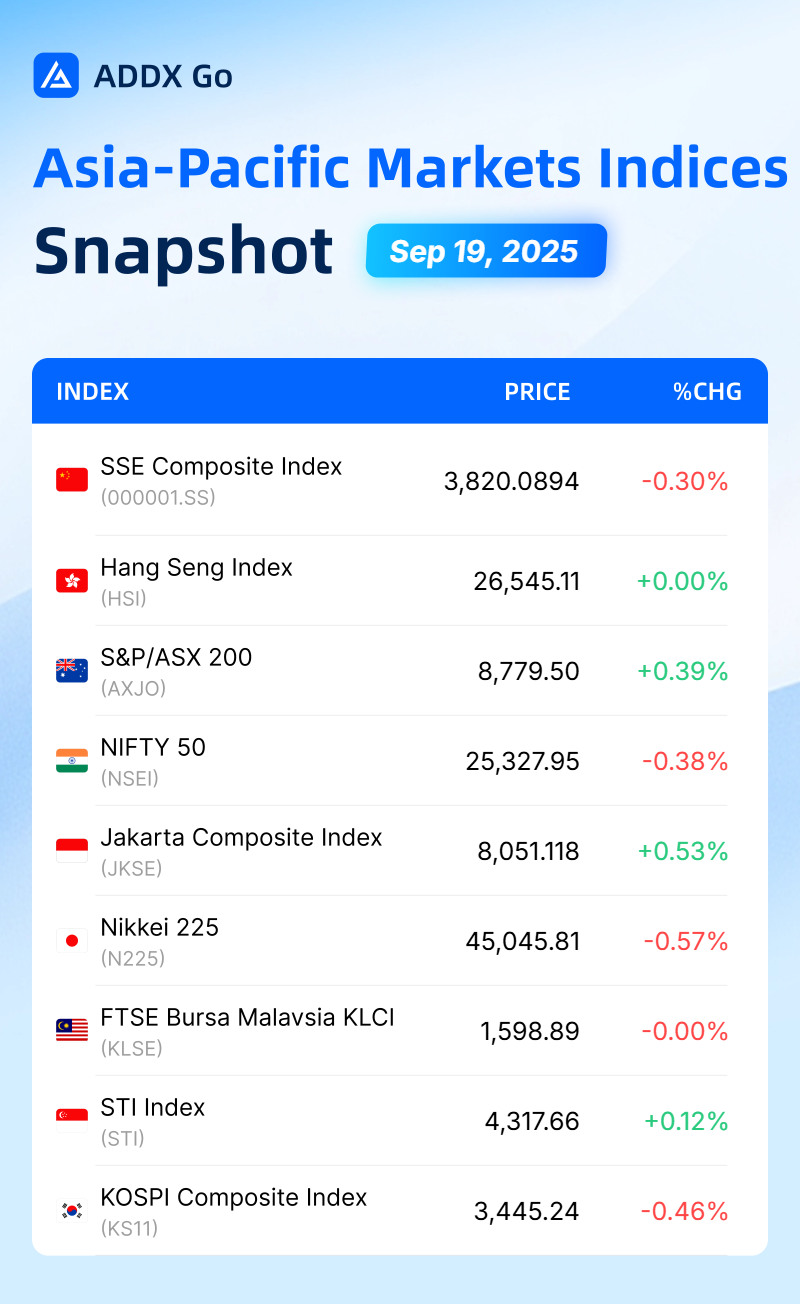
Chinese Stock Market: At close, the Shanghai Composite Index fell 0.30%, the Shenzhen Component Index dropped 0.04%, and the ChiNext Index declined 0.16%.
Sector-wise, energy metals, tourism, and lithography machines led gains, while robotics and industrial mother machines saw the largest declines.
Hong Kong Stock Market: This week, Hong Kong’s three major indices rose collectively, showing a pattern of initial gains followed by pullbacks, with significant market sentiment fluctuations.
At close, the Hang Seng Index rose 0.59% cumulatively to 26,545.10 points; the Hang Seng Tech Index surged 5.09% to 6,294.42 points; and the Hang Seng China Enterprises Index gained 1.15% to 9,472.35 points.
In terms of market performance, gold, cement, and lithium battery sectors performed strongly, while brokerage and robotics stocks were relatively weak.
Japanese Stock Market: The Nikkei 225 fell 0.57%, closing at 45,045.81 yen, down 257.62 yen from the previous day.
By sector, nine industries, including banking, wholesale, securities and commodity futures, and other financials, rose, while 24 industries, including other manufacturing, services, precision instruments, and retail, declined.
South Korean Stock Market: The KOSPI Index fell 0.46% to 3,445.24 points. Healthcare, machinery, business services, and pharmaceuticals led gains, while air freight, electronics, cards, and stationery saw the largest declines.
Australian Stock Market: The S&P/ASX 200 rose 0.32%, closing at 8,773.500 points. Semiconductors, medical services, and furniture sectors gained, while industrial distribution, diversified financials, aerospace, and agriculture saw significant declines.
Singapore Stock Market: The Straits Times Index fell 0.23% to 4,302.71 points. Forestry products, semiconductors, and diversified financials posted strong gains, while medical distribution, waste management, and regulated utilities saw significant declines.
Malaysian Stock Market: The FTSE Malaysia KLCI Index fell 0.04% to 1,598.23 points. Communications and media, transportation and logistics, and industrial products and services rose, while financial services, real estate, and construction declined.
Key Events
Malaysia’s GDP Growth Expected to Slow to 4.1% in 2026 as Fiscal Consolidation Intensifies
CIMB economists Michelle Chia and Azril Azhar stated in a report that Malaysia’s GDP growth is projected to slow to 4.1% in 2026, down from a previous forecast of 4.5%, due to softening external demand and slower consumption growth.
They noted that the government is expected to continue fiscal consolidation, narrowing the budget deficit from 3.8% of GDP in 2025 to 3.6%, while boosting revenue through measures like expanding the tax base, implementing an e-invoicing system, and potentially raising sin taxes.
Fiscal policy should balance consolidation with growth support, and if economic growth falls to or below the central bank’s 4.0%-4.8% target range, monetary policy may play a larger role. CIMB added that it expects interest rates to remain unchanged at the November meeting, with a potential rate cut in Q1 2026.
Bank of Japan Holds Steady as Prime Minister Ishiba’s Resignation Adds Uncertainty
Following Prime Minister Shigeru Ishiba’s announcement earlier this month that he will resign, the Bank of Japan (BOJ) maintained its benchmark interest rate unchanged on Friday to reduce economic and political uncertainty.
The BOJ, after a two-day meeting in Tokyo, announced it would keep the policy rate at 0.5%. All 50 economists surveyed by media expected this outcome.
Amid widespread expectations that the BOJ would refrain from action, Ishiba’s resignation sparked a multi-party race to succeed him.
Insiders previously noted that, from an economic perspective, even if Japan secures a trade agreement with the U.S., BOJ officials are still assessing the impact of U.S. tariffs on Japan’s domestic and international economy.
South Korean President Lee Jae-myung Reiterates Need to Boost Stock Market, Vows to Eliminate Unfair Trading
On Thursday, South Korean President Lee Jae-myung emphasized the need to boost the stock market during a meeting with securities firm executives.
Lee stated that the government will work to eliminate unfair stock trading, opaque governance, and unreasonable decision-making processes to create a predictable and fair market environment.
“I believe we should eradicate stock manipulation and unfair disclosures, and progress has already been made in these areas,” he said.
SoftBank Vision Fund to Cut Nearly 20% of Staff to Focus on AI Bets
A memo revealed that SoftBank Group will cut nearly 20% of its Vision Fund team globally to redirect resources toward founder Masayoshi Son’s large-scale AI initiatives in the U.S.
This marks the Vision Fund’s third round of layoffs since 2022. The fund currently employs over 300 people worldwide. Unlike previous layoffs, the fund reported its strongest quarterly performance since June 2021 last month, driven by gains from listed companies like Nvidia and South Korean e-commerce giant Coupang.
According to insiders, while the Vision Fund will continue making new investments, remaining staff will allocate more resources to Son’s ambitious AI plans, such as the proposed $500 billion “Stargate” project, which aims to collaborate with OpenAI to build a vast network of U.S. data centers.
Institutional Views
UBS: Fed Expected to Cut Rates by 75 Basis Points by Q1 2026
UBS Wealth Management’s Greater China Investment Director and APAC Macro Head Eva Hu said that under the baseline scenario, the Federal Reserve is expected to cut rates by an additional 75 basis points by Q1 2026, prioritizing labor market weakness over potential temporary inflation increases.
In a downside scenario, if labor market weakness proves more severe or persistent, the Fed could cut rates by 200-300 basis points, potentially bringing rates to 1.0-1.5%.
Bank of America: Potential Powell Successor Waller Seems Content with 25-Basis-Point Cut
Bank of America economists, led by Michael Gapen, noted that Fed Governor Christopher Waller, a top candidate to succeed Powell, appears satisfied with a 25-basis-point rate cut.
Gapen said, “We believe Waller has dispelled concerns that his recent dovish shift was politically motivated rather than economically driven. Whether this impacts his candidacy for Fed Chair remains to be seen.”
ING: Fed Decision Overall Bearish for the Dollar
Francesco Pesole of ING stated in a report that the Federal Reserve’s Wednesday rate decision is broadly negative for the U.S. dollar.
The Fed cut rates by 25 basis points as expected, but Chair Powell did not alleviate market concerns about inflation, describing the cut as a “risk-management” move.
TD Securities: Bank of England Expected to Cut Rates by 25 Basis Points in November
James Rossiter, Global Macro Strategy Head at TD Securities, said, “We expect the Bank of England to cut rates by another 25 basis points in November. The bank’s decision to reduce the annual sales of UK gilts purchased between 2009 and 2021 from £100 billion to £70 billion was in line with our expectations, as the market had widely anticipated this adjustment.
Despite speculation that the bank might tweak its statement, it maintained a cautious stance.”
Huatai Securities: Gold Prices May Face Short-Term Pressure Post-Rate Cut, Long-Term Allocation Value Remains
A Huatai Securities report noted that, in the short term, gold may face “sell-the-fact” correction pressure as Fed rate cut benefits are fully priced in. This cut is a preventive one, and based on the September 2024 rate cut, gold prices may form a “temporary” peak post-cut.
Huatai believes gold’s long-term allocation value remains intact, driven by the Fed’s continued rate cuts amid upward economic revisions and sticky inflation, as well as market expectations of a more dovish Fed post-Powell’s 2026 term. Additionally, global trends like de-dollarization, geopolitical risks, and portfolio diversification needs continue to drive central banks and institutional investors to increase gold allocations.
CITIC Securities: Hong Kong Stocks’ Earnings Growth Expected to Turn Around in H2 2025
A CITIC Securities report stated that Hong Kong stocks’ H1 2025 earnings have stabilized, achieving positive growth, with net profit margins and ROE remaining at elevated levels, reflecting stable operational efficiency.
By sector, technology, pharmaceuticals, and raw materials showed strong performance, supporting H1 earnings, while non-banking financials and some consumer sectors also improved. However, energy, utilities, real estate, and most consumer sectors faced earnings pressure.
Based on pre- and post-earnings disclosures, Hong Kong stocks’ earnings outlook is positive, with H2 2025 expected to mark a turning point in earnings growth. Raw materials, healthcare, and technology are expected to maintain high growth with upward revisions, while sectors like energy and staple consumption, which underperformed in H1, are projected to rebound in H2. In the ongoing liquidity-driven Hong Kong bull market, sectors with improving fundamentals are likely to continue attracting market attention.