
Bull Market, Soft Dollar: Is It Time to Buy U.S. Assets — But Hedge the Dollar?

The short answer: yes — buy U.S. assets, but think twice about leaving your currency exposure naked.
Goldman’s hedge-fund chief and a raft of global banks argue the market still has steam, yet a sweeping wave of dollar-hedging — potentially touching $1 trillion — is reshaping how foreign investors participate. Positioning now is about “responsible bullishness,” not blind optimism.
Key points
- Goldman’s Tony Pasquariello: don’t fight the bull, but avoid reckless positioning.
- The rally is fuelled by dovish Fed expectations, strong U.S. consumption and big tech upside.
- Sentiment measures show optimism — but not mania; breadth is debated but all 11 GICS sectors are positive year-to-date.
- Institutional flows into dollar-hedged U.S. ETFs have surged; some banks estimate a potential $1 trillion of additional hedging demand.
- Hedge mechanics (selling dollar forwards) can translate into spot dollar selling and add downward pressure on USD.
Why not fight this bull?
Goldman’s message is blunt: the market is giving returns to those who buy it. Tony Pasquariello warns some internals flirt with “red lines” — vertical moves in hot pockets, surging demand for calls, and option-expiry dynamics that can temporarily amplify moves.
Yet he stresses the obvious: the aggregate case for equities remains intact. If you short or stubbornly oppose this trend, you risk being proven wrong for a long, costly stretch.
Pasquariello’s preferred posture is neither complacent nor combative: “responsible bullishness.” He dislikes current tactical risk/reward setups, but accepts that the market has rewarded even loose risk discipline lately. His practical upshot: be constructive on equities, but manage sizing and risk.
What’s actually driving the rally?
Three forces underlie the bullish narrative. First, investors have priced in a Fed that plans to cut rates as growth strengthens — a sweet spot historically supportive of stocks.
Second, the U.S. consumer remains resilient; corporate conversations from retail and tech conferences back up healthy demand. Third, technology winners are delivering headline gains — dramatic moves in names that lift indices and sentiment.
Goldman’s sentiment work shows retail and institutional flows have risen but not to extreme levels. AAII, NAAIM and Fear & Greed indicators sit well below mania thresholds, implying room for additional inflows without immediate overheating. In short: the market is hot, but not frothy enough to rule out further upside.
Market breadth debate — headlines versus reality
Critics point to narrow leadership and a small cohort of mega-caps carrying indexes. Those breadth metrics are valid and deserve attention.
But there are counterweights: across the 11 GICS sectors, year-to-date returns are positive, a fact that complicates a one-sided “only five names matter” narrative. Put another way, market breadth is mixed — concerning in measures, reassuring in outcomes.
Moreover, structural shifts are broadening how markets behave. Systematic option flows and a booming options-ETF complex have changed liquidity dynamics and short-term volatility profiles. That evolution helps explain a market that can climb quickly while leaving some breadth statistics lagging.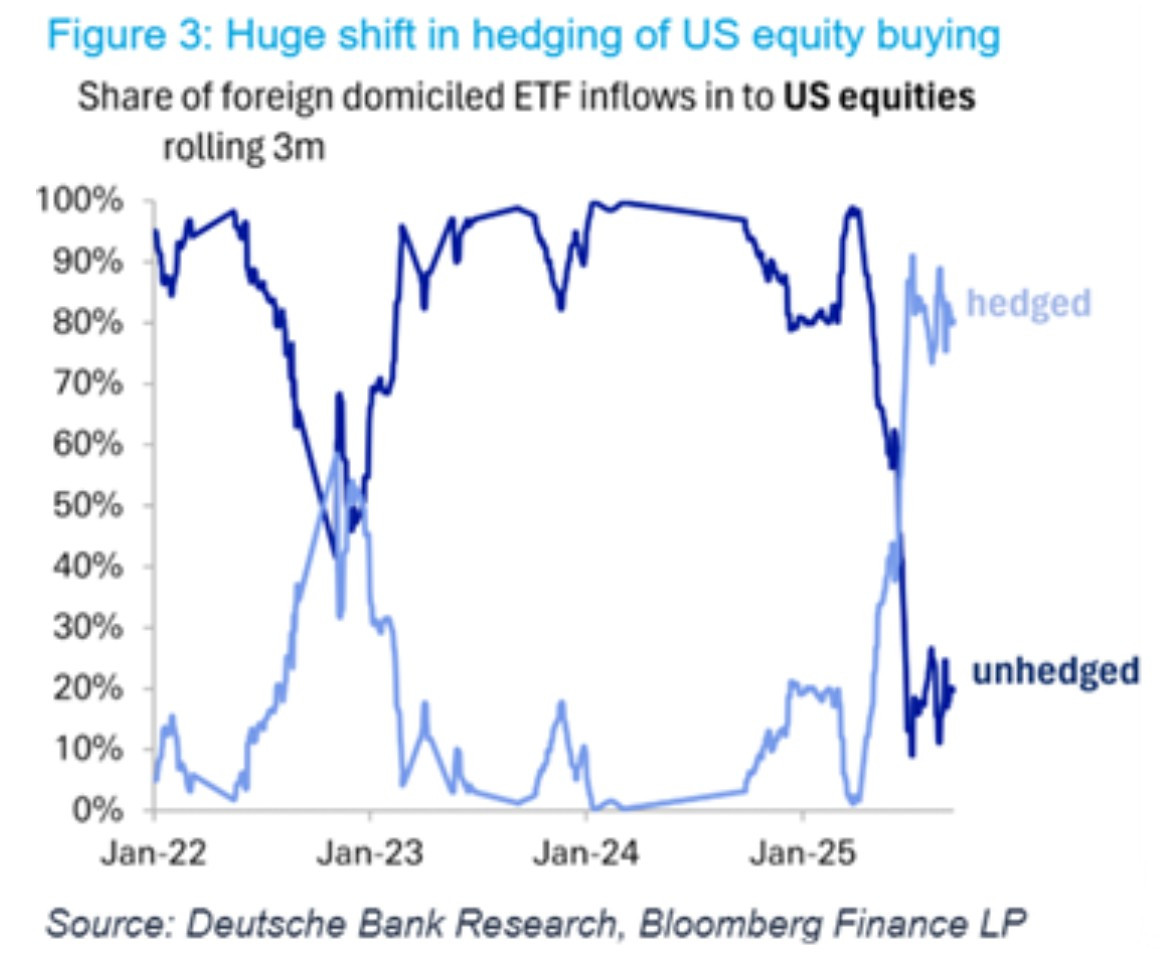
Dollar hedging goes mainstream
A parallel capital-markets story may be as important as the equity rally itself: the return of large-scale dollar hedging. From mid-year, inflows into dollar-hedged U.S. asset ETFs have for the first time in a decade outpaced non-hedged equivalents, according to major banks.
Ninety One’s research director, Sahil Mahtani, pegs the ultimate hedging tide at roughly $1 trillion — a number that would normalize foreign investors’ hedged exposure back to decade averages.
Why does this matter? Hedging is typically executed by selling dollar forwards or other FX instruments. That activity can create direct selling pressure on the USD in spot markets.
In April, a confluence of policy and trade tensions accelerated such flows; BIS and market commentators flagged those dynamics as part of what pushed the dollar lower that month.
Institutional surveys reinforce the shift.
One global bank found about 38% of large managers are looking to increase currency hedges — the highest since June — while custody and asset-servicing data show a measurable decline in the proportion of unhedged foreign holdings.
How the hedge wave interacts with policy and positioning
Several structural facts amplify the hedging argument. Foreign investors now own vast amounts of U.S. assets — roughly $20 trillion in equities and $14 trillion in U.S. bonds, by the figures cited — so even small percentage changes in hedge ratios translate into very large FX flows.
If managers restore hedging towards the ten-year average, the cumulative FX selling could reach the scale Mahtani describes.
Banks including Deutsche Bank, BNP Paribas and Société Générale have noted this shift publicly: flows into dollar-hedged products have accelerated and, for a time, outpaced non-hedged alternatives.
The mechanics are plain — more hedging equals more dollar forwards sold, which can feed through to the spot market and cap any dollar rebound.
Yet the hedging trend is not uniform. Some active managers and fixed-income shops, particularly those focused on domestic return drivers, have not materially increased dollar hedges.
Others — pension funds and long-dated allocators in Europe, Canada and Australia — are explicitly adding hedge layers. The net impact will be a tug-of-war, not a single directional shove.
Practical implications for investors
For U.S.-asset holders outside the U.S., two clear tensions arise. One: equities look attractive on fundamentals and policy expectations. Two: currency exposure matters — and large-scale hedging by foreigners is a real force that can reshape returns for unhedged holders.
Pasquariello’s counsel captures this tradeoff: don’t fight the market, but don’t ignore the currency. A “responsible bullish” program means staying constructive on equities while calibrating dollar exposure, position size and option-based hedges to protect against tail moves and FX volatility.
Mechanically, hedging costs depend on interest differentials (the carry), so the decision is partly technical and partly macro. For some investors, selective hedging — for example, partial or time-layered protection — strikes the balance between benefiting from U.S. equity upside and mitigating damaging FX swings.
What could change the script?
Several developments would alter the calculus quickly. If the Fed’s planned easing accelerates materially, it would reinforce the equity narrative and likely weaken the dollar further — increasing the attractiveness of hedging for foreign buyers.
Conversely, any surprise tightening of policy or a sudden deterioration in growth could flip flows, revive the dollar and penalize unhedged foreign holders.
Geopolitical and policy shocks also matter. The April episode — when tariff rhetoric and policy uncertainty coincided with significant FX moves — shows how quickly sentiment and flows can pivot. Investors must therefore treat the current setup as fragile rather than permanent.
Bottom line: buy with a plan, hedge with intent
The market’s current pulse rewards risk-taking — but prudence pays, too. Goldman’s message and the global-bank flow data converge on a simple, pragmatic playbook: be bullish on U.S. assets where fundamentals and policy align, but size and protect positions in recognition of a resurgent hedging wave and attendant USD risk.
That is the era we are in: a market that can reward “not irresponsible” bullishness, and a dollar environment that demands intentional currency strategy. For global investors, the active question today is not whether to own U.S. assets, but how loudly to sing their praises without getting singed by FX.