
Can Fed Cuts Turn This 15% Rally into a Full-Blown EM Bond Boom?

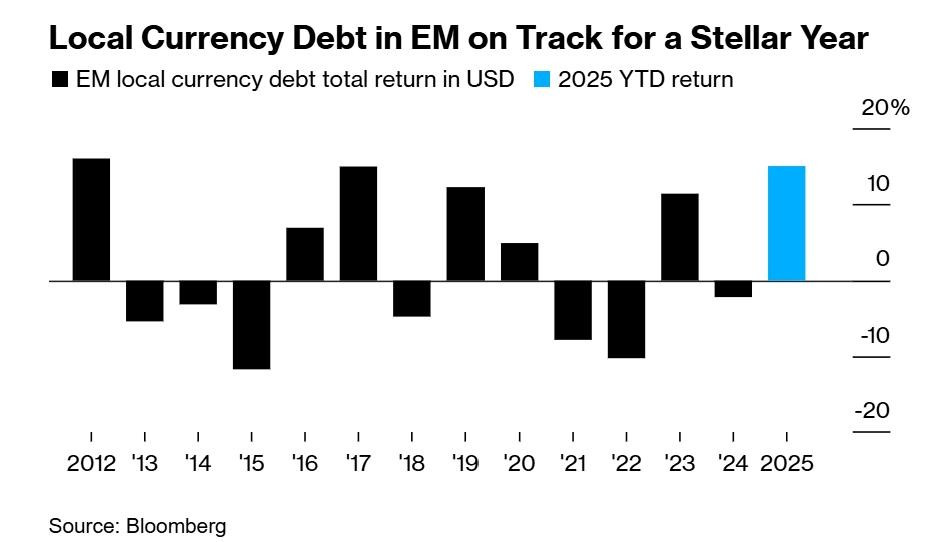
Money managers now see the Fed’s pivot back to cutting rates as the primary fuel for an emerging-market (EM) bond rally that has already returned roughly 15% in dollar terms this year, with local-currency debt poised to benefit further if the dollar keeps sliding.

Key Points
- EM domestic debt ≈ +15% YTD in dollar terms, best since at least 2017.
- Rally led by Brazil, Mexico, Colombia, Hungary and South Africa (≥23% YTD).
- Fed easing + weaker dollar are the main bullish catalysts; flows remain strong.
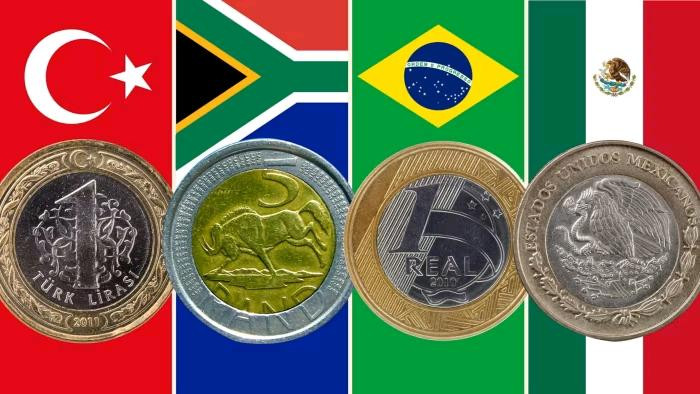
- Risks: dollar rebound, geopolitical shocks, and country-specific crises (Turkey, Argentina).
Why this matters now
The EM domestic-debt benchmark’s roughly 15% dollar return has pushed the asset class toward its strongest year since at least 2017.
That surge began after trade and policy turmoil pushed the dollar down, redirecting global cash into higher-yielding developing-market bonds.
With the Fed resuming cuts after a nine-month pause, investors expect additional dollar weakness and lower U.S. rates.
That mix amplifies the appeal of local-currency EM debt, whose dollar returns rise when home currencies appreciate.
Who’s betting and how the trade works
Managers from DoubleLine, JPMorgan Asset Management, Neuberger Berman and others are favoring local-currency sovereign bonds and higher-yielding EM currencies.
Their targets include markets such as Brazil, South Africa and Hungary, where nominal yields and the prospect of FX gains look attractive.
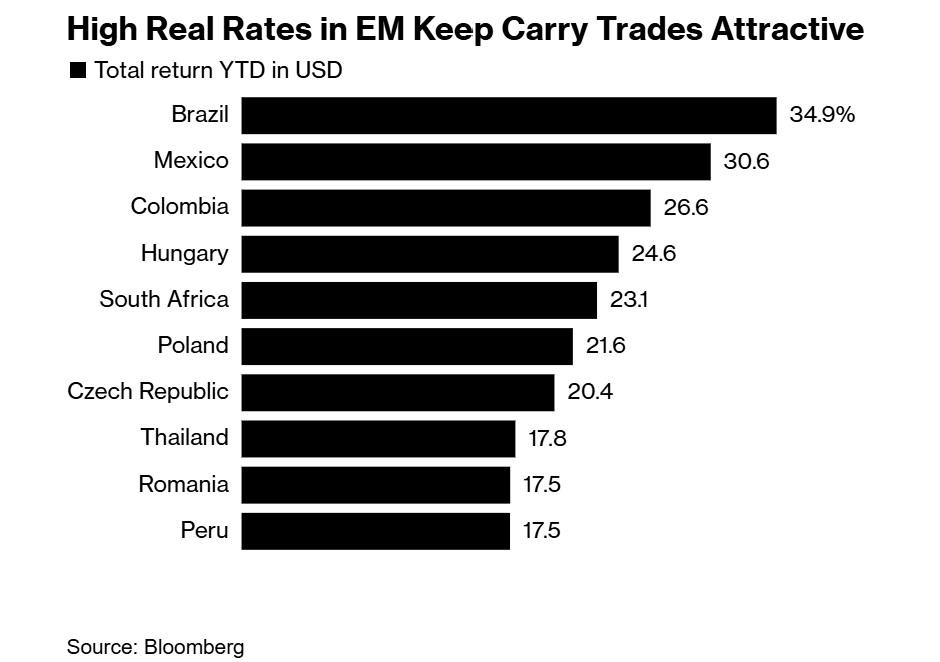
Mechanically, the trade buys local bonds that pay higher yields; a weaker dollar increases dollar-denominated returns.
Carry trades — borrowing in low-rate currency and investing in higher-yield EM debt — can magnify returns if FX moves favor holders.
Flows remain meaningful: EPFR/BofA data show about $300m into EM debt funds in the week to Sept. 17, the 22nd straight week of inflows.
Year-to-date net inflows into EM debt funds stand near $45bn, signalling durable investor interest rather than a one-off surge.
Risks and how managers are responding
A stronger dollar, fewer-than-expected Fed cuts, renewed geopolitical tensions, or country-specific crises could reverse gains quickly.
Recent selloffs in Turkey and Argentina’s currency stress illustrate how political or policy shocks can force sharp reversals.
Many managers are trimming hard-currency exposure after strong performance and shifting into local-currency positions or taking profits.
PGIM, DoubleLine and others keep a tactical short-dollar bias or overweight higher-yielding currencies while locking in gains selectively.
Bottom line — opportunity with caveats
If the Fed follows through with cuts and EM central banks remain relatively tighter, local yields plus FX appreciation can drive further outsized dollar returns.
But the rally’s scale and concentration make it vulnerable: investors should size positions and mind liquidity because a swift dollar rebound or political shock could produce rapid mark-to-market losses.