
Yen Bullish-Bearish Divide Intensifies! Hedge Funds and Asset Managers’ Split Hits 18-Year High

While traditional asset management giants remain bullish on the yen’s exchange rate, hedge funds focused on high-leverage and diversified asset strategies are aggressively betting on further yen weakening.
This sharpens the global financial market’s “bull-bear tug-of-war” over Japan’s sovereign currency, especially amid rising political uncertainty in Japan, heightened expectations of a Bank of Japan (BOJ) rate hike, and plans to sell ETF assets. The future trend of the yen exchange rate grows increasingly unclear.
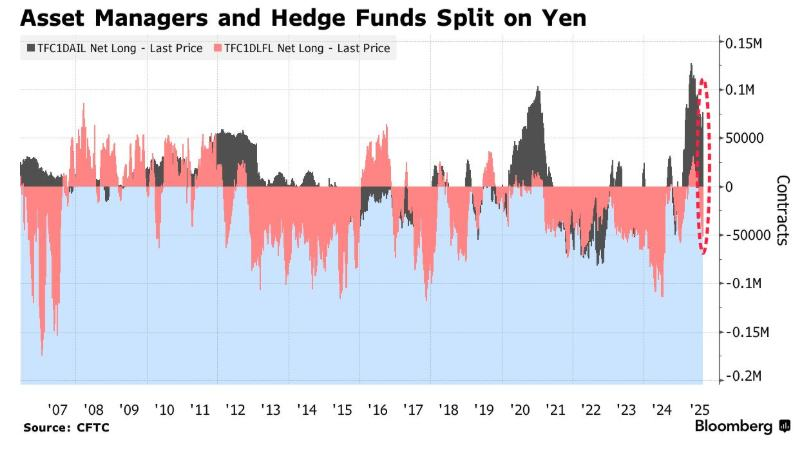
According to weekly data from the US Commodity Futures Trading Commission (CFTC), the gap between asset managers buying the yen and leveraged hedge funds shorting it has widened rapidly this month, hitting the widest bull-bear ratio since 2007.
This rare historical divergence highlights the extreme complexity of investment and speculative moves by global institutions and forex-focused investors in the world’s third-largest trading currency.
Domestic political uncertainty in Japan has muddied the BOJ’s monetary policy path, particularly for the latter—more traders in the interest rate market are betting on a October rate hike, though over 60% of interest rate futures traders still expect a restart in January next year.
Moreover, Japan, a long-standing US trade partner and broad ally, has been dragged into President Donald Trump’s global trade war, dampening market optimism about its assets and eroding the yen’s once-favored safe-haven status.

Last Friday, with global economic and domestic political uncertainty lingering, the BOJ kept its benchmark rate unchanged while announcing plans to start selling exchange-traded funds (ETFs).
A key detail in this rate decision was the unusually delayed announcement, due to internal voting disagreements.
The BOJ voted 7-2 to hold rates steady, with policy board members Hajime Takada and Naoki Tamura dissenting. Both argued for a 25-basis-point hike to 0.75%, citing rising price pressures that warrant moving policy rates closer to a neutral level.
In its rate decision statement, the BOJ concluded its two-day monetary policy meeting in Tokyo on Friday, maintaining the policy rate at 0.5%.
The 7-2 vote marks the first time since Governor Kazuo Ueda took office that he faced two dissenters on a rate-hold decision, seen by markets as a sign of a rising “rate hike faction” within the BOJ’s policy board.
Major Divide on Yen Direction
“Hedge funds are moving fast; some may see Japan’s political risks and uncertain rate path as a key reason to sell or use the yen as a funding currency,” said Shoki Orimori, chief trading strategist at Mizuho Securities.
“However, some traditional asset managers might view the yen as undervalued given the BOJ’s hike cycle and the Fed’s renewed cuts, while technical factors could force certain firms to hold USD/JPY positions. This divide could persist.”
During Monday’s Asian trading session, the yen weakened by 0.3%, trading around 148.32 yen per dollar. The yen has been soft since September, though it posted gains for most of the year, with USD/JPY down over 6% year-to-date, signaling a faster dollar depreciation and yen appreciation.
Yet, year-to-date, the yen is the worst-performing G-10 sovereign currency against the dollar, up only about 6%, while the Swiss franc—another safe-haven currency often compared to the yen—has risen over 13% against the dollar.
“Even if the BOJ restarts rate hikes, with actual rates so low, it’s hard to imagine the yen strengthening much,” said Takuya Kanda, head of research at Gaitame.com Research Institute in Tokyo. “We’re in a tough spot with growing market disagreements.”
Data as of the week ending September 16 shows hedge funds boosted their net short yen positions to nearly a historical high of 58,811 contracts just before the BOJ’s latest rate decision. Meanwhile, traditional asset managers slightly trimmed their long positions but still hold 71,162 contracts betting on yen strength.
Statistics indicate the bull-bear split between the two (hedge funds and traditional managers) is the widest in 18 years, nearing 2007 levels.
Unclear Domestic Politics + Tariff Impacts Still Murky
With Japan’s domestic political uncertainty and the unclear short-term impact of US tariffs on its economy, the resulting confusion makes it hard for markets to gauge the BOJ’s policy path. This underscores the complexity of yen investments, highlighted by the divide between asset managers and hedge funds.
“The key takeaway is: a 25-basis-point hike next month is now in market discussions, with focus shifting to the Tankan report, a key leading indicator due October 1,” said Mark Cranfield, a strategist on Bloomberg’s Markets Live.
The BOJ held borrowing costs steady as expected last Friday.

Though authorities have secured export-import trade deals with Washington, officials are still assessing the domestic and global impact of the US’s 15% tariff policy on Japan.
Amid tariff uncertainty and Prime Minister Shigeru Ishiba’s resignation plans, Japan’s economic outlook grows complex. However, insiders reveal some BOJ officials believe, despite political instability, another rate hike could occur by year-end if economic trends hold.
In this monetary policy meeting, Governor Ueda faced two opposing board members for the first time in his tenure on a rate-hold decision, prompting investors to reassess what this means for future BOJ policy and the yen’s direction.
Rodrigo Catril, a strategist at National Australia Bank in Sydney, said current positions of traditional asset managers and hedge fund giants are “near extreme but not yet at extreme,” suggesting “these stances could hold for some time,” implying the yen divide may intensify further.