
Tempus AI Rockets to New Highs: What’s Behind the Investor Frenzy?

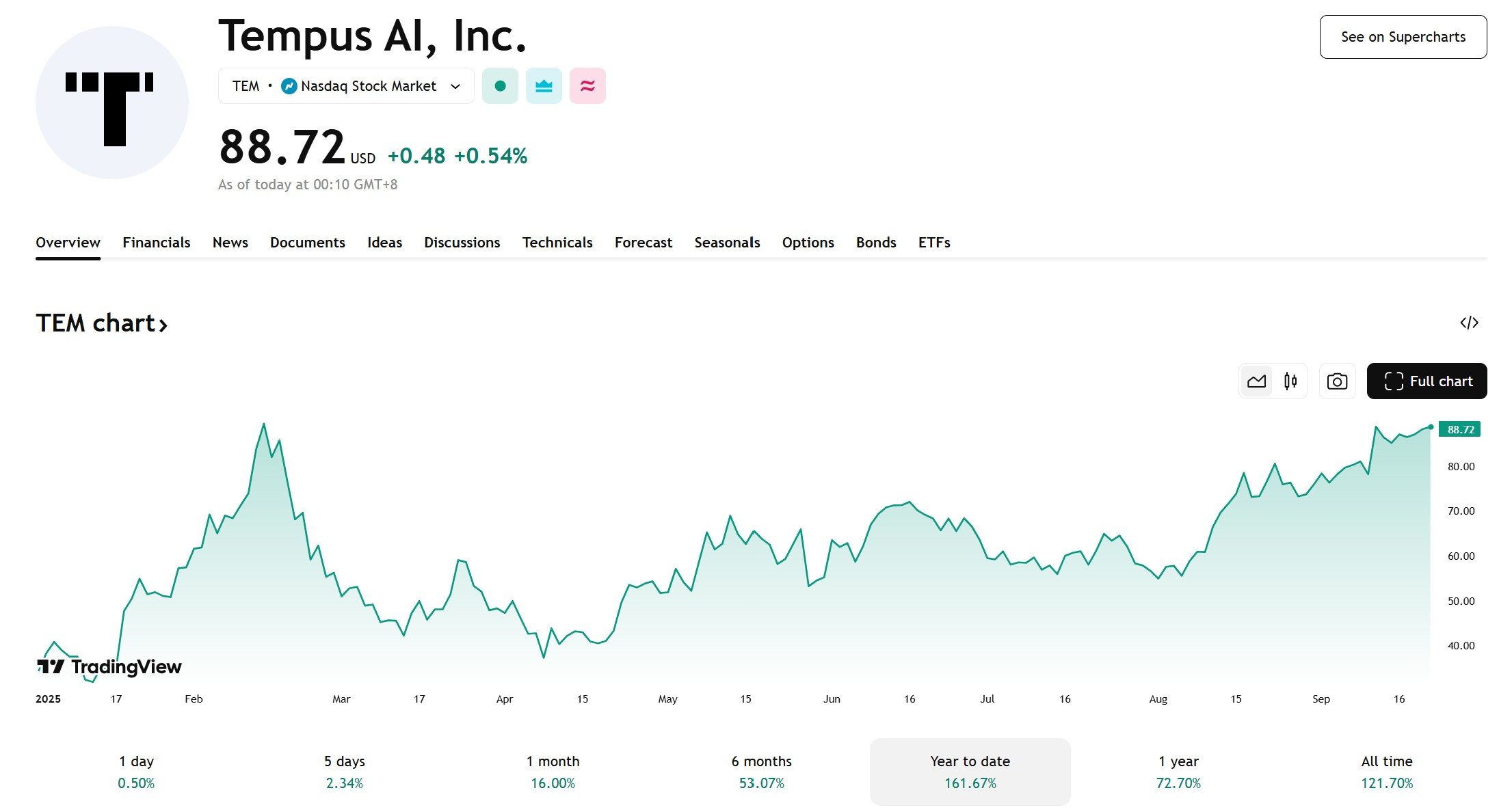
$TEM surged to an all-time high after winning fresh FDA clearances and drawing high-profile backers, sending the stock up more than 180% year-to-date.
The company’s genomics tests, imaging devices and data-licensing business are scaling quickly, and investors are now pricing in both rapid growth and the challenge of turning that growth into steady profits.
Key Points
- $TEM shares hit record highs; YTD gain ≈ +180%.
- FDA 510(k) cleared Tempus Xr Ivd (RNA NGS IVD); Tempus Pixel upgrade also secured a special 510(k).
- Genomics testing ≈ 76% of revenue; Q2 oncology testing $133M (+32.9% YoY); genetic testing $97.3M (+33.6% YoY).
- Data & AI services $72.8M in Q2 (+35.7% YoY); data licensing growth ≈ +40.7% YoY.
- 2025 guidance: revenue ≈ $1.26B (+~82% YoY); adjusted EBITDA targeted ~+$5M.
- Asset base: >5.2M de-identified EHRs, ~350+ PB imaging, partnerships across ~65% of U.S. academic medical centers and ~50% of oncology specialists.
Market reaction and immediate catalysts
FDA approvals landed at a pivotal moment. The 510(k) for the Tempus Xr Ivd RNA NGS device, and a special 510(k) for the upgraded Tempus Pixel cardiac imaging system, validated core product pathways and opened new commercial routes. Those wins accelerated ordering discussions and raised optimism about near-term revenue conversion.
High-profile endorsements — notably public filings tied to figures such as Nancy Pelosi — amplified retail and institutional interest. Combined with the regulatory momentum, accelerating top-line growth and bullish guidance, the stock experienced momentum buying across retail and institutional channels.
Miners of demand for data and imaging in pharma and hospitals now see Tempus as a clearer commercial counterparty. That shift, coupled with rising quarterly metrics, pushed the share price to new highs as investors rewarded visible clinical and regulatory progress.
Business model and why data matters
Tempus operates a three-part platform: genomic diagnostic testing (clinical lab services), a data & AI licensing business, and AI-driven clinical products.
These elements are tightly integrated: testing generates high-quality clinical data, licensed datasets monetize that data, and AI tools use the same data to improve clinical workflows.
The company’s “data flywheel” is straightforward. Offering services to clinicians yields rich, multimodal datasets—genomics, EHRs, imaging, transcriptomics and proteomics.
Anonymized datasets are then licensed to drug developers and biotechs, creating recurring revenue and funding further clinical and commercial expansion.
Tempus’s data assets are unusually deep. The firm reports more than 5.2 million de-identified EHRs and over 350 petabytes of medical images, drawn from partnerships covering about 65% of U.S. academic medical centers and roughly half of oncology specialists. That scale and variety make the dataset costly and time-consuming for competitors to replicate.
Clinical impact and product traction
Tempus highlights concrete clinical gains where its AI products are deployed. Its trial-matching tool increased screening efficiency 4.5x, matching accuracy 3.2x and enrollment rates 2.1x.
Platforms like Tempus Next deliver near-real-time operational insights to oncology and cardiology teams, boosting adoption and deepening data capture.
The recent FDA clearances expand the company’s addressable market by enabling device commercialization in diagnostic and imaging niches.
If hospitals and labs adopt the FDA-cleared devices at scale, Tempus can both expand test volumes and enrich its licensed datasets.
Financials and near-term outlook
Tempus’s revenue mix is weighted toward genomics testing, which accounted for about 76% of total revenue.
Q2 growth was robust: oncology testing generated $133 million (+32.9% YoY), genetic testing $97.3 million (+33.6% YoY), and data & AI services delivered $72.8 million (+35.7% YoY). Data licensing growth of roughly 40.7% YoY underpins rising visibility.
Management updated 2025 guidance to roughly $1.26 billion in revenue—near an 82% increase year-on-year—and expects adjusted EBITDA around $5 million, an improvement of roughly $110 million versus 2024.
Data-license retention and long-term contracts add near-term revenue visibility; Tempus reported data licensing retention around 140% and remaining contract value north of $940 million.
These figures suggest an inflection toward profitability if growth and margin trends continue and capital expenditures and lab scaling remain controlled.
Risks and execution challenges
Regulatory clearance is necessary but not sufficient for long-term success. Several execution risks remain. Converting device approvals into high-margin, repeatable revenue requires pricing and reimbursement clarity, hospital procurement cycles, and operational scale in labs and imaging services.
Competition in AI diagnostics and data licensing is intensifying. Payor reimbursement policies, clinical adoption timelines, and the cost structure of running large clinical labs are potential margin pressures.
Investors must also weigh valuation: current share prices reflect aggressive assumptions about commercial traction and margin improvement.
Finally, momentum-driven rallies can reverse quickly if quarterly metrics miss expectations or if the cadence of new FDA-driven rollouts slows.
How investors can position and what to watch
Bullish investors may consider direct equity exposure to capture upside from continued execution. For those seeking leveraged exposure, the 2x long TEM ETF (TEMT.US) is one higher-risk vehicle. Long-dated LEAPS calls are another way to gain asymmetric upside with lower capital outlay, mirroring strategies used by high-profile buyers.
Key signals to monitor: execution on commercial launches tied to FDA clearances, quarterly revenue and margin progression, renewal and expansion in data-license contracts, hospital adoption rates for devices, and any shifts in reimbursement policy. Insider and institutional flow patterns will also matter in a momentum-driven story.
Bottom line — promise versus proof
Tempus combines a credible origin story, deep proprietary datasets and tangible clinical products, and it’s showing accelerating revenue growth and regulatory progress. That combination justifies investor enthusiasm and explains the stock’s sharp YTD advance.
However, the valuation now prices significant delivery: the market expects Tempus to convert regulatory wins and data assets into sustainable, high-margin revenue.
The central investor question remains executional—can Tempus translate its data flywheel into predictable profitability? The coming quarters, focused on commercial rollout and margin trends, will decide whether the company’s promise becomes enduring value or simply a richly priced growth narrative.