
Biggest Outperformance in Eight Years! Experts Say Asian Stocks Will Keep Outshining U.S. Markets

Many experts believe Asian stocks are likely to keep beating U.S. markets as a weakening dollar boosts the appeal of Asian assets.
In recent months, Asian markets have benefited from lower valuations and a massive flow of capital out of U.S. assets. Growing signs of easing trade tensions are also supporting Asian stocks.
The rally, which has lasted months, shows no signs of slowing. While the Fed’s latest rate cut was widely expected, it’s reinforced a bearish outlook for the dollar and opened the door for Asian central banks to loosen monetary policy.
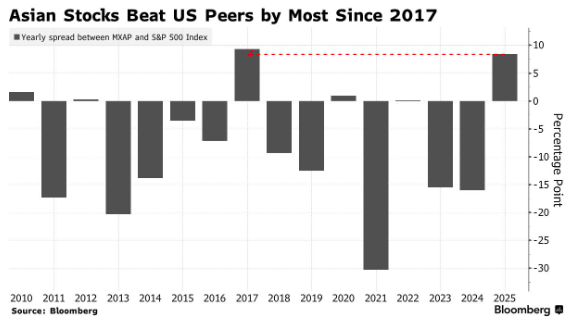
Data shows the MSCI Asia Pacific Index has climbed 22% year-to-date, outpacing the S&P 500 by about 8 percentage points, on track for its biggest annual lead since 2017.
“We’re tactically bullish on Asia-Pacific stocks versus U.S. stocks for the rest of the year,” said Homin Lee, senior macro strategist at Lombard Odier Singapore Ltd.
He added that factors like stable commodity prices, U.S. rate cuts, and fading trade disruption risks should provide a strong backdrop for markets.
Valuation-wise, the MSCI Asia Pacific Index trades at a forward P/E of 16, compared to 23 for the S&P 500. Even in tech, Asia looks cheaper: the Hang Seng Tech Index, which hit a four-year high last week, has a forward P/E of about 21, versus 27 for the Nasdaq 100.
Multiple Advantages
Many in the industry note that, while the pace and scale of the Fed’s current easing cycle remain uncertain, last week’s rate cut clearly bolsters Asian currencies.
Options market signals show traders are paying a premium to hedge against further strengthening of Asian currencies. Aggregated data on Asian currency risk reversals (a measure of demand for options betting on currency strength against the dollar) has been positive for months.
“In this context, we’re increasing exposure to non-U.S. stocks, including Asian equities, over U.S. stocks,” said Chang Hwan Sung, a multi-asset portfolio manager at Invesco’s investment solutions team in Hong Kong.
He added that this is driven by a bearish dollar outlook and “capital outflows from the U.S. seeking international diversification and foreign currency appreciation.”
Of course, any pause in the Fed’s rate cuts driven by inflation or a hawkish policy shift could quickly sour sentiment, and geopolitical tensions between major powers remain a risk. Political uncertainty in Indonesia, Thailand, and Japan is also on the radar.
But for now, widespread optimism suggests that as U.S. exceptionalism faces growing doubts, demand for Asian stocks could stay strong.
“The U.S. remains the hub for AI and corporate earnings, but Asia offers a unique angle, from India’s domestic demand story to Japanese bank stocks amid the Bank of Japan’s tightening, and selective Chinese tech investments as policy support and monetization align,” said Charu Chanana, chief investment strategist at Saxo Markets.