
APAC Market Wrap - 23 Sep

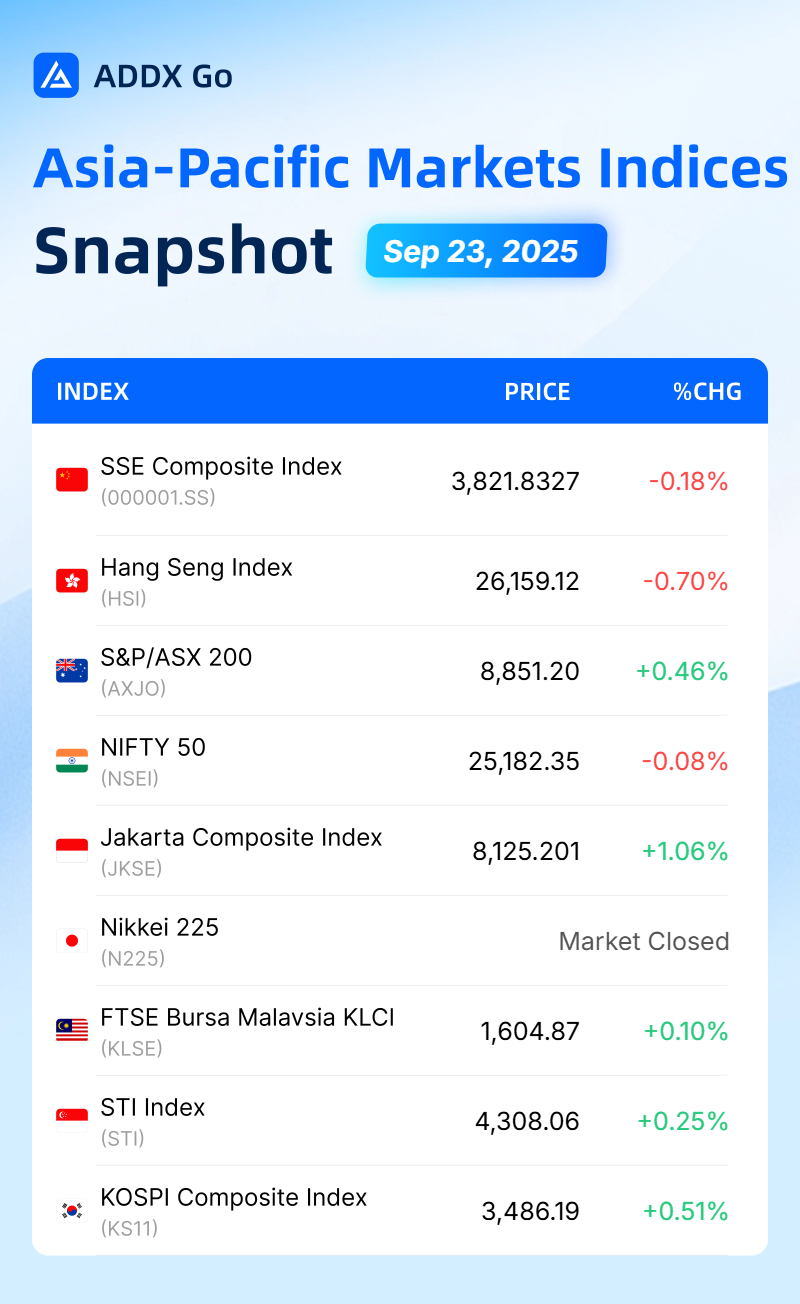
China Stock Market: At the close, the Shanghai Composite Index fell 0.18%, the Shenzhen Component Index dropped 0.29%, and the ChiNext Index rose 0.21%.
Sector-wise, ports and shipping, and banking led gains, while tourism, Huawei-related stocks, and minor metals saw the largest declines.
Hong Kong Stock Market: Hong Kong’s three major indices all closed lower.
At the close, the Hang Seng Index fell 0.70% to 26,159.12 points; the Hang Seng Tech Index dropped 1.45% to 6,767.06 points; and the Hang Seng China Enterprises Index declined 0.86% to 9,290.34 points.
In terms of market performance, banks and gold stocks bucked the trend with gains, while internet tech, automotive, and semiconductor stocks weakened.
Japan Stock Market: Closed today.
South Korea Stock Market: The KOSPI Index rose 0.51% to 3,486.19 points.
Diversified utilities, pharmaceuticals, life sciences, electric utilities, and hotels/restaurants led gains, while shipping, securities, broadcasting/entertainment, and leisure equipment saw the largest declines.
Australia Stock Market: The S&P/ASX 200 rose 0.40% to 8,845.900 points. Aerospace, independent power, homebuilding, and metals sectors gained, while diversified financials, credit, and agriculture saw significant declines.
Singapore Stock Market: The Straits Times Index rose 0.23% to 4,307.22 points. Insurance, industrial products, and metals/mining sectors saw strong gains, while diversified financial services, automotive/parts, and building materials posted notable declines.
Malaysia Stock Market: The FTSE Malaysia KLCI Index edged up 0.01% to 1,603.55 points. Real estate, healthcare, and consumer goods sectors rose, while closed-end funds, plantations, and transportation/logistics declined.
Key Events
H-1B Visa Fee Hike Leads Wall Street to Rely More on India’s Support Centers
U.S. President Donald Trump announced a $100,000 application fee for H-1B visas, a move that will push Wall Street banks to lean more heavily on their India-based global capability centers.
Major U.S. banks like Citigroup, JPMorgan Chase, and Goldman Sachs are key employers at these centers, which handle tasks from trade support and risk management to technical assistance. Staffed with software engineers, quants, and accounting professionals, these centers offer low-cost services while providing access to skilled talent scarce in local markets.
Bridgewater Founder Issues “Doomsday” Warning: U.S. and UK Headed for “Very Dark Times”
Legendary billionaire investor Ray Dalio issued a grim warning about the future of the U.S. and UK, stating he’s not optimistic about their trajectory and believes “we’re heading into very, very dark times.”
As the founder of Bridgewater Associates, the world’s largest hedge fund, Dalio drew on his unique study of 500 years of history, pointing to a predictable 80-year cycle signaling an era of major global and internal conflicts.
His framework highlights five key forces driving historical cycles: money and debt, internal conflict, geopolitical conflict, natural disasters, and human creativity (especially technology). He believes both the U.S. and UK show clear signs of approaching a dangerous phase in this cycle.
Singapore’s August Core Inflation Hits 0.3%, Lowest in Four and a Half Years
Official data released on Tuesday showed Singapore’s August core inflation at 0.3%, the lowest since February 2021, driven by declining service costs.
Excluding private transportation and accommodation prices, this figure was below the 0.5% expected by economists and down from July’s 0.5%.
Overall inflation in August was 0.5%, compared to 0.6% in July.
Goldman Sachs Report: Hedge Funds Pour into Banking, Insurance, and Consumer Finance
Goldman Sachs reported that hedge funds rushed into banking, insurance, and consumer finance stocks last week at the fastest pace in three months, driven by increased trading activity boosting profits and expectations of looser regulations.
Year-to-date, the European Banking Index has risen over 40%, while the U.S. Banking Index is up slightly over 20%.
Goldman’s report noted that these funds aren’t betting on popular regional targets but are instead pouring most of their capital into North American and European markets, wagering on stock gains there.
South Korean President Lee Jae-myung: Concerned U.S. Trade Talks Could Destabilize Korea’s Forex Market
South Korean President Lee Jae-myung told U.S. lawmakers he’s worried that trade and tax negotiations with the U.S. could destabilize Korea’s foreign exchange market.
Lee made the remarks during a meeting with U.S. lawmakers in New York while attending the UN General Assembly.
Still, he expressed confidence that Korea-U.S. trade talks would ultimately be resolved in a way that ensures commercial fairness.
EU and Indonesia Finalize Trade Deal, Tariffs on Nearly All Goods to Drop Near Zero
The EU and Indonesia reached a trade agreement to eliminate or reduce tariffs on nearly all goods to near-zero levels, strengthening bilateral ties as U.S. President Donald Trump seeks to reshape global trade.
EU trade chief Maros Sefcovic said in an interview that the deal will also lift restrictions on critical raw materials trade. He added that it will save European exporters about €600 million ($700 million) in tariffs.
Institutional Views
Morgan Stanley: Dollar Enters “Bear Market Mechanism,” Shorting Costs to Drop, Fed Key, Shutdown a “Potential Negative”
Morgan Stanley says the Fed’s policy shift post-Powell’s Jackson Hole speech, prioritizing jobs over strict inflation control, is fueling a dollar bear market. Market pricing suggests the dollar’s yield advantage will shrink by nearly 100 basis points in 12 months, lowering shorting costs. Rising U.S. government shutdown risks add a potential negative, possibly increasing the dollar’s risk premium.
Morgan Stanley’s latest call is for a sustained and broad dollar sell-off, with a government shutdown as a “potential negative” factor.
Capital Economics: India’s Household Debt Risks May Surface When Rate Cycle Turns in 2027
Capital Economics economist Shilan Shah wrote in a report that India’s rising household debt could raise concerns if central bank policy shifts from easing to tightening. The Reserve Bank of India has cut rates by 100 basis points this year and is expected to cut another 50, easing household debt burdens.
But Shah believes the rate cycle may turn in 2027, when rising debt servicing costs could curb consumer demand. He warns default risks could pose a bigger threat to India’s economy, noting much of current household borrowing may be unsecured loans.
Deutsche Bank: Gold’s Record Highs Signal Panic Lurking in Stock Markets
Gold prices just hit another record high, clashing with the broader market’s optimistic tone, as gold typically serves as a safe-haven during economic unease. Deutsche Bank analyst Henry Allen says this suggests panic is simmering in stock markets, with investors both bullish on stocks and worried about major downside risks.
He noted, “While gold has many drivers, one is its role as a safe-haven asset bought by investors during times of fear.”
CITIC Securities: Global Grid Investment to Exceed $400 Billion in 2025, High Growth Persists
CITIC Securities notes a global upcycle in power equipment demand. In 2025, global grid investment is expected to surpass $400 billion, maintaining high growth. AI is driving global electricity demand, significantly boosting related electrical equipment needs.
Overseas firms are raising capex forecasts, ramping up AI data center infrastructure. U.S. transformer demand remains strong, with price indices staying elevated. The Middle East is seeing rapid transformer demand growth.
Huatai Securities: Semiconductor Equipment in China to See “East Rising, West Falling” Trend Accelerate in H2
Huatai Securities says the “East rising, West falling” trend in China’s semiconductor equipment market may accelerate in H2. Based on Q2 2025 earnings from 32 global chipmakers and 20 equipment firms, global equipment revenue grew 24% year-on-year to $34 billion.
Overseas markets, driven by AI investments, grew 40%, with back-end equipment like testers seeing notable gains. Due to a high base last year, China’s market dipped 1% in H1 2025, showing a different cycle from overseas.