
U.S. Stocks Take Back the Crown as World’s Priciest Market: Is the Top a Tipping Point?

U.S. stocks are riding high on the Fed’s easy-money policies, snagging the title of the world’s most expensive market again. Sure, there’s a chance of a pullback when you’re this high up, but high valuations alone probably won’t spark a sell-off, since risk-adjusted returns are still lower than many global markets.
The chart below shows the MSCI All Country World Index, color-coded to highlight which country’s MSCI index, in dollars, had the highest three-month smoothed P/E ratio over time.
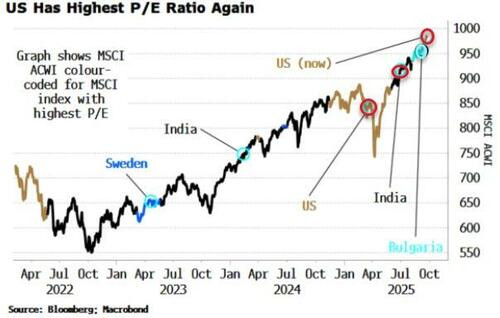
India’s market held the top spot for years, often looking overvalued but always finding support.
U.S. stocks took the lead briefly around Trump’s election last year and kept it during this year’s tariff spats. When the U.S. market got shaky months into the tariffs, India jumped back to the top in June, only to be passed by Bulgaria’s market.
By last week, U.S. stocks grabbed the “holy grail” of the highest global valuations—though it might be a risky prize.
U.S. markets aren’t just the priciest globally; they’re also at a historical high. The S&P 500’s P/E ratio beat its February peak, and its cyclically adjusted P/E is in the 98th percentile of nearly 150 years of data.
Macro strategist Simon White says high valuations don’t tell you when a drop’s coming.
He adds that if U.S. stocks were overbought, it’d be a bigger worry, but their risk-adjusted returns aren’t crazy—neither compared to their own past nor against global assets.
The chart shows the S&P 500 and U.S. tech’s one-year risk-adjusted returns are middle of the pack globally. Gold and Bitcoin have the best return-to-risk ratios, while the S&P 500 is under 1x, and the Nasdaq’s around 1x.
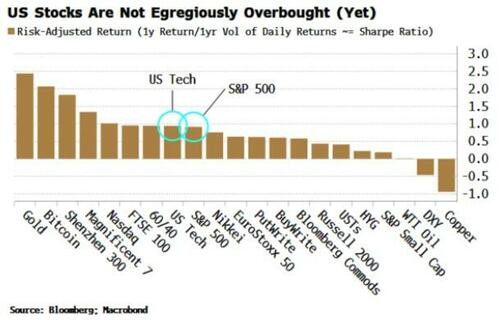
High return-to-risk ratios can hint at sharp reversals, since low volatility with gains can set up a messy fall.
White says there’s no obvious sign of a big U.S. stock crash yet, but investors should keep an eye on risks—especially with valuations topping the world.