
APAC Market Wrap - 24 Sep

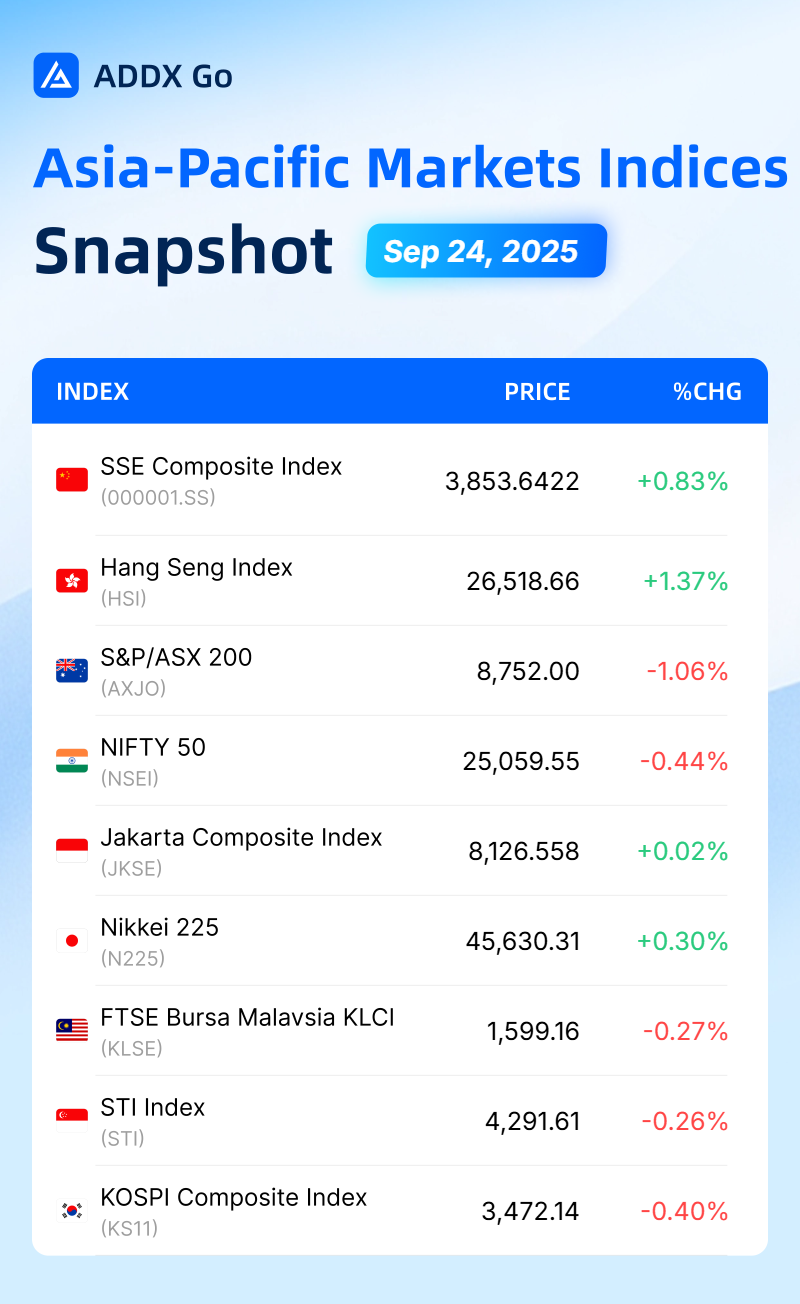
China Stock Market: At the close, the Shanghai Composite rose 0.83%, the Shenzhen Component climbed 1.80%, and the ChiNext Index surged 2.28%.
Sectors like memory chips, lithography machines, and energy metals led gains, while tourism lagged.
Hong Kong Stock Market: Hong Kong’s three major indices rebounded. The Hang Seng Index rose 1.37% to 26,518.65 points, the Tech Index jumped 2.53% to 6,323.15 points, and the China Enterprises Index gained 1.64% to 9,442.99 points.
Internet tech, chips, cloud computing, and batteries performed strongly, while banks and coal stocks weakened.
Japan Stock Market: The Nikkei 225 rose 0.30% to a record high of 45,630.31 yen, up 136.65 yen.
Mining, miscellaneous products, machinery, and nonferrous metals were among 18 sectors that gained, while glass/stone, services, rubber products, and wholesale saw declines among 14 sectors.
South Korea Stock Market: The KOSPI fell 0.40% to 3,472.14 points.
Defense, displays, diversified communication services, and machinery rose, while healthcare, construction materials, bioengineering, and hotels led declines.
Australia Stock Market: The S&P/ASX 200 dropped 0.92% to 8,764.50 points.
Aerospace, independent power, homebuilding, and metals gained, while diversified financials, credit, and agriculture fell sharply.
Singapore Stock Market: The Straits Times Index rose 0.23% to 4,307.22 points.
Aerospace, semiconductors, and alternative energy surged, while restaurants, construction materials, and healthcare declined.
Malaysia Stock Market: The FTSE Malaysia KLCI fell 0.24% to 1,599.66 points.
Real estate investment, real estate, and industrial products rose, while transportation/logistics, closed-end funds, and communication/media declined.
Key Events
Australia’s Woodside Energy Signs LNG Supply Deal with Turkey’s BOTAS
Woodside Energy announced Wednesday a deal to supply Turkey’s state-owned BOTAS with ~5.8 billion cubic meters of LNG starting in 2030 for nine years, primarily from its Louisiana LNG project.
U.S. Trade Rep: Partial ASEAN Trade Deals Expected in Weeks
The U.S. expects to finalize trade deals with some ASEAN nations soon, as President Trump’s policies push for tariff reductions. U.S. Trade Representative Jamison Greer, ahead of a meeting with ASEAN economic ministers in Kuala Lumpur, said deals could be finalized in months or weeks.
Japan’s Next Goldmine? U.S. Hedge Fund Verdad Targets Small-Cap Stocks for Alpha
Boston-based Verdad Advisers plans to launch a Japan stock fund focused on small-cap firms, signaling global investors’ shift beyond blue-chip stocks.
Founder Daniel Rasmussen said the fund, possibly launching this year, will target firms with inefficient capital use, like high debt or excess cash, with a market cap above $400 million.
Hedge Fund Elliott Pushes PepsiCo for Cost Cuts, Urges Coca-Cola-Style Bottling Spin-Off
Elliott Investment Management is pressing PepsiCo to cut costs and divest low-growth brands, with some investor support.
However, its push for PepsiCo to emulate Coca-Cola’s bottling spin-off has less backing. Elliott argues PepsiCo’s integrated model lags Coca-Cola’s franchise system, leading to weak price-packaging management, slower regional innovation, and poor store execution.
Institutional Views
JPMorgan: Foreign Investors May Boost FX Hedging for Japanese Stocks, Triggering Yen Sell-Off
JPMorgan says foreign investors may increase forex hedging for Japanese stocks, potentially sparking yen sales. Strategists, including Ikue Saito, note that low hedging ratios (10-20%) have weakened the correlation between Japanese stocks and USD/JPY. A 1% rise in hedging could trigger ~3 trillion yen in USD/JPY buying, pushing it up 2.8.
S&P Global: PMI Shows Output Growth, but Future Risks Loom
S&P Global’s Chris Williamson said September’s strong output growth capped a stellar Q3 for U.S. firms, aligning with a 2.2% annualized GDP growth. However, growth slowed from July’s peak, hiring eased, and demand weakness limited pricing power. Rising input costs from tariffs squeezed margins, though this could ease inflation.
Capital Economics: Japanese Stocks Likely to Weather BoJ’s ETF Sales
Capital Economics’ Higgins says Japan’s stock market will likely shrug off the Bank of Japan’s ETF sales, equivalent to 0.05% of the TSE Prime market’s value annually. Supported by trade deals, a weak yen, economic momentum, attractive valuations, and rising bond yields, the market could also benefit from AI enthusiasm, though outpacing U.S. stocks in AI by 2026 is unlikely.