
Stock Soars Nearly 100% YTD! Is Micron Technology’s Latest Quarter Still Red-Hot

The AI boom has fueled massive gains for tech giants like Nvidia (NVDA.US) and Oracle (ORCL.US), with soaring earnings and stock prices.
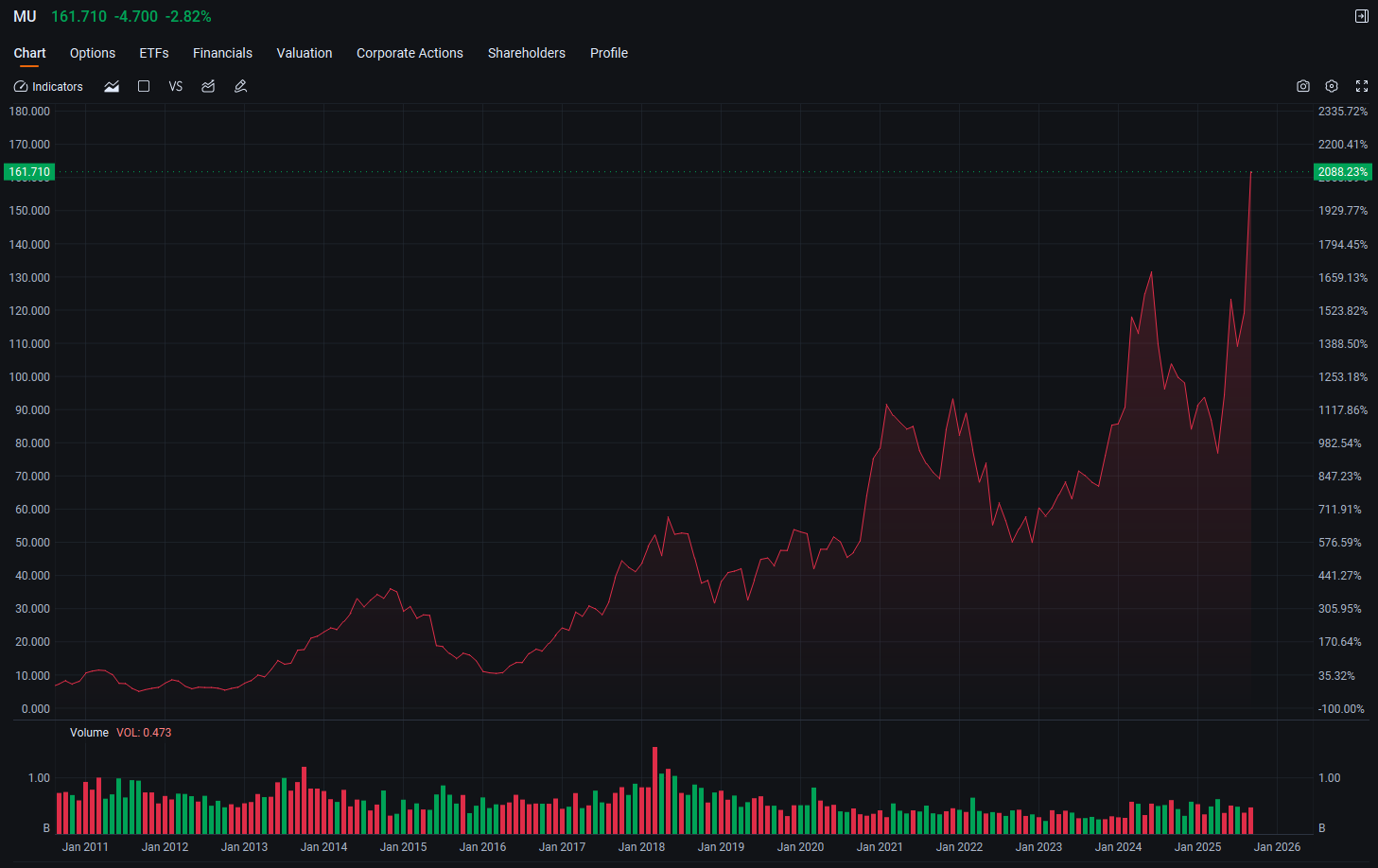
Now, memory chip powerhouse Micron Technology (MU.US) is cashing in on the AI frenzy with a stellar performance.
Fourth Quarter Earnings Explode
After the market closed on September 23 (Eastern Time), Micron unveiled its Q4 2025 results (ended August 31). Revenue hit ~$11.3 billion, a 46% jump year-over-year and 22% quarter-over-quarter, beating market expectations and setting a single-quarter record.
Adjusted operating profit soared 127% to $4 billion, while adjusted earnings per share (EPS) reached $3.03, up 157%, topping both guidance and forecasts.
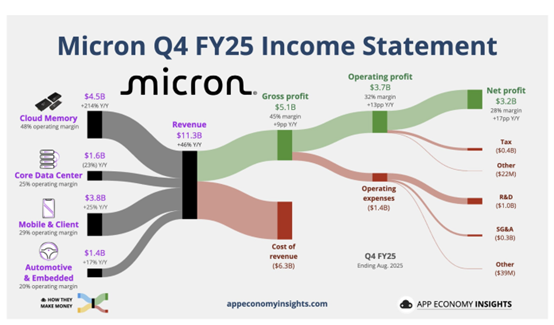
Breaking it down by product, DRAM stole the show. NAND revenue was $2.3 billion, down 5% year-over-year but up 5% quarter-over-quarter, making up ~20% of total revenue.
Meanwhile, DRAM revenue skyrocketed to $9 billion, up 69% year-over-year and 27% quarter-over-quarter, accounting for ~79% of total revenue (up from 76% last quarter).
The real star? High Bandwidth Memory (HBM), the darling of the AI world. Micron’s CEO revealed HBM revenue hit nearly $2 billion in Q4, implying an annualized ~$8 billion.
Micron now has six HBM clients and has locked in pricing for most of its 2026 HBM3E supply, with deals for the rest expected soon. CEO Sanjay Mehrotra touted the company’s record 2025 performance, with Q4 shining as proof of Micron’s leadership in technology, products, and operations. The data center business notched its best year ever, setting Micron up for a strong 2026 with a top-tier product lineup.
Guidance Crushes Expectations
Micron’s Q1 2026 guidance is a head-turner. Revenue is projected at $12.2-$12.8 billion, with the low end beating analyst estimates of $11.9 billion. Adjusted EPS is expected at $3.60-$3.90, and gross margins are forecast at 50.5%-52.5%, well above the 45.9% analysts predicted.
Why the optimism? The memory market is heating up. Micron expects DRAM supply to remain tight through 2026, with NAND conditions improving. Industry demand for both is projected to grow ~15% annually in the medium term. This bullish outlook reflects strong market dynamics and Micron’s strategic positioning.
All-In on AI
Micron’s betting big on AI as its growth engine, doubling down with tech innovation, strategic investments, and lean operations. Its HBM3E product is scaling rapidly, driving nearly $2 billion in Q4 revenue. Micron expects its HBM market share to match its overall DRAM share by Q3 2025—earlier than planned—thanks to strong execution.
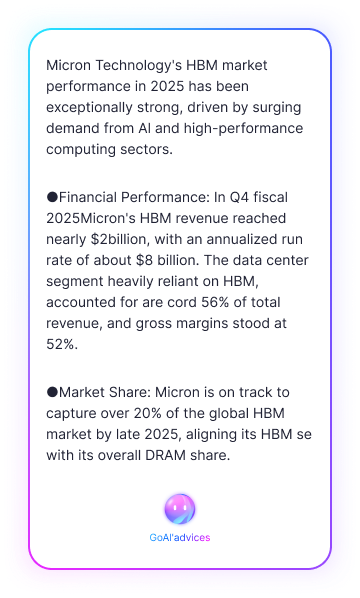
(The image content is sourced from the GoAI intelligent financial AI tool)
Looking ahead, Micron’s already sampling HBM4, with industry-leading bandwidth (>2.8 TB/s) and pin speed (>11 Gbps), outperforming competitors in performance and efficiency. Its in-house CMOS base die is a key advantage. While future HBM4E will involve TSMC for higher-margin custom base dies (slated for ~2027), Micron’s six HBM clients have already secured most 2026 HBM3E supply.
On the tech front, Micron’s 1-gamma DRAM node rolled out at record speed—50% faster than the prior generation—and is already shipping. For NAND, Micron’s ramping up G9 node capacity while phasing out mobile-managed NAND to focus on high-return data center SSDs.
CEO Mehrotra noted that while cutting-edge NAND capacity is maxed out, some older capacity remains underused, reflecting Micron’s disciplined approach to profitability.
Demand Soars, Supply Tightens
AI is supercharging semiconductor demand, while supply constraints create a sweet spot for Micron. Management raised 2025 growth forecasts: server shipments are now expected to grow ~10% (up from mid-single digits), boosted by AI assistants driving traditional server demand. PC shipment growth was upgraded to mid-single digits from low-single digits.
DRAM supply will stay tight through 2026 due to robust demand, low industry inventories (Micron’s own DRAM stock is below target), and the slow shift to advanced nodes to support legacy DDR4/LPDDR4 demand.
HBM’s massive wafer consumption—3x for HBM3E, over 3x for HBM4—further squeezes standard DRAM supply. On tariffs, management noted some customer pre-stocking but said overall demand remains robust.
HBM Market Showdown: Micron Overtakes Samsung in Q2, SK Hynix Holds Top Spot
On Wednesday, new data revealed that Samsung Electronics slipped to third place in the global high-bandwidth memory (HBM) chip market in Q2, while Micron Technology climbed to second.
According to Counterpoint Research, Samsung held a 17% share of the global HBM market from April to June, trailing Micron’s 21%. SK Hynix led with a commanding 62% share.
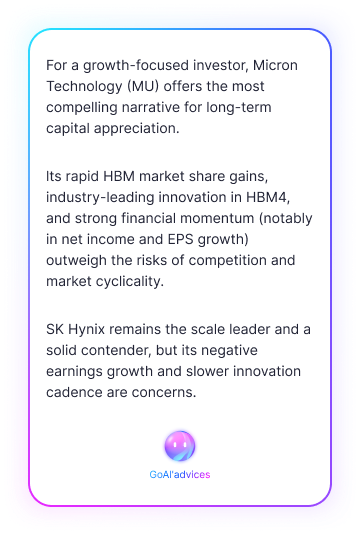
(The image content is sourced from the GoAI intelligent financial AI tool)
HBM, a critical component for AI applications, is seeing explosive demand due to its ability to significantly boost data center processing speeds.
While Samsung currently lags behind SK Hynix and Micron, analysts predict its next-gen HBM4 product, set to join Nvidia’s supply chain, will drive a rebound. Counterpoint forecasts Samsung’s HBM market share will surpass 30% next year.
Is Micron Still a Buy?
With a forward P/E of ~12, Micron’s the cheapest stock in the Philadelphia Semiconductor Index, yet its growth outlook is rock-solid. For investors chasing reliable growth, it’s a golden opportunity. Value investors can still find appeal but should build positions gradually and avoid chasing highs.
Micron’s earnings aren’t just about the company—they’re a signal of the memory industry’s transformation in the AI era. With the stock up nearly 100% this year, the gains are impressive, but caution is warranted when investing at these levels.$MU