
Global Debt Hits New Peak: $337.7 Trillion

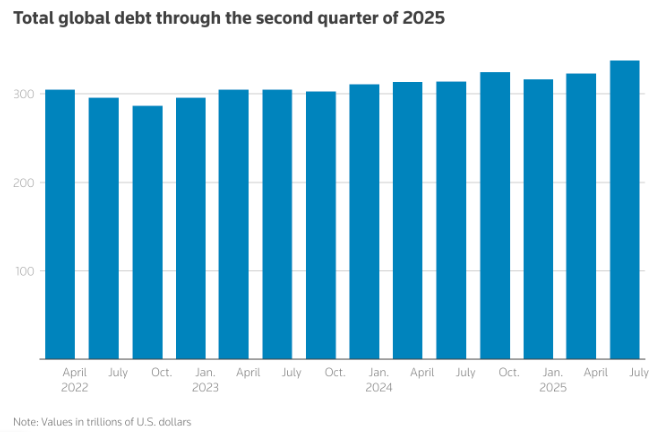
A quarterly report from the Institute of International Finance (IIF) released Thursday shows global debt reached a record $337.7 trillion by the end of Q2, driven by loose financial conditions, a weaker U.S. dollar, and more dovish stances from major central banks.
The IIF’s data reveals that global debt surged by over $21 trillion in the first half of this year, hitting $337.7 trillion.
Measured in dollars, countries like France, the U.S., Germany, the UK, and Japan saw the biggest debt increases, partly due to the dollar’s depreciation. Since the start of the year, the dollar has weakened by 9.75% against a basket of major trading partner currencies.
Debt Surge Rivals Pandemic Era
The IIF’s *Global Debt Monitor* report notes, “This debt increase mirrors the explosive growth seen in the second half of 2020 during the pandemic, when policy responses drove an unprecedented debt pile-up.”
When looking at the debt-to-GDP ratio—a key measure of repayment capacity—Canada, Saudi Arabia, and Poland saw the sharpest rises.
Meanwhile, Ireland, Japan, and Norway saw declines in this ratio. Overall, the global debt-to-GDP ratio continued a slow decline, now just above 324%. However, in emerging markets, it hit a record 242.4%, rebounding from a May report low.
Emerging markets added $3.4 trillion to their debt in Q2, pushing the total past $109 trillion—a new high. The IIF warns that emerging markets face a record $3.2 trillion in bond and loan maturities in 2025, adding repayment pressure.
G7 Debt Soars
Emre Tiftik, the IIF’s sustainable research head, said in a webinar that rising geopolitical tensions and soaring military spending are intensifying government fiscal pressures. He noted that debt growth is largely driven by government borrowing, with G7 countries seeing sharp increases.
Tiftik added that developed economies’ bond markets are reacting more strongly, with G7 10-year bond yields nearing their highest since 2011.
The IIF cautioned that fiscal strain in countries like Japan, Germany, and France could worsen, urging vigilance against “bond vigilantes”—investors who sell off bonds from nations deemed fiscally unsustainable.
The report highlighted that while emerging market government debt ratios spiked in the first half, mature markets saw stronger market reactions this year. It singled out the U.S.’s massive debt burden, noting that short-term debt accounts for ~20% of its total debt and 80% of Treasury issuance.
This reliance, the report warns, could heighten political pressure on the Fed to keep rates low, threatening monetary policy independence.