
Intel Surges 9% on Apple and TSMC Talks: Lifeline or Just a Temporary Bounce?

Shearing sheep
September 26, 2025
GoGPT Summarizes Articles
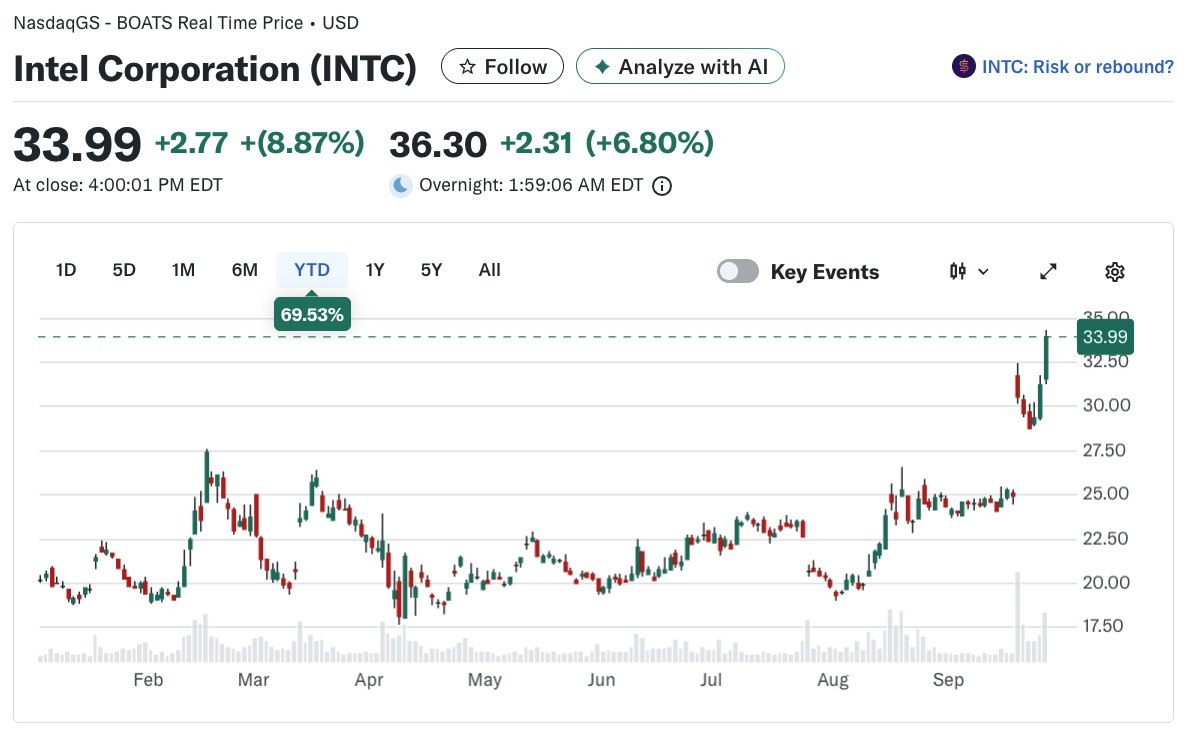
Intel’s ($INTC) stock jumped nearly 9% on Thursday, closing at $33.99, even as the broader market slipped. The rally was sparked by reports that CEO Lip-Bu Tan has been reaching out to Apple ($AAPL) and TSMC ($TSM) about potential investments or manufacturing partnerships. For a company that has been on the ropes for years, the market is asking the obvious question: does Intel finally have a path to recovery, or is this just another short-lived pop?
A Company Under Pressure
Intel has been under intense strain in recent years, steadily losing ground to TSMC in advanced chip manufacturing while piling up losses in its foundry business. In just the first half of 2025, the company posted a $3.7 billion loss. Once seen as the undisputed leader of the semiconductor world, Intel now finds itself scrambling to prove it can still matter in an era dominated by Taiwan’s TSMC and fast-moving competitors like Nvidia ($NVDA) and AMD ($AMD).
Big-Name Backers Step In
To its credit, Intel has been busy lining up heavyweight supporters:
-
U.S. Government: In August, Washington converted a portion of Intel’s CHIPS Act subsidies into equity, taking a 9.9% stake (roughly $8.9 billion). This isn’t just a financial play — it’s about national security. Chips are critical infrastructure, and the U.S. wants to ensure there’s a viable domestic player.
-
SoftBank: Also in August, SoftBank committed $2 billion, a smaller but symbolic vote of confidence tied to its broader tech bets.
-
Nvidia: Earlier this month, Nvidia invested $5 billion for about a 4% stake, with plans to jointly develop PC and data center processors. For Intel, this offers much-needed validation. For Nvidia, it’s about securing extra manufacturing capacity. But Nvidia made it clear: its flagship products will still come from TSMC. This is cooperation, not dependence.
Together, these investments have reignited optimism. Intel’s stock is now up nearly 70% year-to-date, driven less by earnings and more by the credibility lent by these backers.
Knocking on Apple and TSMC’s Doors
Now comes the intriguing part. Reports suggest Intel has been in talks with both Apple and TSMC about either capital injections or strategic partnerships.
Apple: Unlikely Bedfellow
Apple used Intel’s x86 CPUs in its Macs until 2020, when it pivoted to its in-house ARM-based M-series chips. Since then, the split has seemed permanent. But Apple’s role as a supply-chain power broker means even a symbolic investment could reshape perceptions of Intel. Geopolitical risk adds another layer: if Apple wants to de-risk its reliance on Taiwan, buying into Intel’s U.S. capacity could serve as optional insurance.
Still, skepticism abounds. Analysts point out that Apple already has its hands full — with cash earmarked for buybacks and expanding its own silicon roadmap. For Cupertino, betting on Intel stock may look more like charity than strategy.
TSMC: Rival or Partner?
Even more surprising are reports that TSMC might consider a 20% stake in Intel’s foundry arm. On paper, the logic isn’t crazy: TSMC could share risk, gain U.S. exposure, and neutralize some competition. For Intel, the endorsement would be priceless.
But reality bites. Taiwan’s government says it hasn’t received any notification of such plans, and any deal would face political and regulatory hurdles. The idea of the world’s top foundry investing in its wounded rival raises antitrust questions and national security red flags. If it happens, it would be nothing short of a geopolitical balancing act.
Intel’s Internal Shake-Up
Money and rumors aside, Intel has been trying to fix itself from within:
-
Leadership reset: After ousting Pat Gelsinger, Intel appointed Lip-Bu Tan, a seasoned dealmaker and turnaround specialist, as CEO. He has flattened the hierarchy and shifted focus back to engineering execution.
-
Strategic pivot: Instead of fighting in every market, Intel is emphasizing custom silicon for cloud and AI clients, betting on higher-margin niche designs.
-
Customer sign-ups: Companies like Microsoft, Broadcom, and SK Hynix have reportedly agreed (on paper) to use Intel’s advanced packaging and manufacturing. The real test will be whether those deals convert into volume orders.
-
Cost discipline: Intel is targeting a 15% headcount cut and scaling back fab expansion in Europe to preserve cash. Painful moves, but necessary ones.
Despite these efforts, Intel’s foundry division is still bleeding red ink. Optimism aside, profitability remains out of reach.
The Reality Check
On paper, it looks like a turnaround: government support, backing from big investors, and rumors of blockbuster partnerships. But the caveats are huge. Apple already walked away from Intel chips, and TSMC has little incentive to empower a competitor.
The bottom line is that Intel doesn’t just need cash — it needs customers. Without orders to fill its fabs, even billions in government and private money won’t fix its structural weaknesses.
So yes, Intel’s stock will keep popping on headlines like these. But the true measure of survival lies not in press releases, but in execution. If Apple or TSMC actually commit, that would be game-changing. Until then, investors are essentially betting that deep-pocketed allies and political backing can buy Intel enough time to regain its footing.
#Market Spotlight: The Stories Driving Today’s Trading#$Intel Corp(INTC)#$Apple Inc.(AAPL)#$Taiwan Semiconductor Manufacturing Company Ltd.(TSM)#$Nvidia Corp(NVDA)#$Advanced Micro Devices(AMD)