
Who Will Win the Cash Race: Is European Private Equity Headed for a Shake-Out?

Europe’s private equity market is barreling into a crowded fundraising cycle that could force a brutal re-sorting of capital. Large buyout houses are planning to raise far more in 2026 than they did this year, creating a choice-heavy market for institutional investors.
The result: some managers will secure monster funds while many others — especially smaller names — may struggle for committed capital.
Key Points
- Ten mega-funds are targeting €110bn+ in 2026 versus roughly €34bn from six big funds this year (Campbell Lutyens).
- A weak IPO market is delaying exits and distributions, making LPs cautious — Petershill’s delisting and $900m return is a warning.
- Allocators will concentrate on top performers and strong LP relationships; mid-size and niche managers face tougher closes.
Why the money chase matters: Who gets chosen, who gets left out?
Large managers are lining up flagship funds simultaneously, and institutional investors will not have unlimited checks to write.
When ten mega-funds compete in the same period for a finite pool of commitments, allocators must pick where to concentrate capital. That amplifies scrutiny on past performance and relationship depth.
Advisers expect a “tale of haves and have-nots,” as Raymond James’s Sunaina Sinha Haldea put it. In practice, that means top quartile track records, longstanding LP relationships and differentiated strategies will win disproportionate backing. The rest risk slower closes, down-sized vehicles or being pushed off LPs’ shortlists.
Numbers that explain the squeeze
This year, six funds aiming to raise €3bn or more are expected to bring in roughly €34bn combined, Campbell Lutyens says.
Next year the count rises to ten big funds with collective targets north of €110bn. Those headline totals create a funding concentration few allocators can match with new commitments alone.
Fund managers are already adapting: many have postponed fundraising, launched earlier than planned, or extended processes into 2026.
Advent’s $26bn target, for instance, had been expected to close this year but continues to pull in capital and had hit about $20bn. Nordic Capital’s €10bn-target vehicle launched this year and will roll into next.
The exit problem: Why tougher IPOs change everything?
The fundraising pressure is compounded by a weaker market for exits. The biggest private equity houses typically buy businesses sized for IPOs — when public listings cool, those exit routes become clogged.
That reduces distributions back to LPs, lengthens the time capital is tied up, and makes investors more cautious about writing fresh checks.
Petershill Partners’ troubles are a case in point. The group, which aggregates minority stakes in PE firms, has seen its share price slump and will delist while returning more than $900m to shareholders.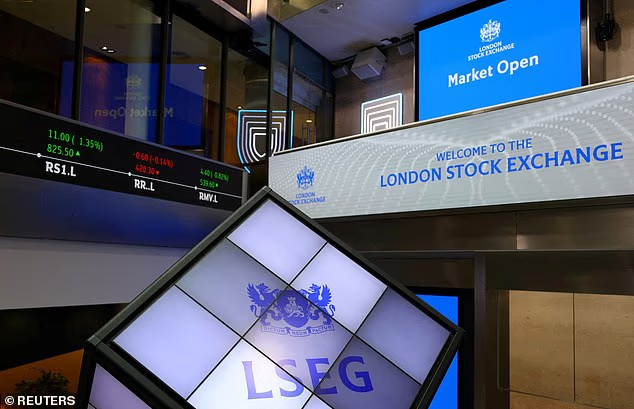
Its chair blamed the broader difficulty of realising PE positions for investor wariness — a warning sign for funds that rely on healthy exit markets to prove returns.
Who’s in the ring: the big names and their strategies?
Several heavyweight managers are already in the market or preparing to be. Hg, Ardian and Oakley have closed or are expected to close €3bn-plus funds this year.
Permira is seeking a €17bn vehicle; Advent pursues a $26bn vehicle that remains open; Nordic Capital targets €10bn. Cinven and PAI are among the other groups expected to come to market.
For large institutional investors, the crowded calendar will likely focus attention on comparative performance. LPs being courted by many managers may also have less cash to allocate to smaller European funds, squeezing mid-market players and niche managers.
Dealmaking mood versus fundraising reality: parties and pipelines
Despite fundraising headaches, deal activity and industry socialising are lively. Dominant firms like Blackstone are prepping major portfolio companies for IPOs, and KKR says it deployed more than $20bn in Europe this year.
Industry gatherings — from Oktoberfest tents in Munich to IPEM in Paris and FT events in London — underscore robust appetite among some global investors to place capital into Europe.
Yet the revelry masks uneven activity. Germany’s M&A mix shows both opportunistic asset sales and sector stress, while an otherwise busy autumn includes specific large private placements such as Tennet Germany’s €9.5bn raise.
The picture is therefore mixed: pockets of buoyant deployment, but also pressure around exits and fundraising duration.
The political and tech overlay: bigger forces at play
Broader political shifts are also rerouting flows. The FT reports an unusual pivot from some US flows into Europe as investors diversify in response to geopolitical instability.
Meanwhile, tech and political developments intersect: under proposals linked to the Trump administration, TikTok US would be valued at $14bn with a split ownership involving Oracle, Silver Lake and Abu Dhabi’s MGX controlling roughly 45%, and ByteDance retaining 19.9%. That deal — if it proceeds — would reshape strategic allocation across tech and buyout investors.
At the same time, major tech leaders are cultivating Washington ties. Sam Altman and Mark Zuckerberg have reportedly visited the White House about half a dozen times this year, seeking regulatory and political cover to advance large AI investments.
Those relationships matter because the tech giants’ capital allocation and regulatory outcomes will influence where private capital chases growth opportunities.
What this means for investors and managers?
For institutional investors: anticipate more concentrated allocations toward managers with demonstrable exit records and stable LP relationships.
Expect tougher due diligence cycles and more selective co-investment choices. With fundraising processes longer and larger funds crowding the market, timing and liquidity profiles will be critical.
For mid-tier and smaller managers: prepare for a tougher market. Raising follow-on funds will require sharper differentiation — via sector specialization, creative exit paths, or closer LP alignment — or face the prospect of smaller closes and slower deployment.
For the industry at large: the next 12–18 months may accelerate consolidation. Firms that fail to meet target sizes could be pushed into strategic mergers, spin-outs, or reduced ambitions. Conversely, the top handful may further entrench their advantage as allocators concentrate capital.
Final view: shake-out or recalibration?
The short answer is both. The planned surge of mega-fundraisings sets the stage for a shake-out — but it also forces a market recalibration that institutional investors have been signalling for years.
Where capital concentrates, winners will likely widen their lead. Where exits remain constrained, the sector must adapt its timelines, expectations and fee narratives to retain LP trust.
For now, the most immediate watchpoints are the fund closes in the coming quarters, any improvement in IPO windows, and whether the largest managers can deliver the exits investors expect.
If they do, the market’s tidal wave of fundraising may moderate into a more orderly cycle. If not, the industry’s social season of merriment could quickly yield to a year of hard choices.