
Big Names, Bigger Bets: Will Private Credit Make 2025 EM’s Biggest Year Yet?

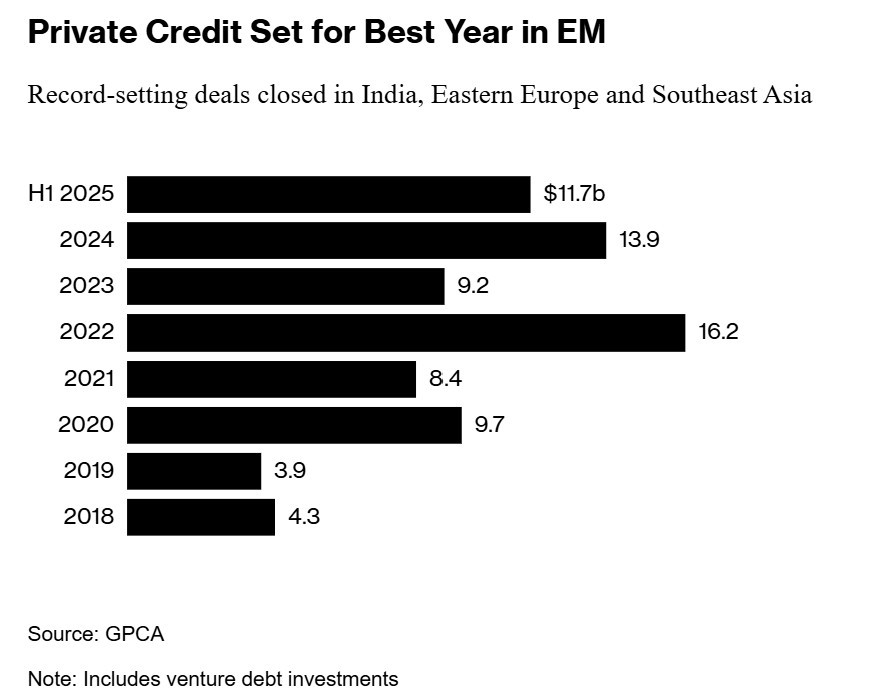
Emerging-market private credit is surging, and global heavyweights are leading the charge. The first half of 2025 saw $11.7 billion deployed into EM private credit — a pace nearly matching last year’s full total.
With Blackstone, Apollo, KKR and others backing record deals across India, Southeast Asia, Eastern Europe and the Gulf, 2025 looks set to be the largest year yet for EM private lending.

Quick take — the numbers you must remember
- H1 2025 deployed: $11.7bn (Global Private Capital Association).
- EM share of global GDP: ~50%, but of private credit market: <10% of $1.7tn.
- Public EM performance this year: equities up ~23%, hard-currency bonds ≈ +9%.
- Big single deals: Shapoorji Pallonji $3.4bn; Superbet €1.3bn; Southeast Asia private-credit $1.1bn.
- Local fund raises: Aspire11 €500m; EAAA India Alternatives ₹45bn (~$510m).
Why the rush? Who’s coming and why
Global private credit managers are stretching into EM because the supply-demand gap is clear. EMs represent roughly half of global GDP yet attract a sliver of private credit.
That imbalance, plus stronger public-market returns and larger local borrowers, is drawing Blackstone, Apollo, KKR, Ares and others.
Industry sources say larger borrowers and bigger ticket sizes have helped. Where once EM deals were deemed “too small” or too complex, recent mega-deals have changed perceptions and reduced the barrier to entry for global managers.
Deals that change perception: where money actually moved
India featured prominently: a $3.4bn financing for Shapoorji Pallonji drew Ares, Cerberus, Davidson Kempner and Farallon; Apollo supplied $750m for a Mumbai airport project. In central and eastern Europe, Blackstone and HPS backed Superbet with €1.3bn. Southeast Asia recorded $1.1bn in private-credit deals.
These transactions are notable not just for size but for structure and sponsor quality — evidence that local borrowers are willing to tap private lenders for large, often complex financings.
Local capital and Gulf muscle: funding the pipeline
Local fund initiatives are accelerating access to homegrown capital. Aspire11 launched a €500m platform to channel pensions into startups and VC. India’s EAAA India Alternatives raised ₹45bn (about $510m) for its first private credit fund.
In the Gulf, Saudi Arabia’s Public Investment Fund agreed to anchor Goldman Sachs asset-management funds focused on credit and equity across the GCC, signalling the region’s growing role as both investor and borrower.
Why private credit, not banks or bonds?
Private credit offers agility, confidentiality and bespoke structures, attractive for take-privates and carve-outs. For many EM firms, private lenders can move faster than syndicated markets and provide flexible terms when public issuance is costly or slow.
But private credit can be pricier than public debt. For some borrowers — especially where senior bank lines are cheaper — private credit is used selectively, often for working capital or to bridge equity-cost gaps.
Investment grade: is that the next frontier?
At a recent IPEM meeting, executives said moving into investment-grade lending is the industry’s hot topic.
Apollo and Blue Owl have already done large high-grade deals; others sense a massive addressable market if private credit can scale up to fund data centres, energy grids and AI infrastructure.
Apollo’s estimate that expansion into investment-grade lending could push the opportunity far beyond today’s scale — even as high as trillions more — has been cited in panel discussions.
If private lenders succeed at competitive pricing and insurer interest grows, this could become a structural growth driver.
Competition and cautions: pricing, banks and complexity
Direct-lending growth has slowed relative to its pandemic-era boom, and syndicated bank markets are returning with cheaper pricing. Private lenders face tough competition on cost for investment-grade borrowers.
Panels at IPEM flagged that competing on pricing with leveraged loans is hard, so managers must find “other angles” such as proprietary deal flow or complex carve-outs.
Deals in EM can be small relative to public debt volumes: EM corporates raised $299bn in public dollar bonds this year — far larger than private credit totals. That reality limits private credit’s share of overall corporate financing for now.
Who benefits: investors, borrowers and the region?
For private-credit investors, EM exposure offers diversification and potentially higher yields. Public-market rallies in EM stocks and bonds have helped create investor confidence.
For local firms, private credit provides alternative funding that can support capex, infrastructure and expansion when banks or public markets are constrained.
Local sponsors and managers benefit from scaled funding options, while global firms gain access to new deal flow and diversification away from North America and Europe.
Structural growth: funds, platforms and product innovation
Fund launches and local platforms are multiplying in response. New funds target pension pooling, local lending and regional specialization.
Private credit managers are also experimenting with asset-backed lending, retail-facing products and sector-specific strategies such as infrastructure and real-assets financing.
These product expansions aim to broaden the investor base and capture opportunities as borrower sophistication and balance-sheet size increase across regions.
Risks to watch: macro, political, and liquidity
EM private credit is not risk-free. Commodity swings and country-specific pressures can affect borrower cashflows.
Political events and elections — such as upcoming Czech polls and other scheduled releases cited in market calendars — can alter sentiment quickly.
Liquidity also matters: private credit is typically less tradable and often more expensive than public debt. Investors and borrowers should weigh term, covenant strength and exit options carefully.
What to watch next
- Flow of large, repeatable deals — especially big-ticket infrastructure and data-centre financings.
- Whether investment-grade private credit expands meaningfully and attracts insurers.
Continued public-market performance for EM equities and bonds, which underpins investor appetite. - Local fund-raising momentum in India, the Gulf and Central Europe.
- Competition with banks over pricing for larger, lower-risk credits.
Bottom line: a boom, but still early days
2025 is shaping up as a landmark year for emerging-market private credit, with global titans underwriting record deals and local platforms scaling up.
But the market remains a small slice of global private credit. Growth will be meaningful only if pricing, deal scale, institutional investor demand and macro stability all align.
For now, private credit’s EM expansion looks like measured boldness rather than a white-heat rush — a strategic pivot by big managers seeking yield, scale and diversification.
Whether that pivot becomes a durable transformation or a shorter cycle of opportunism will depend on the next wave of deals and how managers handle competition, risk and complexity.