
Why AMD Surged 23% in a Day ?

If you’re talking about the most attention-grabbing company lately, it’s gotta be OpenAI. I’ve never seen a company stir things up like this. One day, they announce a partnership, and that company’s stock jumps 23%.
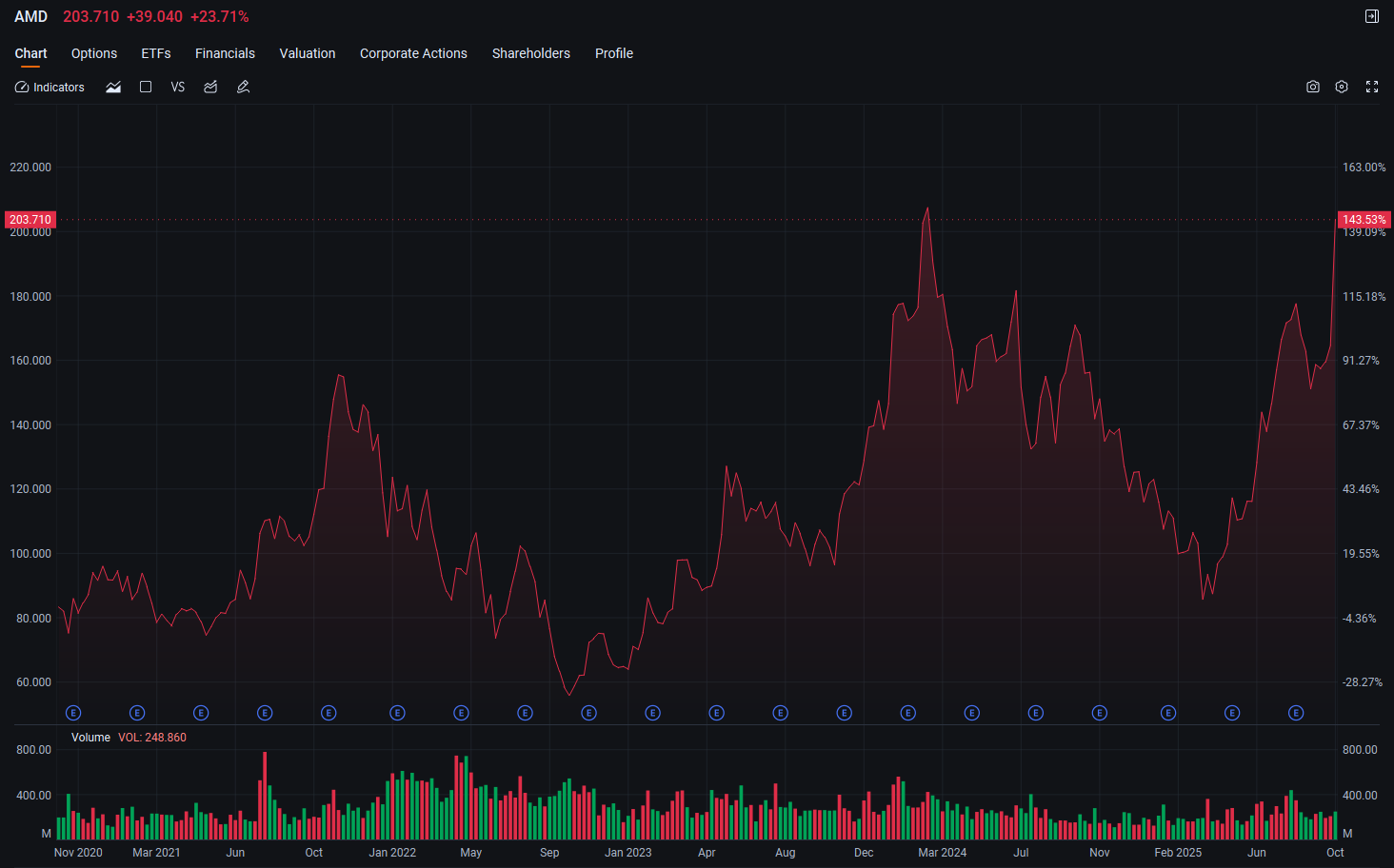
According to Bloomberg, OpenAI and AMD sealed a blockbuster investment deal. The agreement has OpenAI committing to build and deploy a 6-gigawatt AI data center over the next few years, entirely powered by AMD GPUs. This could bring AMD tens of billions in new revenue.
While 6 gigawatts is smaller than the 10-gigawatt project with Nvidia, it’s still the second-largest data center deal disclosed so far. In return, OpenAI gets a five-year call option with a near-zero strike price, allowing them to buy up to 10% of AMD’s shares—but only if AMD’s stock keeps climbing past $600. After the news broke, AMD’s stock soared nearly 40% intraday, closing up over 23% at around $203.
So, what does this mean for AMD? And what about its biggest rival, Nvidia?
Bloomberg points out that Nvidia’s data center revenue dwarfs the combined total of all other players. While this deal will bring AMD billions, it’s not enough to overturn Nvidia’s lead. On the bright side, AMD’s commitment will at least help OpenAI rely less on Nvidia.
Reducing dependence on a single supplier is a key business strategy. Bernstein analyst Stacy Rasgon noted, “It wasn’t clear before if AMD’s customers were just ordering to gain leverage in Nvidia negotiations or if they genuinely wanted AMD GPUs. But this deal feels different. Its scale is huge, and it shows AMD’s GPUs have real appeal. We’ll see if this sparks interest from other clients.”
That said, like Oracle, AMD is now heavily tied to OpenAI’s grand plans. While OpenAI diversifies its suppliers, AMD’s customer base is becoming dominated by one client, which brings risks. Rasgon added, “Long-term, Sam Altman’s either going to crash the economy or lead us into the future. Right now, we don’t know which side we’re on.”
For AMD, this deal is undeniably a big win. OpenAI’s willingness to buy AMD’s products shows the company hasn’t fallen behind in AI. A massive order like this boosts revenue and cash flow significantly—AMD’s data center business already pulls in over $10 billion a year, and this “tens of billions” deal is a game-changer. With an order this big, AMD’s surge today makes total sense.
But will this shift the GPU competition between Nvidia and AMD? I don’t think so. OpenAI’s motives are clear: it’s not just about AMD’s tech but the lower cost of the deal. Estimates suggest that with the equity swap, OpenAI’s getting computing power almost for free—who wouldn’t take that?
Plus, this gives OpenAI another source of computing power, reducing reliance on Nvidia, much like their deal with Broadcom. There’s no clear evidence this deal narrows the gap between AMD and Nvidia. In the end, AMD still needs to compete on performance, technology, and ecosystem to keep orders rolling in—they can’t swap equity for every deal, right?
The fate of these two companies hinges on who’s got the best product. Nvidia’s fundamentals remain untouched, and while AMD’s rally today is well-deserved, sustaining that growth will take more hard work.$AMD