
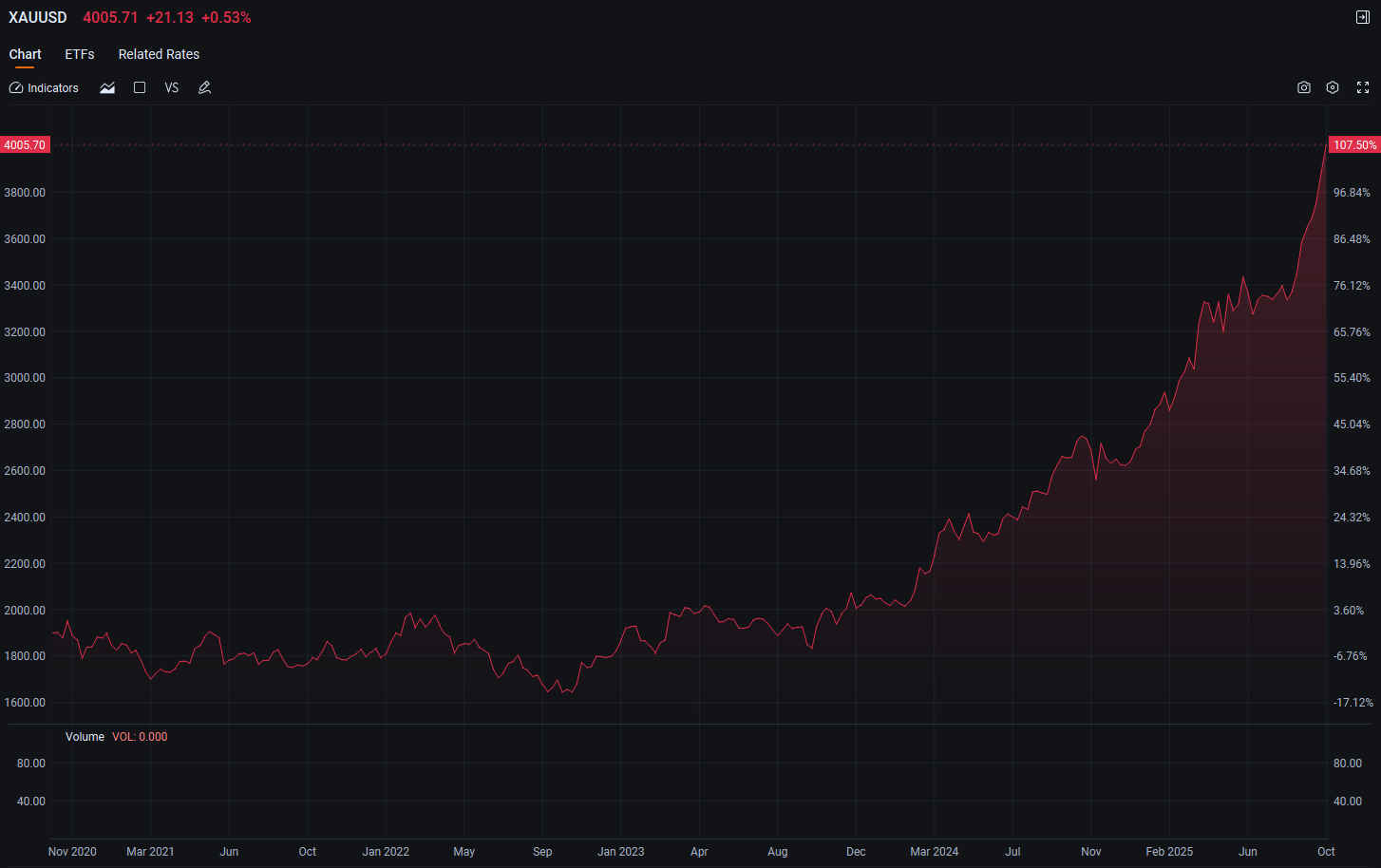
Spot Gold Breaks Historic $4,000 Barrier, Up Over 50% This Year

Spot gold has surged past the $4,000 per ounce milestone, driven by a potent mix of the U.S. government shutdown, a tech stock pullback, and global political uncertainty.
Investors are flocking to the gold market with unprecedented enthusiasm, seeking refuge amid rising global economic and geopolitical risks.
Meanwhile, cracks are appearing in the market’s fervor for tech stocks. Overnight reports about Oracle’s cloud business margins sparked concerns that the AI-driven rally may have reached “overly exuberant” levels.
Coupled with France’s political crisis and Japan’s leadership transition, global risk aversion is spiking, cementing gold’s status as the ultimate safe haven. Year-to-date, gold prices have soared over 50%.
As Bridgewater founder Ray Dalio said on Tuesday, gold is “undoubtedly” a safer haven than the dollar, echoing Citadel founder Ken Griffin’s view that gold’s rise reflects deep market anxieties about the dollar.
U.S. Government Shutdown Amplifies Fed Policy Uncertainty
The most immediate catalyst for gold’s recent surge is the U.S. government shutdown, now in its second week.
The partial suspension of government operations has delayed key economic data releases, casting a thick shadow over the Fed’s rate decision path.
Without clear economic indicators, speculation about the Fed’s next moves is intensifying, and uncertainty is a natural ally of safe-haven assets like gold.
Despite the data gap, traders broadly expect the Fed to cut rates by 25 basis points this month.
Rate cut expectations typically boost non-yielding assets like gold, as the opportunity cost of holding it decreases. The market’s bet on looser policy amid uncertainty provides solid support for gold prices.
Global Political Turmoil and Fiscal Risks Fuel Safe-Haven Buying
Beyond the U.S., political upheaval in multiple regions is adding fuel to gold’s rally.
In France, reports indicate that PM Lecornu submitted his resignation to President Macron, who accepted it. Lecornu’s tenure lasted less than 30 days, hampering efforts to control the eurozone’s largest fiscal deficit.
In Japan, Sanae Takaichi is nearly confirmed as the next prime minister. Advocating fiscal expansion and a right-leaning stance, she has called for sustained loose monetary policy, arguing the Bank of Japan should not raise rates. This leadership shift also brings uncertainty.
MKS Pamp SA’s Research and Metals Strategy Head Nicky Shiels noted in a report that political shifts in France and Japan have heightened market concerns about fiscal risks, boosting gold’s rebound. She said:
“The recent rally is driven by retail demand in Europe and Japan combined with institutional inflows. This global risk aversion is strengthening the dollar against the euro and yen but also pushing investors toward gold.”
“De-Dollarization” Narrative and Strong Institutional Demand
Beyond short-term catalysts, broader “de-dollarization” and “de-globalization” narratives provide structural support for gold’s long-term rally.
TD Securities’ Commodity Strategy Head Bart Melek said these increasingly loud narratives “have greatly stimulated gold demand.” President Trump’s aggressive moves to reshape global trade and geopolitics have accelerated investors’ shift from the dollar to safe-haven assets.
Strong institutional demand is a key feature of this bull market.
Central banks have become avid gold buyers, with reports indicating China’s central bank has increased its gold reserves for 11 consecutive months. Meanwhile, as the Fed begins its rate-cutting cycle, investors are pouring into gold ETFs.
Goldman Sachs noted in a report that, given sustained ETF inflows and central bank buying, they raised their December 2026 gold price forecast from $4,300 to $4,900.
Wall Street’s Bullish Outlook and Rising Investor Sentiment
As gold hits new highs, some analysts warn of short-term pullback risks.
Bart Melek noted that, given the speed and scale of this rally, speculators may lean toward profit-taking. Ultima Markets’ senior analyst Elon Gu also believes a consolidation could follow such a rapid surge.
Still, more strategists recommend gold as a core holding. Invesco’s Global Market Strategist David Chao advises “overweighting gold to hedge dollar risks and prepare for further shocks.”
He added that gold allocations in investor portfolios are likely in the low single digits, but raising that to ~5% is “a prudent move.”