
Payment and Crypto Asset Service Closed Loop: SoftBank’s PayPay Takes Stake in Binance

Yesterday, Tokyo’s financial circles were abuzz with news that could reshape Japan’s financial landscape.
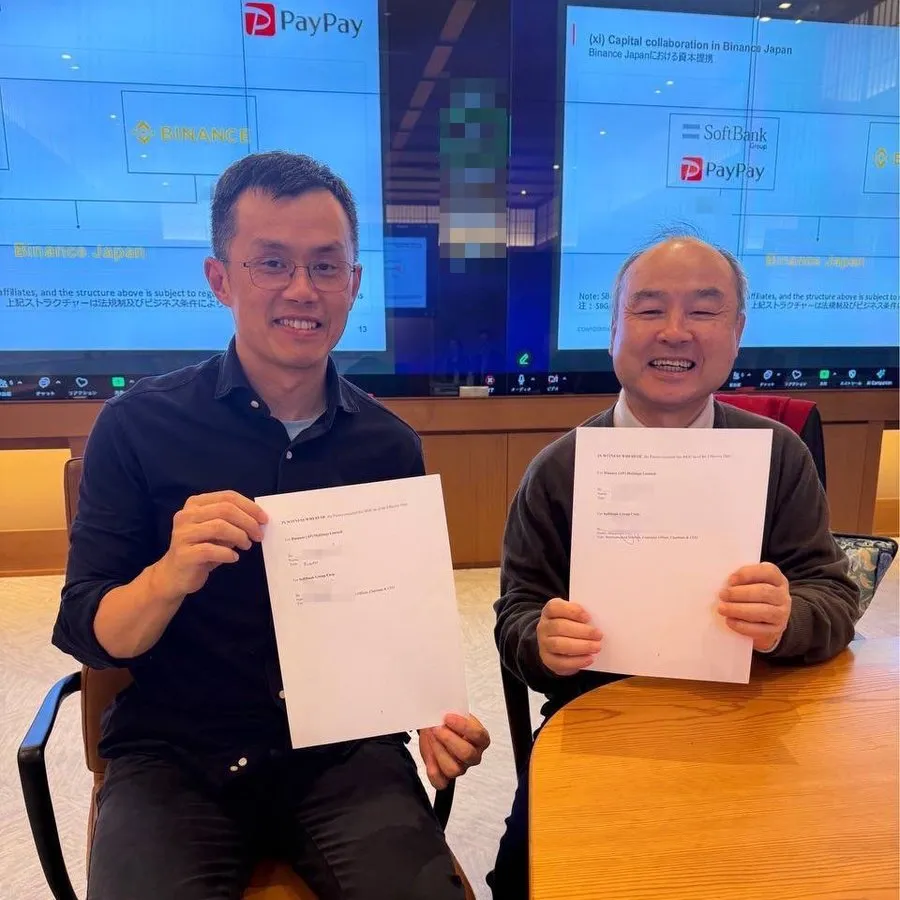
SoftBank’s mobile payment giant PayPay announced it has acquired a 40% stake in Binance Japan.
This deal brings together a payment platform integral to daily life in Japan with one of the world’s largest cryptocurrency exchanges.
The announcement sent some compliance-related coins in the PayPay ecosystem soaring over 10x. Let’s break down the core logic behind this move.
First, Understand: Masayoshi Son Isn’t Just “Buying Equity”—He’s Filling a Gap
To grasp why Son made this move, we need to look at the strengths and weaknesses of the two key players. The essence of this partnership is mutual gap-filling.
The first player is PayPay, Japan’s “cashless payment king” with 70 million users—nearly half the country’s population. It’s used for everything from offline stores to online shopping and utility bills, akin to Japan’s Alipay.

But the cashless payment race is nearing its ceiling: Japan hit its 40% cashless payment target in 2024. To grow users and revenue, PayPay needs a new frontier, and the clearest opportunity is cryptocurrency.
Japan was among the first to issue compliance licenses to crypto exchanges, with Binance Japan registered as a “crypto asset exchange provider” with the Kanto Finance Bureau in 2023.
Japanese listed companies like Metaplanet are adding Bitcoin to their balance sheets, and yen-backed stablecoins are emerging, with growing user acceptance. But PayPay lacks the tech and licenses to enter crypto—it needs a savvy partner.
The second player is Binance Japan, the compliant local arm of Binance, holding licenses for crypto spot trading and wealth management, backed by Binance’s global tech and security. So,what is its weakness?
The answer is lack of local traction. Despite Binance’s global fame, Japanese users prefer native payment tools, finding bank transfers to fund Binance Japan accounts “too cumbersome.” It needs PayPay’s “local traffic + payment channels.”
Masayoshi Son’s 40% stake acquisition is about pairing PayPay’s user base and payment infrastructure with Binance Japan’s licenses and tech. PayPay enters the crypto race, Binance Japan gains users, and SoftBank secures a “cashless payment + crypto” combo.
This isn’t just a financial investment—it’s a growth engine for PayPay’s future.
Dig Deeper: Japan’s “Crypto-Friendly” Environment Gives Masayoshi Son Confidence
Masayoshi Son never bets without policy backing, and this move hinges on Japan’s favorable crypto climate.
First, Japan’s government is pushing crypto adoption. Since 2018, it’s promoted a “cashless vision,” now doubling down on Web3 with clear, compliance-first rules that make businesses feel safe. Binance Japan’s license and upcoming yen stablecoin issuances have solid regulatory frameworks, reducing fears of sudden policy shifts—a foundation for Son’s bet.
Second, Japanese users are embracing crypto. Once a geek niche, crypto is going mainstream: listed firms hold Bitcoin as a store of value, and regular users are curious about safe ways to buy in.
Funding accounts is a hassle—bank transfers require tedious forms, and credit cards have limits. Post-deal, PayPay users can buy Bitcoin or Ethereum directly with their wallet balance and cash out to spend via PayPay, slashing barriers.
This “policy support + user demand” combo is rare globally. Son’s timing isn’t chasing trends—it’s capitalizing on a market that’s ready, much like his Alibaba bet caught China’s e-commerce boom. This is his bet on Japan’s crypto adoption wave.
This Is the Start of SoftBank’s “Global Digital Finance Play”
Thinking Masayoshi Son’s just playing in Japan underestimates him. This deal reflects his vision for “next-gen payments.”
The payment industry is shifting from “cashless” to “digital asset payments.” In the future, users might pay with crypto at PayPay-partnered stores, use NFTs for membership perks, or leverage blockchain for cross-border remittances—disrupting traditional banks’ credit card and international transfer businesses.
By acquiring a 40% stake in Binance Japan, Son secures a “key node in Japan’s digital finance”: users buying crypto with PayPay and spending crypto cash-outs via PayPay. SoftBank can tap into all future “payment + crypto” businesses.
This model could scale to markets like Southeast Asia, where PayPay aims to expand, and Binance’s compliant network is established, ready to replicate this “local payment + crypto” playbook.
For SoftBank, this isn’t a standalone investment—it’s tying “traditional fintech” to “Web3” to pave the way for the next decade of digital payments.
Why Did PayPay-Related Coins “Explode” in Value?
Why did PayPay-related coins skyrocket post-announcement? It’s about “expectations materializing.”
Previously, these coins were just “linked to PayPay payments” without real crypto business backing, and their valuations didn’t factor in PayPay’s 70 million users. Post-deal, their value proposition changed: they’re now “backed by PayPay’s user base and Binance’s compliance licenses.”
Millions of PayPay users might buy these coins, and merchants may accept them via PayPay, massively expanding use cases.
Funds, being ultra-sensitive, rush in to capture this “value revaluation,” driving rapid surges.
This isn’t speculative hype—it’s the market pricing in future profits from real business integration. The coins’ earlier valuations ignored PayPay’s traffic; now, that’s corrected, and 10x gains reflect a “return to value.”
What’s Next?
I expect PayPay and Binance Japan to roll out new moves, like crypto payment rewards or NFT membership systems, which will impact related coin trends.
Short-term profit-seekers should seize this opportunity. Moreover, this payment-crypto closed loop could ripple through the broader crypto market.
Looking ahead, when Japanese consumers can buy digital assets as easily as coffee in their favorite payment app, a new financial paradigm will quietly take hold. PayPay and Binance’s handshake not only adds a bold stroke to Japan’s financial landscape but may also point the way for the global payment system’s next evolution.
Before posting this article, I glanced at the market: Bitcoin is far ahead, while some altcoins are still lingering.
Despite the meme-driven buzz like “Binance life,” the structural, institutional, and value-driven trends in this cycle remain unchanged. The partnership between CZ and Masayoshi Son is a prime example.
Moving forward, we’ll see more collaborations between traditional internet and finance players and Web3 exchanges or projects—whether through deep equity ties, app-traffic partnerships, or other forms—to collectively “carve up the global user market.” The industry may also accelerate toward a Matthew Effect.
We can’t change the industry’s broader trends. In this era of uncertainty, to stay in the game, we need to find our unique value—something that won’t be swept away by the market.
The mindsets and assumptions we’ve taken for granted in the past may need to shift.