
AI vs. Gold: Two Hottest Trades, One $600 Trillion Question

Shearing sheep
October 10, 2025
GoGPT Summarizes Articles
It’s rare to see both AI stocks and gold soaring together, yet that’s exactly what’s happening in 2025. Tech-driven optimism and inflation-driven fear are now coexisting, each attracting in massive capital. The result? Two investment manias that, oddly enough, mirror the same global dilemma: can productivity catch up with wealth creation, or will inflation eventually do the “reset” for us?
A Tale of Two Booms
So far this year, AI-related stocks have pushed the S&P 500 to more than 30 new record highs, while gold has surged over 50%, breaking above $4,000 per ounce for the first time ever. One represents trust in the future, the other fear of it.
On one side, investors are buying into the “AI revolution” narrative. AMD CEO Lisa Su recently described her company’s collaboration with OpenAI as a “positive and virtuous cycle” for advancing computing power — a statement that captures the current market mood perfectly.
On the other, gold buyers aren’t so optimistic. With U.S. debt surpassing $37 trillion, the dollar seeing its steepest annual drop since the 1980s, and global trade alliances constantly shifting, investors are hedging against the fragility of the post-pandemic financial order.
The Bigger Picture — $600 Trillion and Counting
A new report from McKinsey Global Institute offers a striking snapshot of the world’s balance sheet. Global net wealth has quadrupled since 2000, reaching an eye-watering $600 trillion by the end of last year — and likely even higher by now.
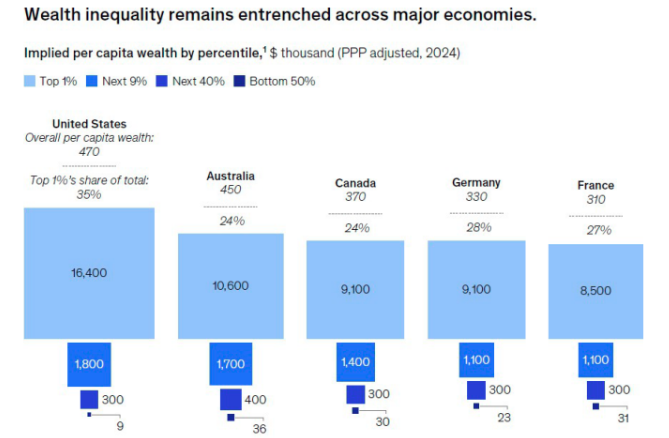
But here’s the catch: this wealth expansion has vastly outpaced real economic growth. The ratio of global net worth to GDP has jumped from 4.7x to 5.4x over the past 25 years. Wealth concentration also remains striking — the top 1% of individuals now hold about one-fifth of all global wealth.
McKinsey notes that when balance sheets expand faster than the real economy, vulnerabilities start to emerge. Since the early 2000s, global wealth has increased by roughly $400 trillion, yet more than one-third of that rise is purely on-paper gains, largely detached from real economic activity. Around 40% of the increase stems from accumulated inflation, while only 30% comes from new investment.
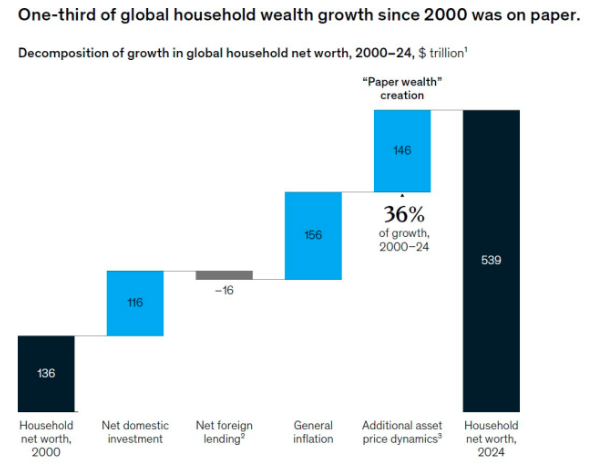
In simple terms: every new dollar of investment has created $3.50 of household wealth — but also nearly $2 of new debt. The world is now sitting on a debt pile 2.6 times larger than global GDP, with asset prices (especially equities and housing) inflated well beyond the real economy’s output.
Productivity or Inflation — The Fork in the Road
McKinsey outlines two broad paths from here.
-
The “Productivity Boom” scenario — led by AI and digital transformation — where technology drives economic output to catch up with asset values. In this case, growth would balance the books without sparking runaway inflation.
-
The “Inflation Reset” scenario, where productivity fails to keep pace, forcing economies to inflate away their debts — a slower, more painful correction that erodes real wealth and widens inequality.
The contrast is stark. For the average American saver, McKinsey estimates the wealth gap between these two futures could reach $160,000 per person by 2033 — from a gain of $65,000 in the productivity case to a loss of $95,000 under persistent inflation.
Markets Are Betting on Both
This year’s dual rally — in AI stocks and gold — perfectly reflects this split reality. Investors are chasing the upside of innovation and hedging against the downside of inflation at the same time. The irony? Both bets can’t win forever.
AI represents faith in human progress and productivity gains. Gold represents fear of systemic fragility and policy missteps. Together, they’re the two ends of the same spectrum — a market that’s both excited and anxious about what comes next.
In short: the next decade’s $600 trillion question is whether technology can deliver real productivity growth fast enough to justify today’s paper wealth — or whether inflation will end up doing the dirty work of rebalancing it all.
#gold#ai