
APAC Market Wrap - Oct 10

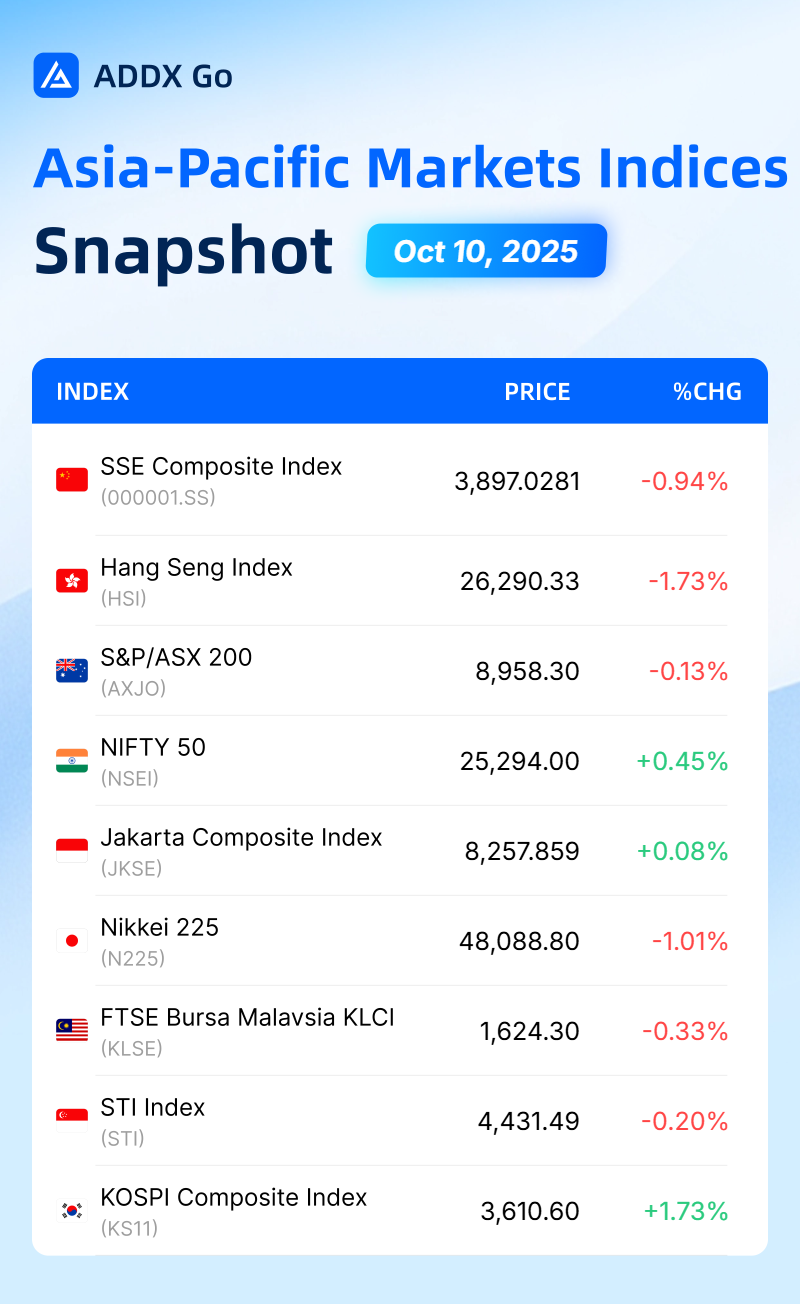
China Stock Market: The market oscillated and adjusted throughout the day, with the three major indices collectively falling. The Shanghai Composite fell nearly 1%, dropping below 3,900 points, showing clear divergence between blue-chip and second-line stocks.
At the close, the Shanghai Composite fell 0.94%, the Shenzhen Component dropped 2.70%, and the ChiNext Index declined 4.55%. By sector, gas and coal led gains, while semiconductors, batteries, and precious metals saw the largest losses.
Hong Kong Stock Market: This week, Hong Kong’s three major indices adjusted. At the close, the Hang Seng Index fell 3.13% cumulatively to 26,290.32 points; the Tech Index dropped 5.48% to 6,259.75 points; the H-share Index declined 3.11% to 9,358.32 points.
From Friday’s performance, the three indices continued their recent consolidation trend, with the Hang Seng down 1.73%, the Tech Index down 3.27%, and the H-share Index down 1.80%.
Specifically, banking, insurance, and catering stocks performed strongly, while gold, semiconductors, and lithium batteries weakened.
Japan Stock Market: Japanese shares ended lower on Friday after wholesale prices rose in September. The Nikkei 225 fell 1.01%, or 491.64 points, to close at 48,088.80.
By sector, retail rose, while securities, mining, oil, and other sectors saw sharp declines.
South Korea Stock Market: The KOSPI rose 1.73%.
By sector, machinery, display panels, semiconductors, and electrical equipment surged. Electrical products, aerospace, and steel fell.
Australia Stock Market: The S&P/ASX 200 fell 0.13% to 8,969.80 points.
Construction materials, aerospace, and semiconductors saw strong gains, while industrial products, cyclical retail, and apparel & accessories posted larger declines.
Singapore Stock Market: The Straits Times Index fell 0.36% to 4,456.30 points.
Agriculture, medical distribution, and steel surged, while diversified media, construction materials, and aerospace saw significant declines.
bThe FTSE Malaysia KLCI dropped 0.46% to 1,622.25 points.
Transportation & logistics, closed-end funds, and energy rose, while communications & media, healthcare, and technology fell.
Key Events
Malaysia Warns Ending Chip Tariff Exemptions Could Hurt Competitiveness and U.S. Supply Chain
In a report on Friday, the Malaysian government warned that if the U.S. cancels tariff exemptions for Malaysian semiconductor exports, it could harm Malaysia’s competitiveness and strain supply chain networks.
In August, the Trump administration imposed a 19% tariff on Malaysian imports to the U.S., but semiconductors and some other products remain exempt pending a national security review.
South Korea’s Post-Holiday Market Debuts Strong, Chip Giants Hit New Highs
After a nearly week-long holiday, South Korea’s market hit a record high on Friday.
Amid AI positive news during the break, chip giants SK Hynix and Samsung Electronics both surged, setting new highs.
The direct driver was the OpenAI-AMD deal announced on October 6, where AMD and OpenAI agreed to deploy 6GW of AMD Instinct GPUs over several years, worth tens of billions of dollars.
SK Hynix stated that the project’s storage chip demand could reach 900,000 wafers monthly, twice the current global high-bandwidth memory (HBM) capacity, underscoring its massive scale and the rapid pace of global AI development.
Gold Boom Adds $2 Trillion to Indian Household Wealth
Indian households’ love for gold shows no signs of fading.
Over the past decade, India has imported an average of 817 tons of gold annually, with jewelry demand accounting for ~70%.
A World Gold Council report (July 2023) estimated that as of March 2023, Indian households held ~25,000 tons of gold, worth ~$1.7 trillion.
Since then, global gold prices have risen 105%, with ~500 tons added annually, boosting household gold assets by nearly $2 trillion to ~$3.7 trillion.
Rate Hike Bets Fade, Yen Set for Biggest Weekly Drop This Year
The yen fell nearly 4% against the dollar this week, hovering at an eight-month low.
The sharp slide stems from Sanae Takaichi’s dovish stance after winning the LDP leadership race last Saturday, raising doubts about the BOJ’s independence and rate hike capacity, leading traders to slash end-of-year hike odds to ~45%.
Asian Rice Prices Hit 10-Year Low, Philippines’ Import Curbs Add to Downtrend
Asian benchmark rice prices have fallen to their lowest in a decade, meaning lower food costs for households and import-dependent nations.
According to the Thai Rice Exporters Association, Thailand’s 5% broken white rice wholesale price dropped 1.9% to $355 per ton on Wednesday, the lowest since September 2015.
The decline coincides with the Philippines, the world’s largest rice importer, extending import restrictions to support local farmers.
Institutional Views
Citi: September Core Inflation Expected to Cool
Citi economists forecast September core CPI to rise 0.28%, down from August’s 0.35%. While tariffs may keep goods prices firm, cooling housing inflation should ease overall services inflation. The shutdown may delay data, but Citi says a softening labor market and cooling home prices lower sustained inflation risks.
Barclays: Gold Rise Reflects Distrust in Fiscal and Monetary Order
Barclays Global Research Chairman Ajay Rajadhyaksha said in a report that gold’s 2025 surge signals growing market distrust in the existing fiscal and monetary order. He noted that four major economies—the U.S., UK, France, and Japan—have debt exceeding 100% of GDP, with fiscal conditions worsening.
“There’s almost no political will for fiscal consolidation,” he added. Meanwhile, traditional safe havens like the yen and Swiss franc are losing appeal. Rajadhyaksha said gold typically rises during shaky economies or financial crises. Despite healthy markets now, gold’s recent gains should alert policymakers.
ING: Gold Bull Market to Persist, But “World Peace” Could Bring Pullback
ING believes gold’s bull market has further upside. They forecast gold to average $4,000 per ounce in Q4, reaching $4,100 in Q1 2026, and $4,200 in the following quarter.
ING’s Ewa Manthey said in a report: “Central banks are still buying, Trump’s trade wars continue, geopolitical risks remain high, ETF holdings keep growing, and market expectations for further Fed rate cuts are strengthening.” What could derail gold? Manthey said “world peace.” She added that a major market sell-off could force investors to sell gold for cash.
ING: Yen Becoming Preferred Funding Currency
ING’s analyst Chris Turner said in a report that the yen could weaken further, as expectations of low rates persisting encourage investors to use it for carry trades. Carry trades involve borrowing low-rate currencies to invest in higher-yielding ones.
Takaichi’s LDP leadership win lowered hike prospects. Turner said while a BOJ hike is possible in October, it’s not guaranteed. “Before then, low volatility will keep carry trades popular—the yen is now the go-to funding tool.”
Mizuho: Still Expect BOJ to Maintain Hawkish Stance Short-Term
Global hedge fund Man Group said a weakening dollar and high Treasury yields signal investors should prepare for deepening U.S. stock underperformance. Chief Market Strategist Kristina Hooper said, “We’re seeing the U.S.’s safe-haven status erode.”
She added, “Investors should rebalance portfolios, take profits from U.S. holdings, and increase exposure to Europe, Asia, and emerging markets.” Hooper noted that as investors favor gold over Treasuries as a safe haven, higher yields could pressure U.S. stocks, especially long-duration ones like tech.
Corporate earnings may face headwinds from tariffs and policies like H-1B visa disputes. She believes expectations for massive AI spending may not be enough to drive U.S. stocks higher amid these headwinds.