
Bitcoin Plunges 13% Intraday Amid Record $19B Crypto Liquidations — Tariff Shock Sends Markets Reeling

Shearing sheep
October 11, 2025
GoGPT Summarizes Articles
The crypto market just experienced one of its most dramatic crashes in recent memory. On Friday, Bitcoin ($BTC) — which had only days ago touched a record high above $126,000 — suddenly tumbled as much as 13.5%, briefly breaking below $106,000 before stabilizing around $113,000 in late New York trading.
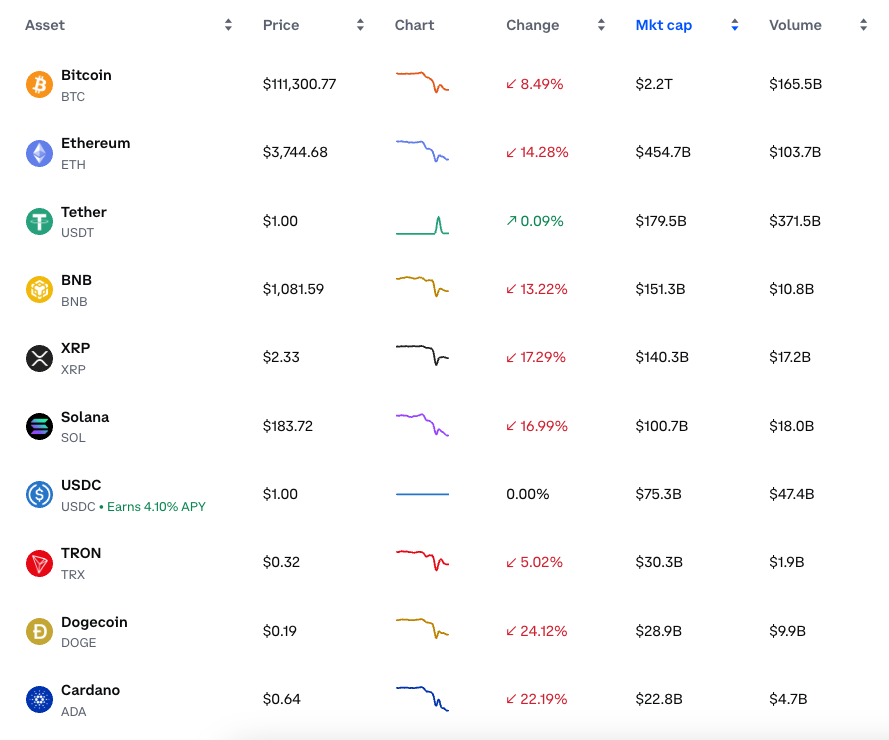
The selloff was accompanied by a wave of forced liquidations that reached an astonishing $19.1 billion, marking the largest single-day liquidation event since early April.
The spark for the crash came from renewed trade war fears. On Friday, U.S. President Donald Trump escalated tensions with China by threatening a 100% tariff on all Chinese imports starting November 1 (or earlier, depending on China’s response).
His announcement on the platform Truth Social pointed to Beijing’s “aggressive” expansion of export controls — especially on rare earth minerals, which are critical for tech and defense supply chains. In response, Trump also proposed new export controls on critical software.
Markets took the threat seriously. U.S. stock indices tumbled: the Dow fell nearly 900 points (–1.9%), the S&P 500 slumped about 2.7%, and the Nasdaq dropped roughly 3.6% — marking their worst daily performance since April.

Ironically, the greater the tension, the more risk assets like crypto were hit — especially leveraged positions.
According to data from Coinglass, more than 1.6 million traders were liquidated within 24 hours. Roughly $16–17 billion of those losses came from long positions, while around $2–3 billion were short positions — meaning bullish traders, who had piled in expecting further gains, suffered the most.
The largest single liquidation, worth about $203 million, occurred on an ETH-USDT contract at the Hyperliquid exchange. Bitcoin alone saw $5.3 billion in forced liquidations, followed by $4.4 billion for Ethereum ($ETH) and billions more across Solana ($SOL), XRP ($XRP), and other altcoins.
The cascade effect was brutal. Ethereum plunged over 17% at one point, while smaller tokens like XRP and Dogecoin ($DOGE) lost more than 30%. CME crypto futures mirrored the panic, with Bitcoin futures sliding nearly 6% to below $116,000 and Ethereum futures dropping over 11% to around $3,879.
Ironically, just a few days earlier, Bitcoin’s surge had been fueled by macro anxiety — investors hedging against a possible U.S. government shutdown and inflation risks. Derivatives activity had surged, particularly in options markets, as traders bet on continued upside. But that speculative buildup became a trap: once volatility spiked, leveraged longs were rapidly liquidated, amplifying the selloff.
Market analysts note that this episode highlights the structural fragility of crypto markets. Unlike traditional assets, where large institutions provide deeper liquidity, much of the crypto ecosystem still depends on retail leverage. When volatility hits, derivatives markets — especially perpetual futures — can dictate spot prices, creating feedback loops that accelerate both rallies and crashes.
Beyond crypto, the tariff shock has shaken broader markets. Analysts warn that Trump’s latest move could mark the beginning of a new wave of global trade friction, one that risks destabilizing supply chains and reigniting inflation. The U.S. dollar strengthened as investors sought safety, adding more pressure to risk assets. Meanwhile, bond yields dipped as money rotated into Treasuries — a classic “flight to safety” moment.
Whether this selloff becomes a turning point or just another violent correction will depend on how the weekend plays out. For now, Bitcoin’s ability to hold the $110,000–$115,000 zone looks crucial. A break below could open the door to further declines, while stabilization might signal that the worst of the forced selling has passed.
Still, this week’s events serve as a reminder that in crypto, leverage can turn on its holders faster than any headline. A single geopolitical spark — in this case, tariffs — can ignite a chain reaction that ripples through every corner of the market.
While the short-term pain is acute, the event may also help reset overly speculative exposure and force more prudent positioning going forward.
Crypto, however, remains vulnerable — as long as macro risks, derivatives overhang, and geopolitical volatility coexist. Whether this episode proves to be a buying opportunity or the start of a deeper correction will depend heavily on how global conditions evolve in the coming days.
#Crypto Market Watch: Trends, Regulation & Institutional Moves#$BTC/USDT COINBASE(BTC)#$ETH/USDT COINBASE(ETH)#$SOL/USDT COINBASE(SOL)#$XRP/USDT COINBASE(XRP)#$DOGE/USDT COINBASE(DOGE)