
Stockpiling the Future: Is the U.S. Buying Its Way to a Strategic-Minerals Edge?

The U.S. — through the Defense Logistics Agency and related White House moves — is accelerating large-scale purchases and equity stakes in critical minerals.
That push is already lifting resource names from rare earths to lithium and antimony, creating a high-conviction, high-volatility investment theme: government-supported supply reshaping market winners and raising both opportunity and risk.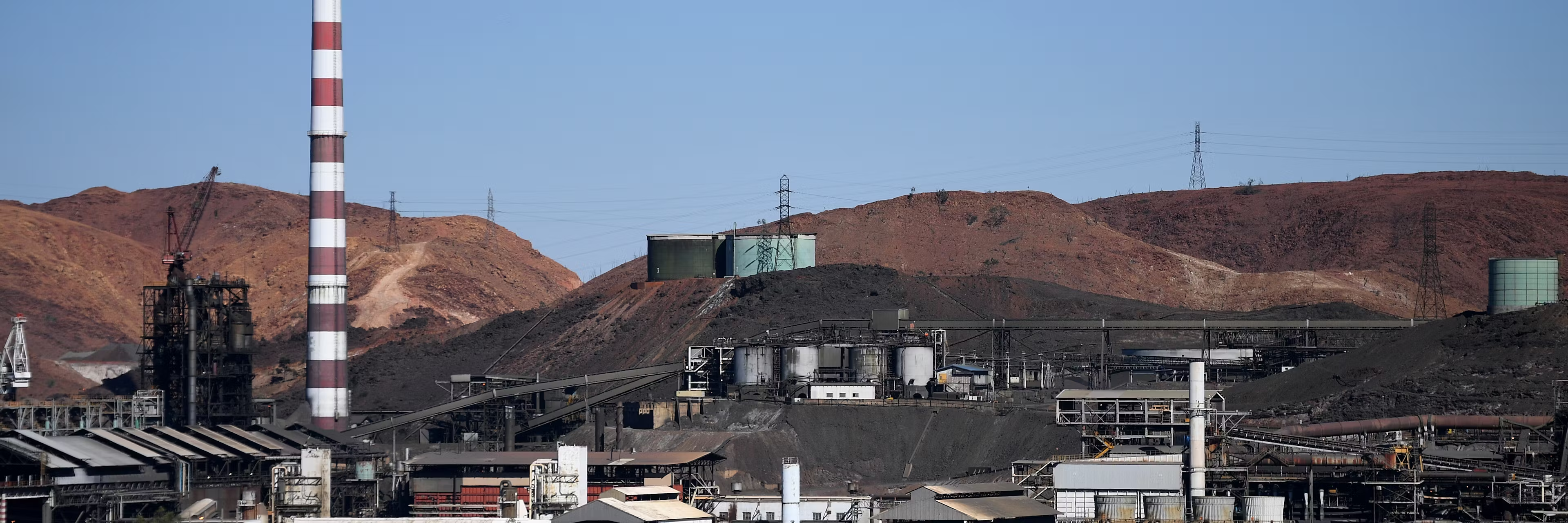
Key Takeaways
- The Department of Defense (DLA) has signaled purchase intents totaling up to roughly $1 billion across cobalt, antimony, tantalum, and scandium.
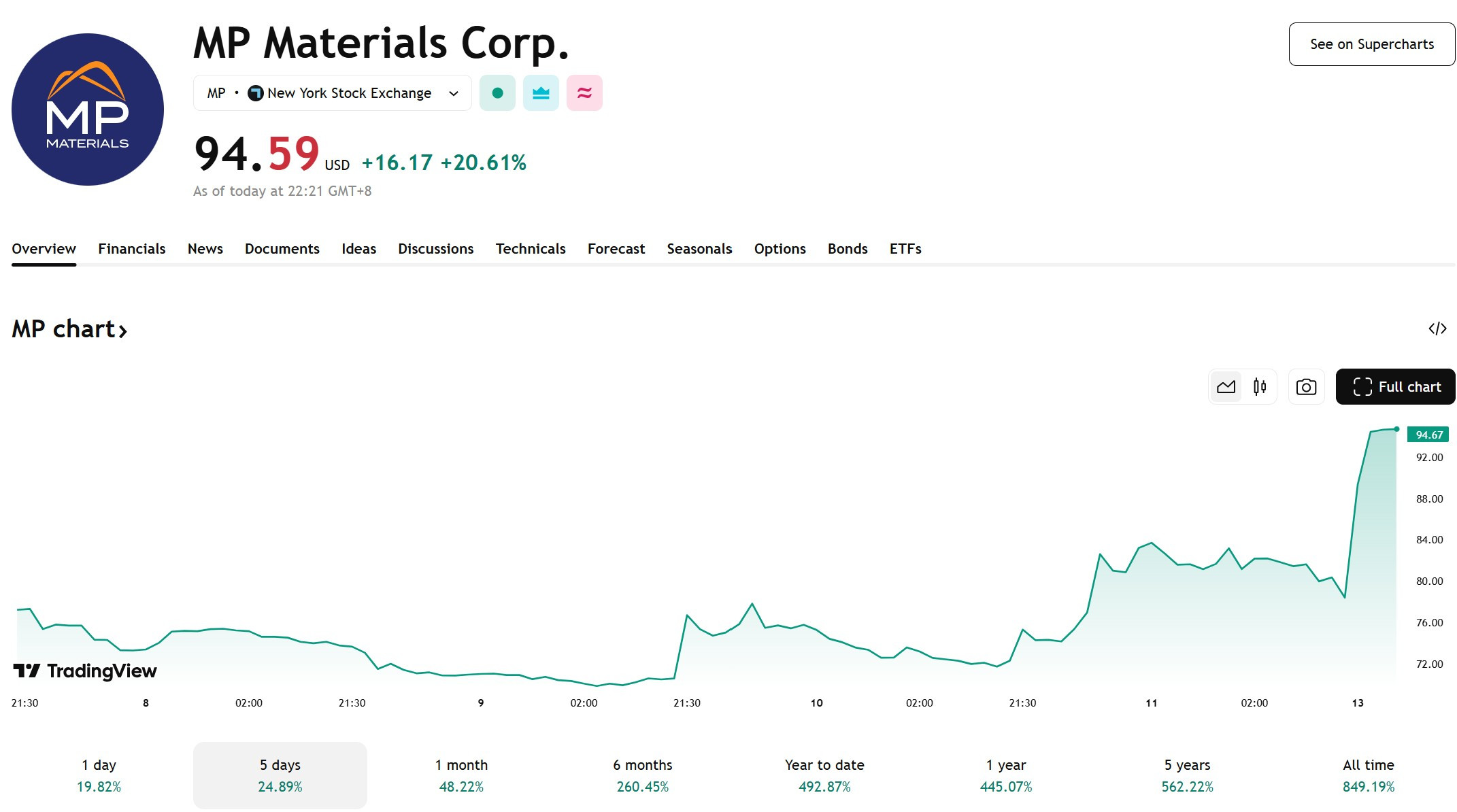
- The White House and agencies have made direct investments and stake purchases (MP Materials, Lithium Americas, Trilogy Metals), fueling large share gains for those companies.
- Market reaction: rare-earth and related resource stocks have surged; some names have risen multiples this year ($MP , $TMQ ) and LAC rallied ~150% YTD.
- Big private-sector support — JPMorgan’s new financing push — multiples the effect by pairing bank capital with government demand.
- Investors face a high-reward but high-risk landscape: early-stage projects, geopolitical friction, and policy unpredictability create both upside and sharp drawdowns.
What did the Pentagon announce — and why does it matter?
The Defense Logistics Agency has publicly signaled intent to buy strategic minerals in large dollar amounts.
Specifically, DLA plans purchases of up to $500 million of cobalt, $245 million of antimony, $100 million of tantalum, and about $45 million of scandium. The agency is also gathering data on rare earths, tungsten, bismuth, and indium.
That matters because government procurement at this scale is not a marginal policy — it creates guaranteed demand, accelerates domestic supply-chain projects, and transforms commercial viability for miners and processors.
For firms with production, processing, or strategic projects, the prospect of a durable offtake or priority access to federal buying can be a game-changer.
Who’s already benefited from the government push?
The White House and federal agencies have already deployed capital into strategic-minerals names.
Examples named in recent reports: an earlier $400 million commitment to MP Materials, an equity position in Lithium Americas, and a confirmed plan to acquire roughly 10% of Trilogy Metals.
These moves have catalyzed big share-price responses: MP Materials and Trilogy Metals have climbed more than fourfold year-to-date; Lithium Americas has risen roughly 150% this year.
Such outsized moves reflect two market realities: (1) investor scarcity premium for western suppliers of critical minerals, and (2) the market’s appetite for policy-backed winners whose cashflows look closer to guaranteed when Washington signals long-term demand.
Which resource categories are in focus — and why investors care
Rare earths: Called the “industrial vitamins,” rare earths are central to high-end manufacturing and defense tech. U.S. moves to secure domestic capacity elevate producers like MP Materials, USA Rare Earth, and others that own strategic deposits or processing ability.
Lithium: The battery-grade metal — dubbed “white petroleum” by some — is a cornerstone of EV and storage supply chains. Lithium Americas and other North American-focused developers stand to gain from direct government interest and potential offtake or partnership arrangements.
Antimony and tantalum: These less-talked-about elements have outsized defense and industrial uses. U.S. antimony suppliers (for example United States Antimony) have already won multi-year DLA contracts; such wins can underpin long-term revenue visibility.
Uranium, copper, graphite, scandium and beryllium: Each fills a specific technological or energy role — from nuclear fuel to grid and EV infrastructure — and the administration’s broader approach signals an appetite to diversify suppliers across this full spectrum.
Market microreaction: is this already priced in?
Short answer: not fully — and volatility is high.
Reports show premarket and session gains across rare-earth, storage, and other resource lists; specific premarket runs pushed MP Materials, USA Rare Earth, Energy Fuels, and United States Antimony higher.
At the same time, futures and safe-haven flows (gold) have also reacted — gold touched around $4,080/oz in one session — suggesting policy shocks are rippling across asset classes.
But while headline-grabbing stakes and purchases cause immediate re-ratings, many critical-minerals projects are early-stage and capital-intensive.
The market often over-appreciates headlines in the short term and then re-prices on execution risks, permitting timelines, and processing bottlenecks.
How private finance and Wall Street are amplifying the trend
This policy shift is colliding with private-capital commitments. Major banks and financiers are mobilizing capital for strategic industries.
For example, a large bank recently announced multiyear financing and direct-investment programs aimed at rare earths, AI supply chains, energy projects, and advanced manufacturing.
When major financiers pair capital availability with federal demand, projects that were once financing-challenged become bankable.
That reduces execution risk for some developers and makes a subset of miners investable at scale — but it also concentrates attention (and crowding risk) into a handful of headline names.
Investor playbook: three pragmatic ways to think about exposure
Policy-proof exposure: Prioritize companies with existing production, refinery capacity, or signed government contracts. These names stand to capture near-term policy demand.
Selective developer bets: For higher upside, pick developers with permitted projects and established offtake or financing partners — but expect longer timelines and capital risk.
Diversified basket approach: Because the winners are uncertain, many investors prefer baskets or ETFs that cover rare earths, lithium, and broader critical-minerals exposure to spread idiosyncratic risk.
Risks — don’t ignore the other side of the ledger
Government moves can be reversed, delayed, or diluted; supply-chain projects face permitting, environmental, and technical hurdles.
Markets have already shown sharp rallies on headlines, and those rallies can reverse on disappointment. Geopolitics — especially trade relations with major producers — remains a structural wildcard.
Also, many juniors are pre-revenue and require repeated capital raises; headline-driven spikes often coincide with dilution risk. Finally, early large gains can produce crowded trades that experience sudden drawdowns when sentiment shifts.
What to watch next — short list of market signals
- DLA contract awards and any formal offtake agreements.
- Official equity purchases, stake filings, or Treasury/White House announcements.
- Financing pipelines from major banks and confirmation of direct-investment vehicles.
- Execution signals from projects: permits, debt or equity financing closed, and construction starts.
- Broader market risk sentiment — if risk-off returns, resource rallies can quickly pause.
Bottom line — opportunity with a caution flag
The U.S. pivot to stockpiling and investing in critical minerals is not purely symbolic: dollar-sized purchase intents and equity buys create real demand and a policy premium for domestic suppliers.
For investors, that premium creates compelling trade ideas — from produced-and-processing firms to select developers — but it also elevates execution and policy risk.
If you’re positioning, separate government-backed names with visible demand from speculative juniors. Expect headline-driven rallies, prepare for volatility, and treat this area as an event-driven, policy-sensitive allocation rather than a passive long-term buy-and-forget sector.