
Daily Crypto Roundup - 13 Oct

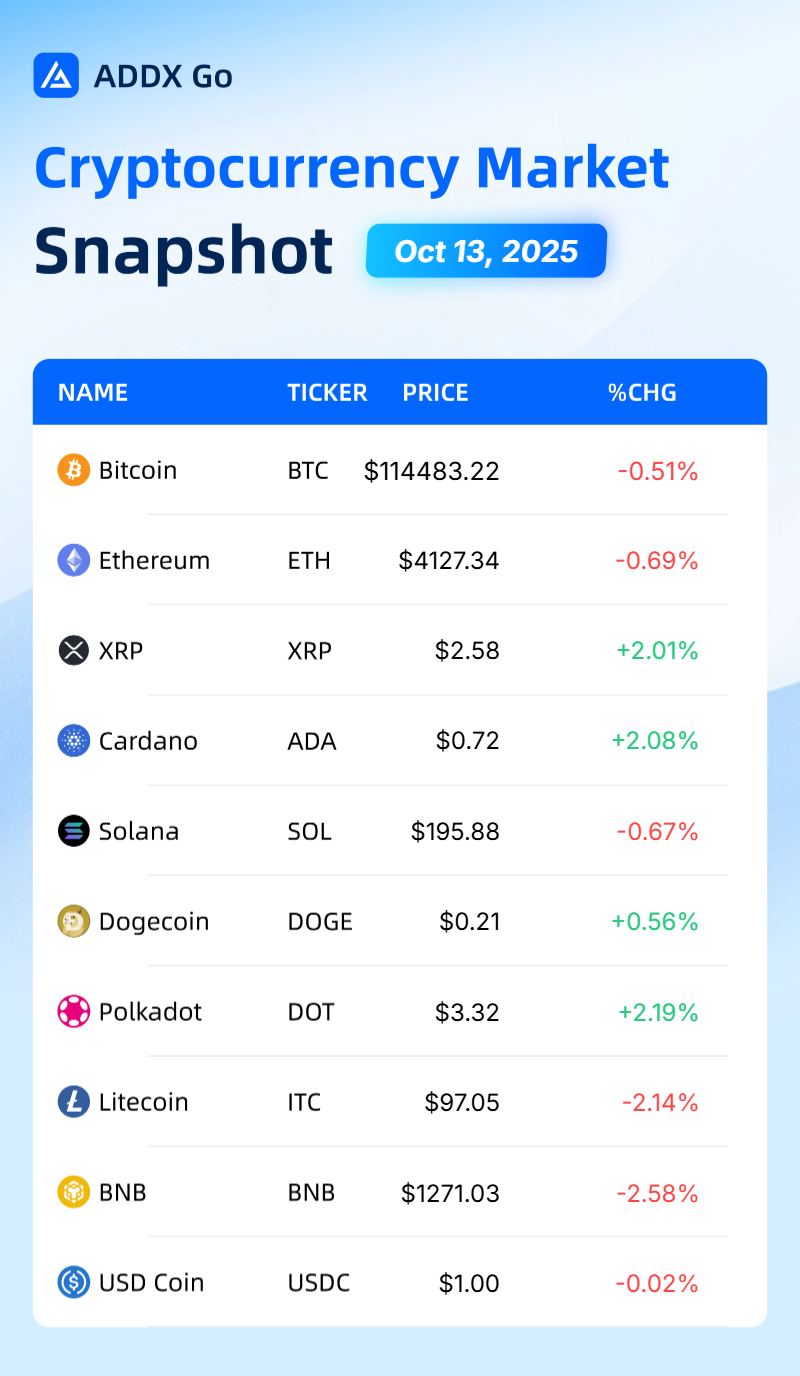
Today’s Market Update
Crypto Dynamics Roundup
1. Forbes: Trump Among America’s Largest Bitcoin Investors, Holding ~$870 Million
According to Forbes, U.S. President Trump holds an estimated $870 million in Bitcoin, positioning him as one of the world’s largest Bitcoin investors. His holdings are discreet because they are indirect, through his stake in Trump Media & Technology Group (TMTG), which operates Truth Social.
Despite TMTG’s annual revenue of less than $4 million, its Nasdaq valuation reaches billions. Earlier this year, TMTG pivoted to crypto, raising $2.3 billion through debt and overvalued stock sales in May, then purchasing $2 billion in Bitcoin in July.
Stock sales diluted Trump’s ownership from 52% to 41%. Since TMTG’s Bitcoin investment, BTC’s price has risen ~6%, valuing Trump’s 41% share of the company’s estimated $2.1 billion Bitcoin reserve at ~$870 million.
2. Analysis: Full Impact of Crypto’s “10.11 Flash Crash” May Take Days or Weeks to Unfold
After the “10.11 Flash Crash,” the crypto market has regained some ground, but the full impact may take days or weeks to materialize, per industry voices:
3. Morgan Stanley Lifts Crypto Fund Restrictions for Wealth Clients
Per CNBC, Morgan Stanley informed its financial advisors on Friday that it’s expanding crypto investment access to all clients, allowing such investments in any account type, including retirement accounts, starting October 15.
Previously, this was limited to clients with high risk tolerance, at least $1.5 million in assets, and taxable brokerage accounts. Sources say Morgan Stanley will rely on automated monitoring to prevent over-concentration in volatile crypto assets.
Its Global Investment Committee recently issued a model suggesting initial crypto allocations up to 4%, depending on goals from “wealth preservation” to “opportunistic growth.”
Advisors are currently limited to recommending BlackRock and Fidelity Bitcoin funds, but the bank is eyeing industry trends to potentially include other crypto exchange-traded products.
Clients can also request any listed crypto exchange-traded product.
4. Russia to Allow Banks to Conduct Crypto Business with Strict Limits
According to Cryptopolitan, Vladimir Chistyukhin, First Deputy Governor of the Central Bank of Russia (CBR), revealed at the Finopolis Forum that the CBR will allow banks to engage in crypto business but impose strict capital caps and reserve requirements.
Chistyukhin acknowledged, “We’re conservative. We’re considering whether including crypto in balance sheets truly fits banking.” But he added, “After discussions with professional bankers, we think it may make sense not to rule out banks’ involvement.”
He noted the CBR aims to pass comprehensive crypto investment regulations next year, enabling a licensing mechanism with the first licensed providers entering the market by year-end. Chistyukhin’s call for swift crypto legislation approval was backed by CBR Governor Elvira Nabiullina.
5. EU Commission: European Crypto Rules Sufficient to Address Stablecoin Risks
Per Reuters, the European Commission stated on Friday that its crypto regulations adequately address stablecoin risks, deeming major adjustments unnecessary despite ECB calls for stronger safeguards.
Europe has enacted landmark crypto-specific laws, but Brussels faces ECB pressure to curb “multi-jurisdictional issuance” stablecoin models. The debate centers on whether multinational stablecoin firms can treat tokens issued in the EU as interchangeable with those held outside.
On Tuesday, six crypto industry associations, including Circle, wrote to EU commissioners, urging guidance to confirm multi-jurisdictional issuance under the Markets in Crypto-Assets (MiCA) regulation.
An EU Commission spokesperson said MiCA provides a robust yet proportionate framework for stablecoin risks and that clarifications are being prepared. The European Systemic Risk Board flagged inherent risks in multi-jurisdictional structures, and the ECB warned of reserve run risks, though issuers claim sufficient reserves for redemptions.
6. Analysis: Bitcoin Must Build Quantum Defense by 2026 to Counter Attacks
Per Deloitte research, ~25% of Bitcoin could be vulnerable to quantum attacks. If not moved to quantum-resistant addresses, widespread quantum computing could lead to losses in the hundreds of billions or trillions.
Charles Edwards, founder of digital asset manager Capriole Investments and long-time Bitcoin advocate, said quantum threats are closer than perceived and urged the community to build defenses by 2026. He criticized some investors for downplaying the threat to stay bullish, warning that lagging in the quantum tech race could zero out Bitcoin’s value.