
Goldman Sachs Q3 Earnings Preview: Can the Momentum Survive the Next Hurdle?

Shearing sheep
October 14, 2025
GoGPT Summarizes Articles
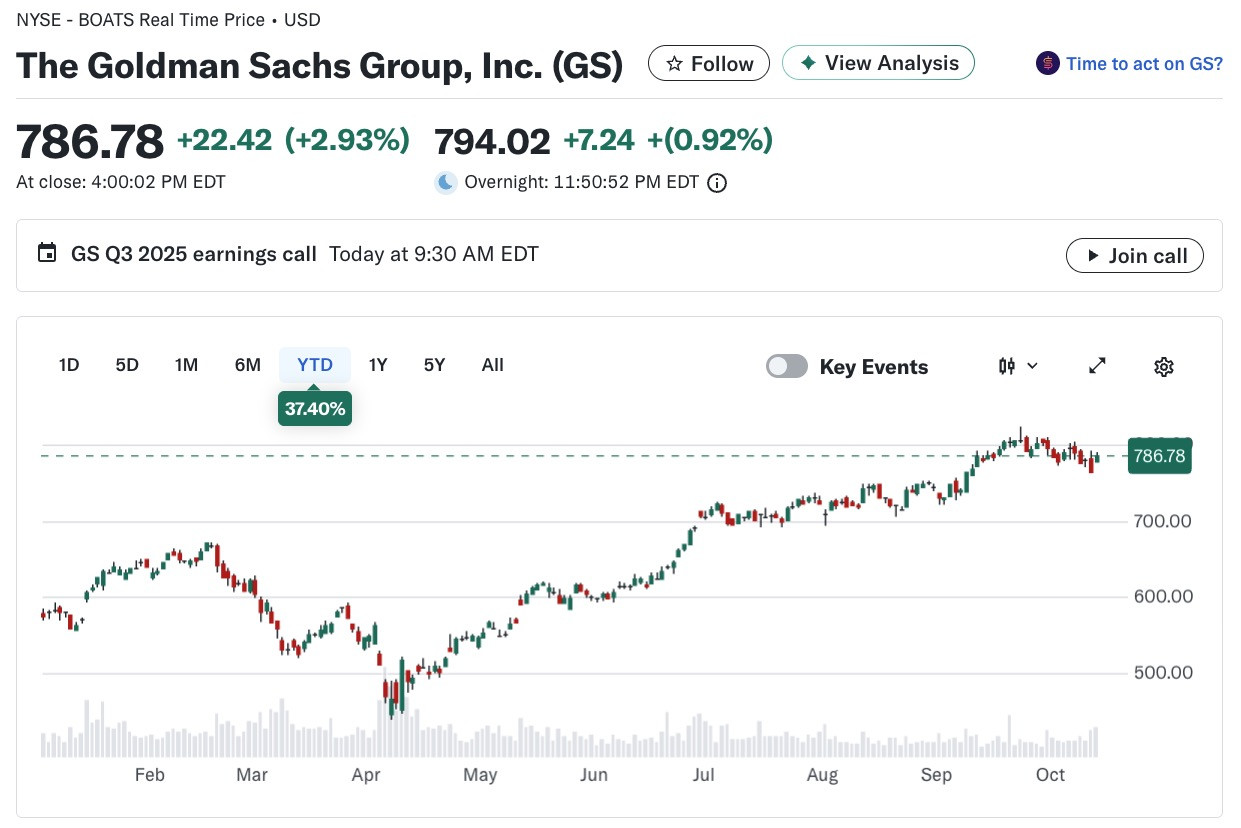
Goldman Sachs ($GS) steps into its third-quarter earnings report with both tailwinds and landmines in its path. The firm reports before the U.S. markets open on October 14, and by now, much of the optimism is baked into the stock. With shares up more than 37% year to date and over 52% over the past 12 months, Goldman is seen as one of the key beneficiaries of a broader revival in capital markets.
What’s Priced In — And Why It Matters
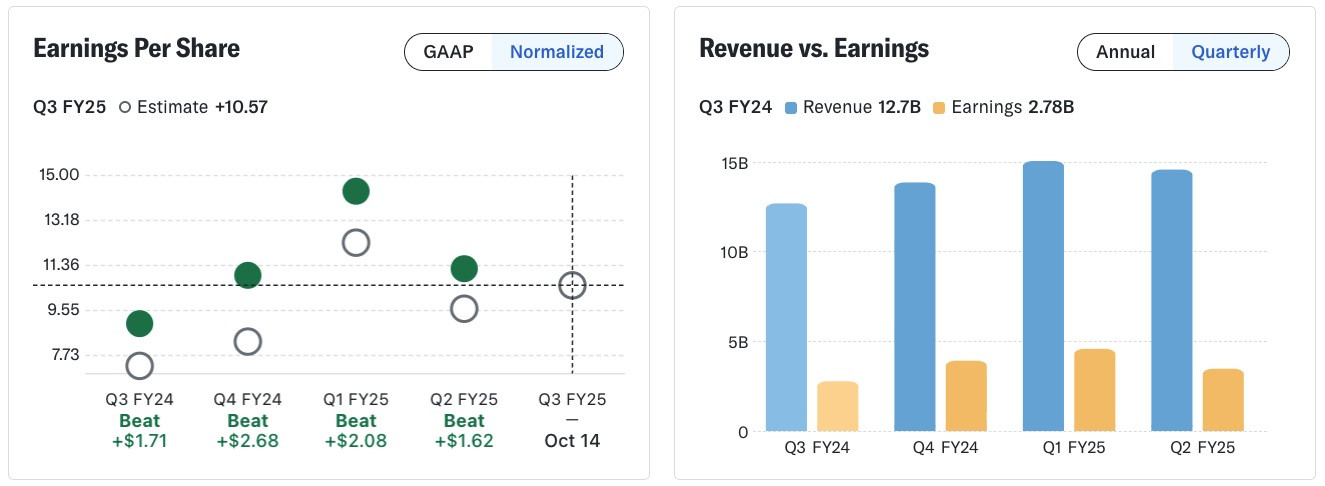
This quarter, analysts expect Goldman Sachs’s revenue to rise 11.9% year over year to $14.21 billion — a notable acceleration from the 7.5% increase recorded in the same period last year. Adjusted earnings per share are projected to reach $10.57, representing a 17% year-over-year increase. That optimism rests on a fairly clean narrative: after a prolonged drought in dealmaking, corporate confidence appears to be returning. M&A mandates, equity underwriting, IPOs — all of these have been showing signs of life.
The backdrop supports that narrative. Goldman’s own M&A outlook for the second half of 2025 projects sustained activity, even in a more volatile macro environment. The bank’s public outlook suggests that companies are increasingly willing to reposition or reorganize in response to evolving technology, competition, and regulatory pressures.
Trading desks, too, could benefit. Volatility in rates, commodities, and credit markets is back, which tends to favor fixed-income and macro-oriented desks. While the equity trading business might see some normalization (especially if the first half was unusually strong), the mix could still skew favorably. But it’s not just about volume; margins, hedging, positioning, and risk control will all factor in.
If Goldman nails execution and avoids negative surprises, there’s room for upside, especially if advisory fees materially exceed expectations or if volatility surprises to the upside. But the real line in the sand will be how management frames the quarter in context of 2026.
The Narrative Pivot: Cyclical or Structural?
One of the most interesting aspects of this cycle is how much of Goldman’s rebound is cyclical — catching up from an extended slump — versus structural, meaning a new, more stable growth regime. To convince investors it’s a structural shift, not just a rebound, Goldman must deliver more than a strong quarter — it must show sustainable, diversified growth beyond its traditional trading core.
That’s one reason the recent acquisition of Industry Ventures is particularly noteworthy. Goldman is paying roughly $665 million upfront (in cash and equity) plus up to $300 million in contingent payments through 2030 to acquire this venture capital and secondary investment platform. The deal brings ~45 professionals into Goldman’s alternatives and venture investing arm and aims to enhance its exposure to high-growth tech and private markets. The move signals Goldman is serious about augmenting its fee-based, recurring, long-duration income streams — a counterbalance to the cyclicality of capital markets.
Yet, integration risks and execution challenges remain. Can Goldman’s asset & wealth management side meaningfully scale over time? The track record has been mixed — growth here will need consistency, not one-off deals.
Risks, Caveats, and the Fine Print
No preview is complete without considering potential pitfalls.
First, Goldman has lost more than a dozen senior investment bankers this year amid internal reshuffling and dealmaking slowdowns in earlier quarters. While that level of turnover isn’t necessarily fatal, it raises questions about morale, incentives, and talent retention at a moment when deal competition is intensifying.
Second, management has openly warned about downside risk. CEO David Solomon has cautioned that parts of the current euphoria around AI may echo historical bubbles and that a drawdown isn’t out of the question over the next 12–24 months. In other words: they are aware that sentiment is stretched. That gives them some rhetorical flexibility if things wobble, but it also sets a trap — any cautious tone may be read as lack of conviction.
Third, macro and regulatory headwinds loom. Tariffs, policy shifts, geopolitical jitters, or even a surprise economic slowdown could spook deal activity, credit, or risk appetite. Goldman itself has flagged tariff pressures as a possible headwind. Additionally, consensus expectations for broader S&P 500 earnings growth show some moderation — the tailwinds that powered EPS growth earlier in 2025 may be less benign in Q3.
Fourth, the cost side is always a danger. Compensation, technology investment, legal/regulatory compliance — in a high-growth quarter these costs tend to rise. If Goldman fails to manage leverage or operating efficiency, the margin expansion could be muted.
Finally, structural competition in asset & wealth management — from fintechs, digital platforms, and low-cost active/ passive alternatives — is intensifying. Big banks are no longer the only gatekeepers of client capital.
What I’ll Be Watching on the Call
When the numbers drop, the market won’t just care about whether Goldman beats expectations — it’ll be watching how the rebound story takes shape. The biggest focus will likely be on management’s tone around its dealmaking pipeline and backlog guidance. Any signs of stronger M&A momentum or renewed confidence heading into 2026 could fuel optimism for a sustained recovery.
Another key area will be the performance of the trading division — whether recent gains were driven by favorable volatility or more durable client activity. Investors will also pay attention to compensation and expense ratios, since rising costs could limit profit growth even in a strong revenue quarter.
Lastly, Goldman’s capital deployment strategy will be closely watched. A heavier tilt toward share buybacks or reinvestment into its wealth and asset management businesses would signal how confident management feels about the broader environment.
My View & Scenarios
In a base case, Goldman delivers a solid beat (or meets expectations) and couples it with confident forward commentary — that would likely extend the rally into year-end. With much of the upside already priced in, however, the market may be less forgiving of softness or hedges.
If management leans cautious — implying that this is a cyclical surge, not a regime shift — sentiment could cool quickly. On the flip side, if they aggressively lean into asset growth, capital deployment, and the structural side of the business, investors may dynamically reprice Goldman toward a more sustainably higher multiple.
In sum, I’m leaning cautiously positive. The forces at work (deal revival, market liquidity, AI-driven capital flows) are real, but they’re starting from a base that’s already elevated. Execution, story, and tone will matter more than raw numbers — and how Goldman positions itself for 2026 could define whether this rally still has room to run.
#Q3 Earnings Season: Key Insights and Market Movers#$Goldman Sachs Group Inc.(GS)