
Bank of America Q3 Earnings Preview: All Eyes on the $50 Line

Shearing sheep
October 15, 2025
GoGPT Summarizes Articles
Bank of America ($BAC) will release its third-quarter results before markets open on Wednesday, and investors are watching closely to see if the banking giant can finally break through the stubborn $50 resistance level that has capped its share price for months.
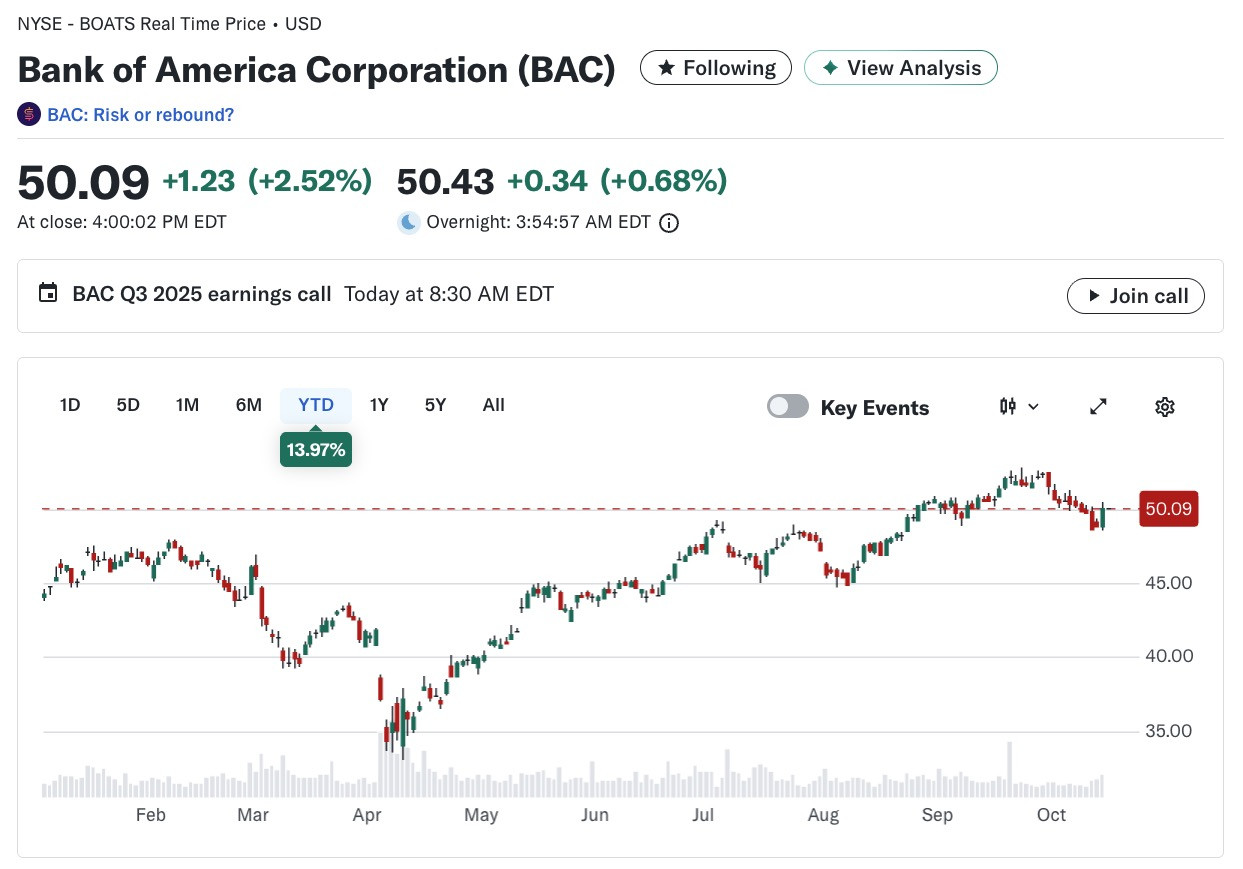
The stock has already gained over 13% this year, supported by stronger trading performance, solid consumer banking revenue, and an improving investment banking backdrop.
But as always with the big banks, what matters now is not just the numbers — it’s the tone of management’s outlook. For BofA, the real test lies deeper — in how well it balances traditional banking fundamentals with growth, risk, and technology.
What the Street Expects
In the second quarter, Bank of America reported revenue of $26.46 billion, up 4.3% from a year earlier, and earnings per share of $0.89. This time around, Wall Street expects a stronger set of results: earnings per share of roughly $0.95, a 17% increase year-over-year, and revenue in the ballpark of $27.5 billion — nearly 9% higher than last year’s flat quarter.
To hit those numbers, management will need to deliver a strong performance across several fronts. They’ve already flagged that investment banking fees could be up 10–15%, reflecting the stronger deal flow this year. Trading and markets activity is also expected to contribute materially. But what those topline boosts will mean depends heavily on net interest income, funding costs, and credit quality — the pillars on which bank valuations rest.
Deep Dive: The Mechanics Under the Hood
Net Interest Income & Funding Pressures
The interplay between interest rates, deposit costs, and loan repricing drives the heart of the bank’s profitability. With short-term rates still elevated and deposit competition stiff, funding costs remain under pressure. BofA faces a delicate balancing act — repricing assets without alienating customers, while managing liability costs. Analysts expect the bank to rely on fixed-rate asset repricing and hedging strategies to stabilize NII later this year.
Ultimately, net interest income remains the key swing factor. With rates stabilizing and deposit costs rising, BofA’s margin advantage is starting to narrow. Investors will be looking for signs that the bank can offset that pressure through loan growth or balance-sheet discipline. Another key question is credit quality. So far, Bank of America’s loan book has held up well, but with lingering concerns over commercial real estate and consumer delinquencies, any uptick in provisions could quickly change sentiment.
If deposit costs ease, that would be a welcome relief. Indeed, some commentary has flagged that lower funding costs might free up margin expansion — but that depends on how fast deposit rates decline relative to asset yields.
Revenue Mix & Capital Markets Gains
Beyond the lending engine, BofA’s non-interest revenue streams will be put under close scrutiny. The rebound in investment banking and capital markets is a broadly confirmed theme this quarter: Reuters reports that the six largest U.S. banks are set to benefit from a revival of deal activity, which bolsters expectations for BofA’s advisory and underwriting business.
But BofA isn’t just riding others’ coattails. Its investments in digital transformation and AI are increasingly central to its narrative. The bank has been promoting efficiency gains, predictive analytics, and cost savings from tech adoption. Some on Seeking Alpha explicitly call out AI as a key theme to watch, expecting management to highlight how recent tech upgrades are beginning to yield operational leverage.
If BofA can show that its technology investments are contributing meaningfully to margin stability, it would help differentiate it from banking peers who remain more reliant on rate-based tailwinds.
Risk, Credit, and Reserves
No bank call is complete without talking about credit. The consumer and commercial lines have held up so far, but cracks could emerge, especially in sectors like CRE or among high-leverage borrowers. If BofA opts for a more conservative posture, it may increase loan loss provisions or highlight elevated reserves. Any surprise there could dampen enthusiasm, especially if the message suggests latent weakness.
Peer Signals & Sector Context
What BofA does will be more telling when juxtaposed with how its siblings fared earlier in the week. JPMorgan ($JPM) and Goldman ($GS) delivered strong beats, buoyed by deal flow gains and trading strength. JPM even raised its full-year net interest income forecast, signaling it’s feeling confident in the rate environment going forward.
The broader banking narrative is that we’re witnessing a re-ignition of Wall Street: investment banking fees are surging, trading is active, and capital markets are waking up. But that optimism is tempered by macro uncertainty — inflation, global policy risk, and uneven credit signals lurk in the background.
So BofA needs to not just outperform on its quarter, but also articulate a credible path forward — where growth isn’t just cyclical but sustainable.
What Could Move the Stock — Beyond the Numbers
The market will likely react more to tone than to small deviations in EPS. If management delivers cautious guidance, it might offset any strong bottom line. On the other hand, a confident outlook — especially around capital deployment, expenses, and tech leverage — could reignite momentum.
Investors will also parse the buyback and dividend story. Earlier this year, BofA authorized a $40 billion share repurchase plan, replacing an earlier $9.1 billion program. That signals management confidence. But the question now: will they accelerate buybacks, or hold back given regulatory or macro overhangs?
Another under-appreciated factor is valuation compression around expectations. BofA has repeatedly approached the $50 resistance line, only to be pushed back. A clean quarter might break that pattern, but a soft quarter could drag the stock back toward $47–48 support.
Finally, the Buffett angle is subtly influencing sentiment. Berkshire Hathaway still holds over 600 million shares, making BofA its fourth-largest position, but the recent reductions have drawn attention. While the motive behind Buffett’s trimming isn’t entirely clear — whether caution or mere rebalancing — it adds another layer of intrigue as BofA steps into earnings.
Final Thoughts: Watch the Message, Not Just the Math
Earnings season in banking today is as much about narrative as it is about numbers. BofA enters Q3 with decent tailwinds: rebounding capital markets, a resilient consumer backdrop, and optional leverage from its tech investments. But it also carries several potential landmine risks: margin compression, credit surprises, and guidance that underwhelms.
If I were to bet, a solid execution across both interest income and non-interest lines — paired with confident forward commentary, could be enough to push BofA through the resistance ceiling it’s been punching at. But anything ambiguous, especially on credit or cost control, could lead to a knee-jerk down move, even if the quarter is “good enough.”
For now, the consensus view remains cautiously optimistic. Most analysts expect a steady performance with room for upside if revenue growth and cost control align. Erste Group recently upgraded the stock to Buy, citing solid deposit growth and a healthy credit outlook. UBS, Evercore ISI, and Morgan Stanley have all raised their price targets in recent weeks, reflecting renewed confidence in the bank’s medium-term trajectory.
As CNBC’s Jim Cramer put it recently, “Bank of America tends not to do all that much.” That might be true, but in a market where “boring” banks have quietly powered this year’s rally, steady execution might be exactly what investors want to see. And if Bank of America delivers that steadiness this quarter, breaking the $50 line might finally be more than just a technical dream.
Source: GoAI (👉 Full GoAI analysis)
#Q3 Earnings Season: Key Insights and Market Movers#$Bank of America Corporation(BAC)#$JPMorgan Chase & Co.(JPM)#$Goldman Sachs Group Inc.(GS)