
APAC Market Wrap - Oct 15

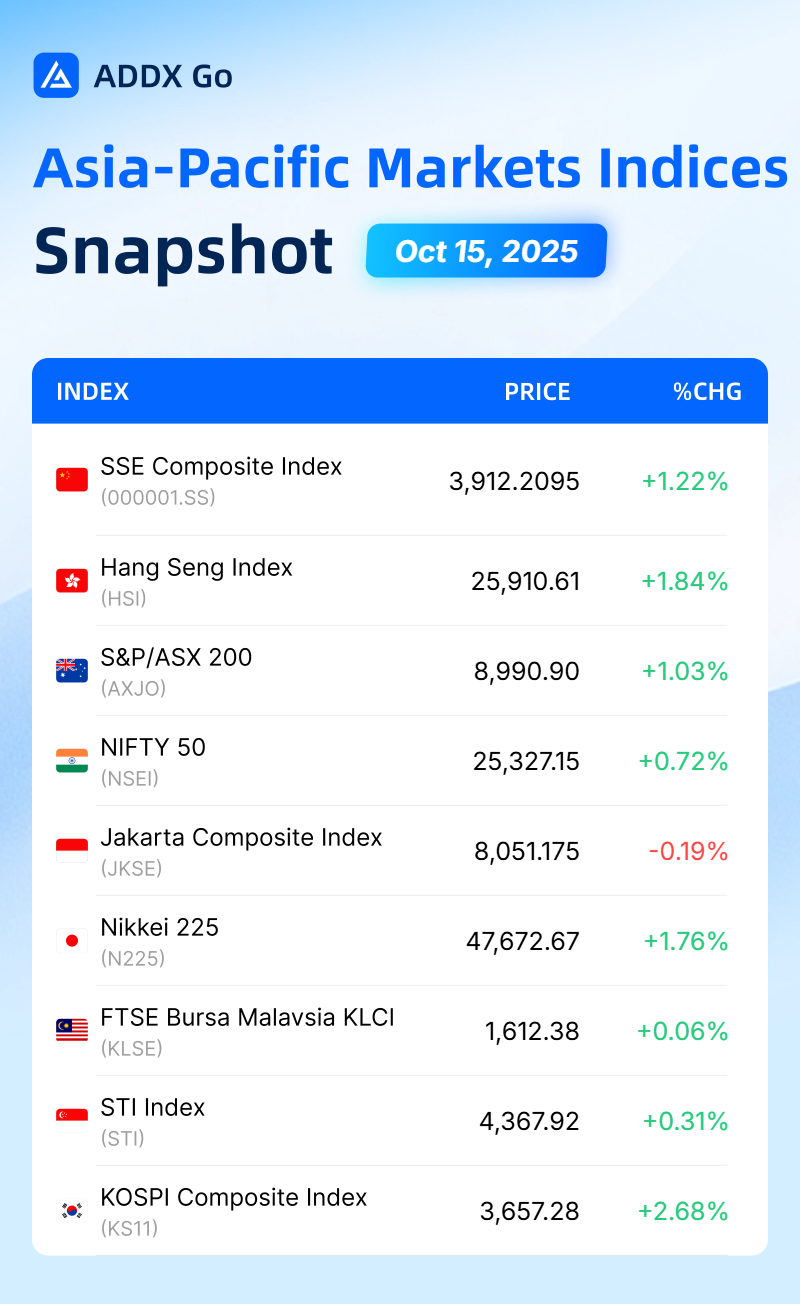
China Stock Market: At the close, the Shanghai Composite rose 1.22%, the Shenzhen Component gained 1.73%, and the ChiNext Index climbed 2.36%.
By sector, autos, power grid equipment, and pharmaceuticals led gains, while port shipping and lithography machines saw the largest declines.
Hong Kong Stock Market: Hong Kong’s three major indices collectively strengthened today.
At the close, the Hang Seng Index rose 1.84% to 25,910.60 points, the Tech Index gained 2.57% to 6,075.27 points, and the H-share Index increased 1.89% to 9,250.91 points.
Aerospace, construction materials, robotics, and auto stocks performed strongly, while shipping stocks weakened slightly.
Japan Stock Market: The Nikkei 225 rebounded sharply by 1.76% after three trading days, closing at 47,672.67 yen, up 825.35 yen.
By industry, 30 sectors rose, except for services, rubber products, and shipping. Machinery, securities & commodities futures, nonferrous metals, electrical equipment, and power & gas saw significant gains.
South Korea Stock Market: The KOSPI rose 2.68%.
By sector, machinery, electrical equipment, communication equipment, and utilities surged, while consumer services, insurance, and tobacco declined.
Australia Stock Market: The S&P/ASX 200 rose 1.03% to 8,990.90 points.
Housing construction, building materials, and industrial distribution saw modest gains, while aerospace, independent power, waste management, and oil & gas posted larger declines.
Singapore Stock Market: The Straits Times Index rose 0.32% to 4,368.42 points.
Industrial products, cyclical retail, autos & parts, other energy, and non-alcoholic beverages saw slight gains, while furniture, industrial distribution, building materials, and diversified media saw larger declines.
Malaysia Stock Market: The FTSE Malaysia KLCI edged up 0.01% to 1,611.55 points.
Real estate, commercial trusts, and technology rose, while transportation & logistics and closed-end funds fell.
Key Events
Global Pension Systems Annual Rankings Released: Singapore Joins A-Grade for First Time
Singapore entered the top tier of the annual global pension system rankings for the first time, while the Netherlands retained the top spot.
In this year’s Mercer CFA Institute Global Pension Index, released Wednesday, Iceland, Denmark, and Israel also received A-grade ratings. The report evaluated 52 pension systems based on adequacy, sustainability, and integrity.
Report lead author Tim Jenkins, a Sydney-based partner at Mercer, said Singapore’s consistent strengthening of its pension system has boosted its global ranking. Recent government efforts have focused on improving transparency to ensure better understanding of post-retirement pension benefits.
Japan Regulator to Draft Rules Banning Crypto Insider Trading
Japan’s regulators plan to ban insider trading in cryptocurrencies, a first for this Asian nation among the earliest to engage with digital assets.
On Tuesday, October 14, reports indicated that Japan’s top financial regulator, the Securities and Exchange Surveillance Commission (SESC), will soon have authority to investigate suspected violations and recommend fines or criminal referrals for trades based on non-public information.
The SESC’s parent agency, the Financial Services Agency (FSA), will discuss details of the new rules, aiming to enact legislation by 2026.
South Korea Introduces New Measures to Curb Overheated Property Market
South Korea rolled out new measures to control its overheated property market, intensifying efforts to curb speculative buying while policymakers consider rate cuts to boost a slowing economy.
The latest measures include tighter loan restrictions in the Greater Seoul area (newly designated as overheated), faster implementation of higher risk weights for bank housing loans, and lower loan-to-value ratios for mortgages.
Despite prior measures like tighter loan caps in Seoul and restrictions on foreign buyers, home prices continue to rise.
Institutional Views
Bank of America Survey: Long Gold Overtakes Long Magnificent Seven as Most Crowded Trade
Bank of America’s October Global Fund Manager Survey shows most investors view “long gold” as the market’s most crowded trade. 43% of respondents listed “long gold” as the most crowded, surpassing “long Magnificent Seven” at 39%.
The survey also found 39% of investors have near-zero gold positions, 19% hold ~2%, and 16% hold ~4%. The weighted average gold allocation is 2.4%.
Bank of America Survey: Global Recession Fears Drop to 2.5-Year Low
Bank of America’s October survey shows global recession fears at their lowest since February 2022. Growth optimism saw its largest six-month rise since October 2020. 33% of respondents expect a “no-landing” scenario (strong growth and inflation), an eight-month high, up from 18% in September. “Soft landing” expectations fell to a six-month low of 54%, down from 67%. “Hard landing” expectations dropped from 10% to 8%.
JPMorgan: Holding Gold in Portfolios Is “Semi-Rational”
JPMorgan CEO Jamie Dimon said he sees some logic in holding gold but declined to comment on whether it’s overvalued after its historic rally. Dimon noted: “I’m not a gold buyer—it costs 4% to hold. But in an environment like this, its price could easily hit $5,000 or $10,000.
This is one of the few times in my life I think holding some gold in a portfolio is ‘semi-rational.’” He added: “Asset prices are generally high,” impacting nearly all asset classes. Last week, Citadel founder Ken Griffin said investors view gold as safer than the dollar, calling it “truly concerning.”
Capital Economics: Japan’s Political Uncertainty Unlikely to Drag Down Bonds or Stocks
Capital Economics’ Asia-Pacific markets head Thomas Mathews said Japan’s political uncertainty is unlikely to weigh on its bonds or stocks and may even provide a short-term boost. Despite the LDP-Komeito coalition split, markets have remained largely unfazed.
Mathews noted investors likely expect the turmoil to be brief, with new LDP leader Sanae Takaichi becoming prime minister—Capital Economics’ base case. Prolonged policy uncertainty could dampen interest in Japanese assets, but the impact depends on economic effects.
A more divided government could pose long-term risks, especially if it hinders corporate governance reforms that boost profitability.