
ASML Rides AI Orders But China Casts a Shadow on the Road Ahead

When $ASML reported its latest quarterly results, the market cheered—its stock jumped over 3%. The reason was obvious: solid order rebounds. But underneath that applause lies complexity, tension, and a strategic inflection that every investor should heed.
In this article, I’ll walk you through what’s really going on—from the technical backbone of the chip world to the tensions between demand, policy, and China—and then share how I’m viewing ASML from an investment lens.
A Powerful Position at the Heart of Chipmaking
To grasp ASML’s importance, you need to understand lithography. It’s the process by which chipmakers “print” circuits onto silicon. The more advanced the chip, the more precise that printing must be.
ASML holds the near-monopoly on EUV (extreme ultraviolet) lithography machines—the tools required for the most cutting-edge chip nodes (3 nm and below). There is no current alternative at the same precision and scale. In effect, ASML is the gatekeeper for many high-end chip fabs.
So when the AI and memory booms require denser, more advanced chips, orders for ASML gear become essential. That’s why investors watch every quarterly announcement about ASML with bated breath.
Q3 Results and What They Mean
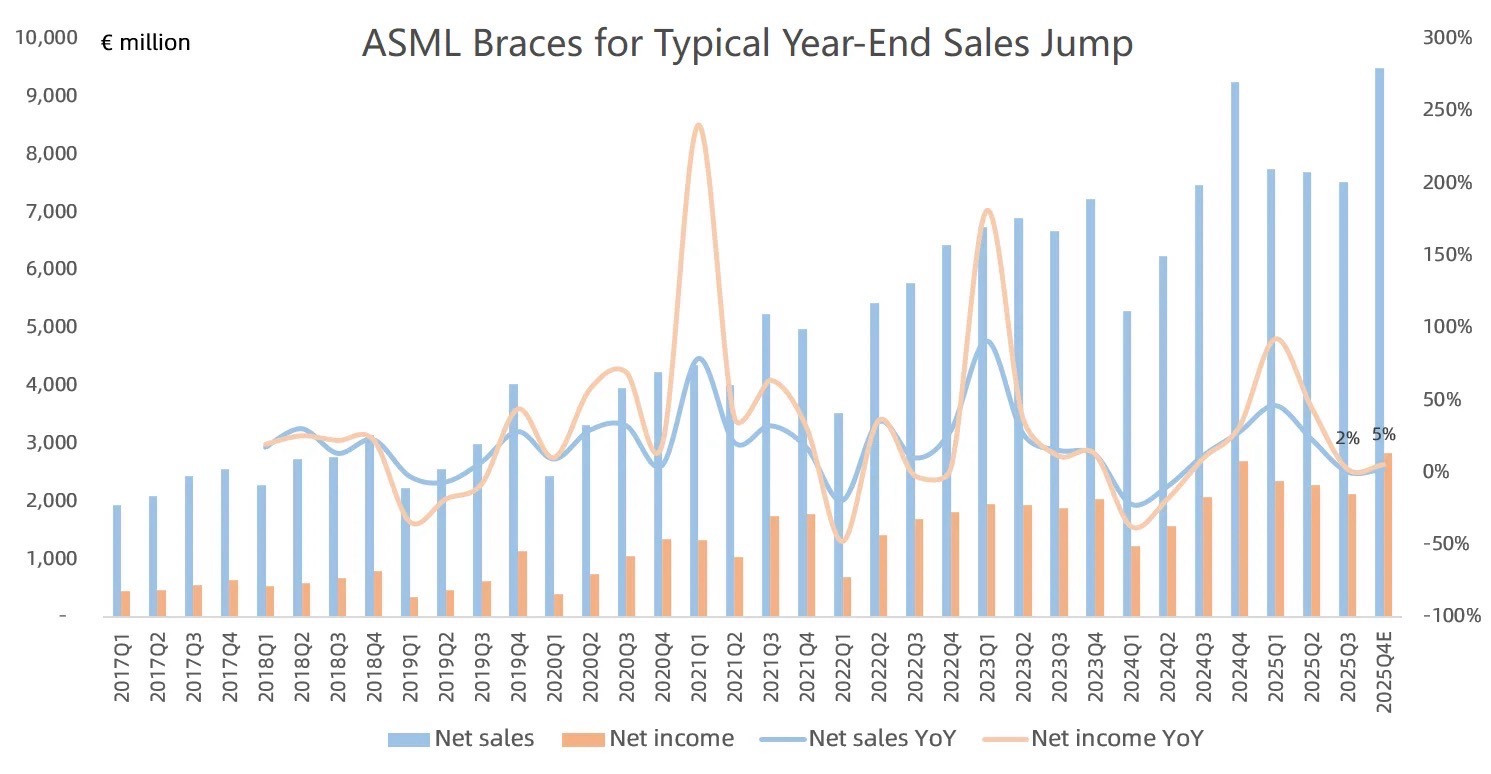
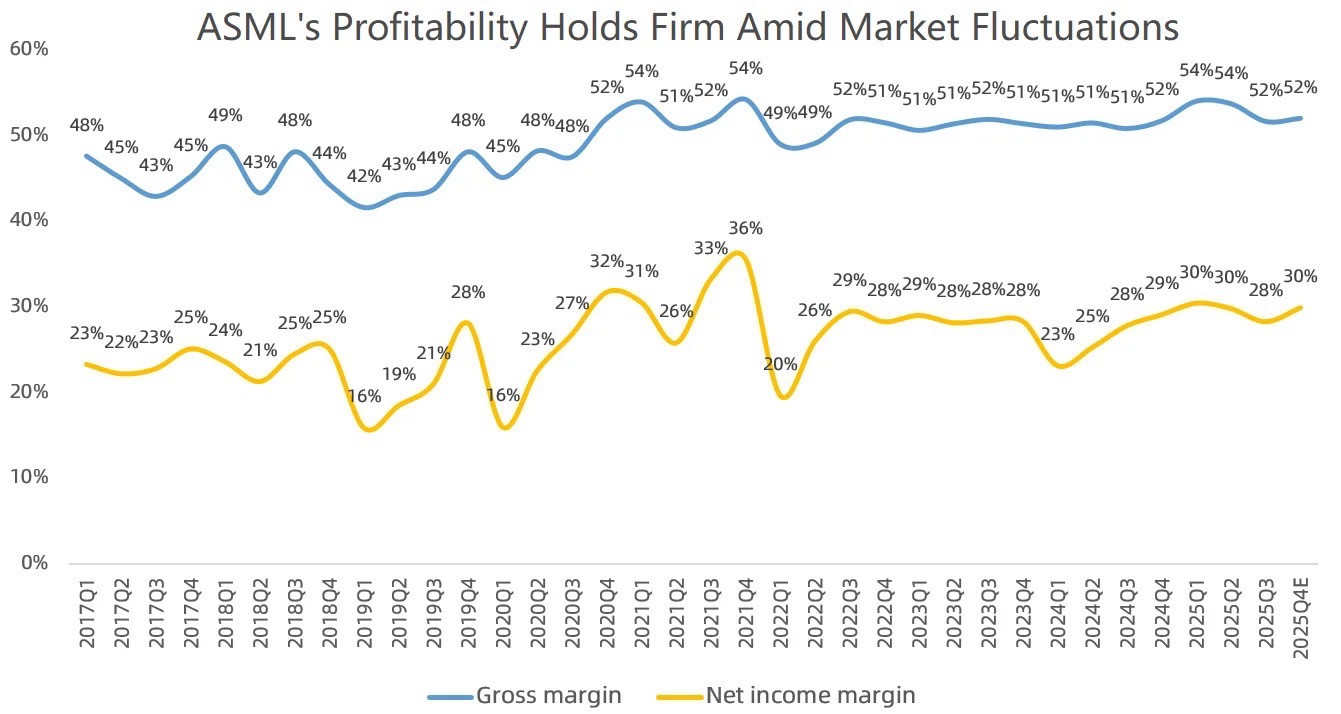
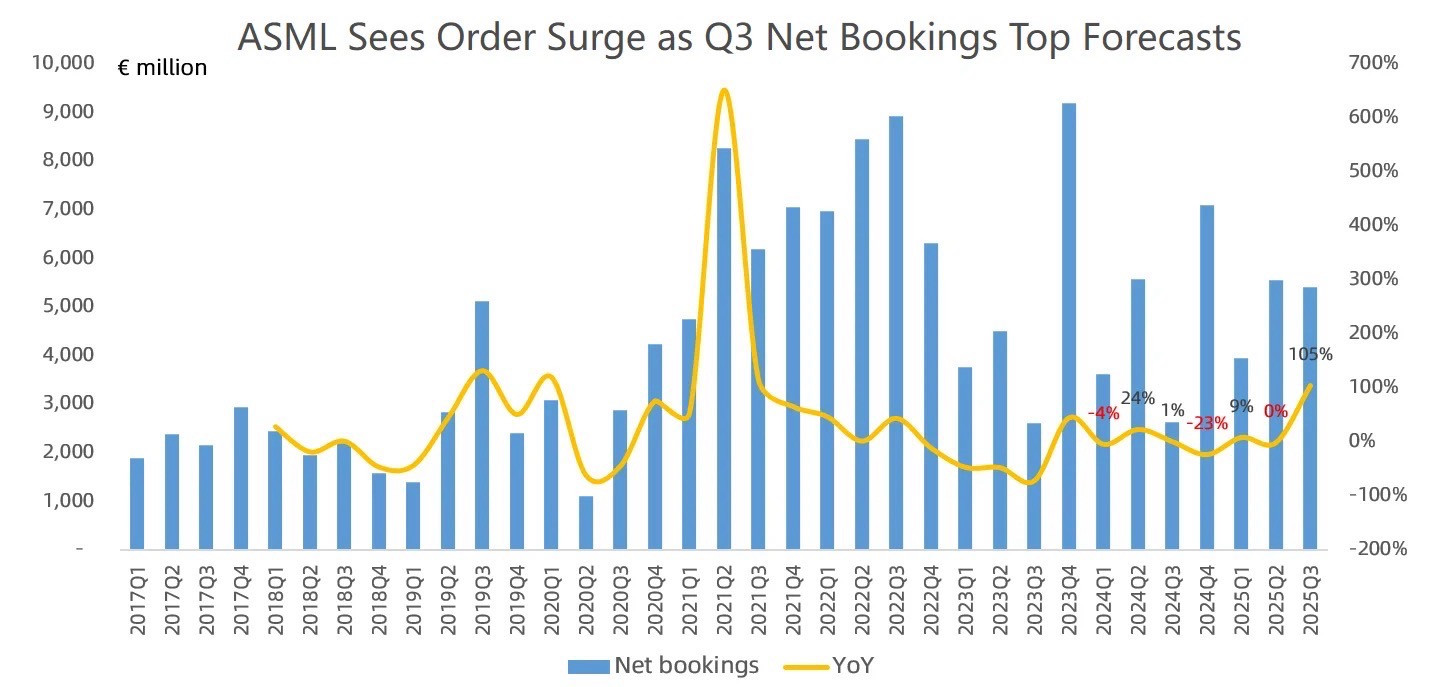
ASML delivered revenue of €7.52 billion, roughly flat year-on-year and slightly below consensus. Gross margins came in at 51.6%, a modest year-on-year improvement and slightly above expectations. Net income rose 2% year-on-year but fell 7% quarter-on-quarter. While revenue growth is muted, bookings—new orders—told a different story. Net bookings reached €5.4 billion, more than doubling from a year ago, with EUV systems driving a significant portion of the increase.
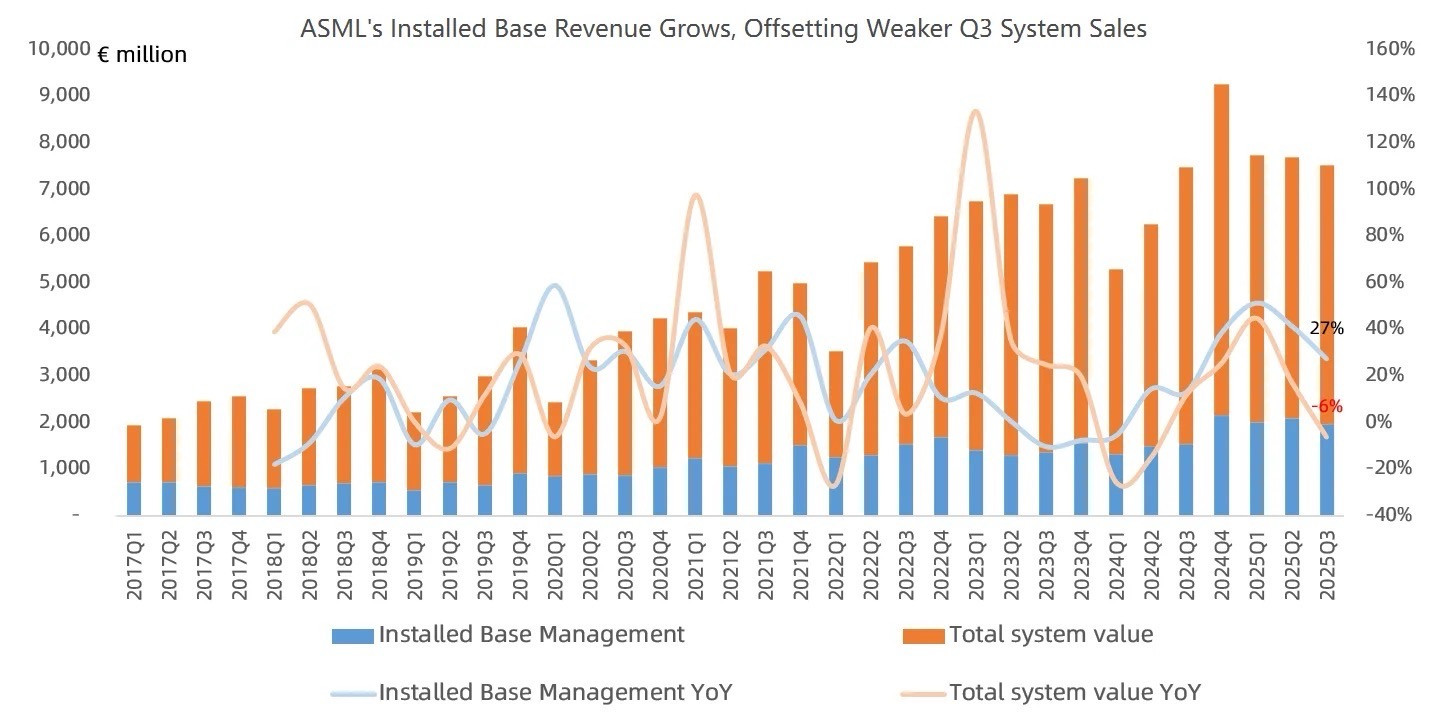
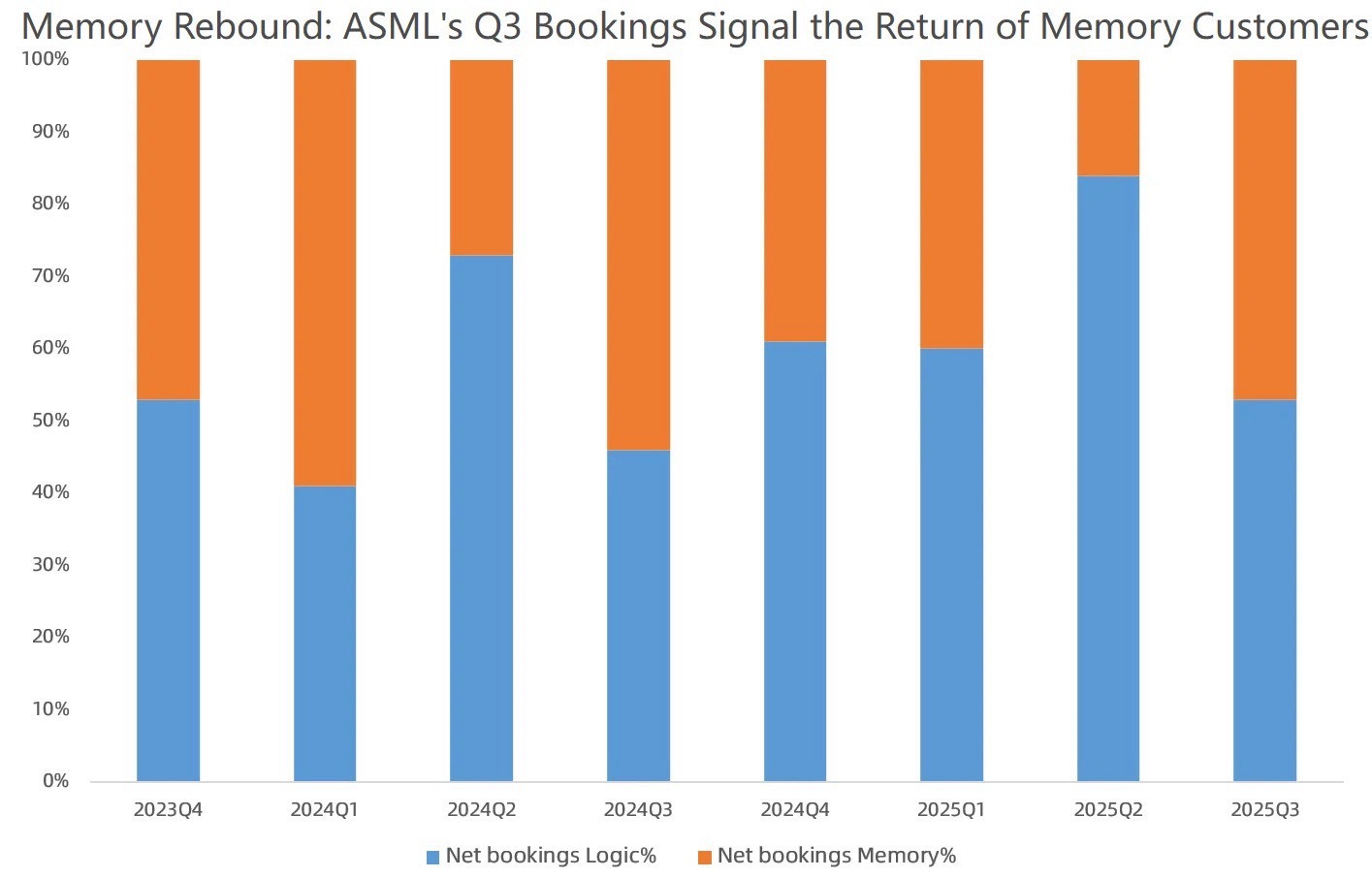
Breaking down the demand, memory chipmakers are taking a larger share of orders, reflecting the surge in AI workloads and high-bandwidth memory requirements. Logic chips continue to grow steadily, thanks to the AI boom in datacenters. Meanwhile, ASML delivered 72 lithography systems in the quarter, a decline from last year, reflecting timing differences between order intake and actual shipments.
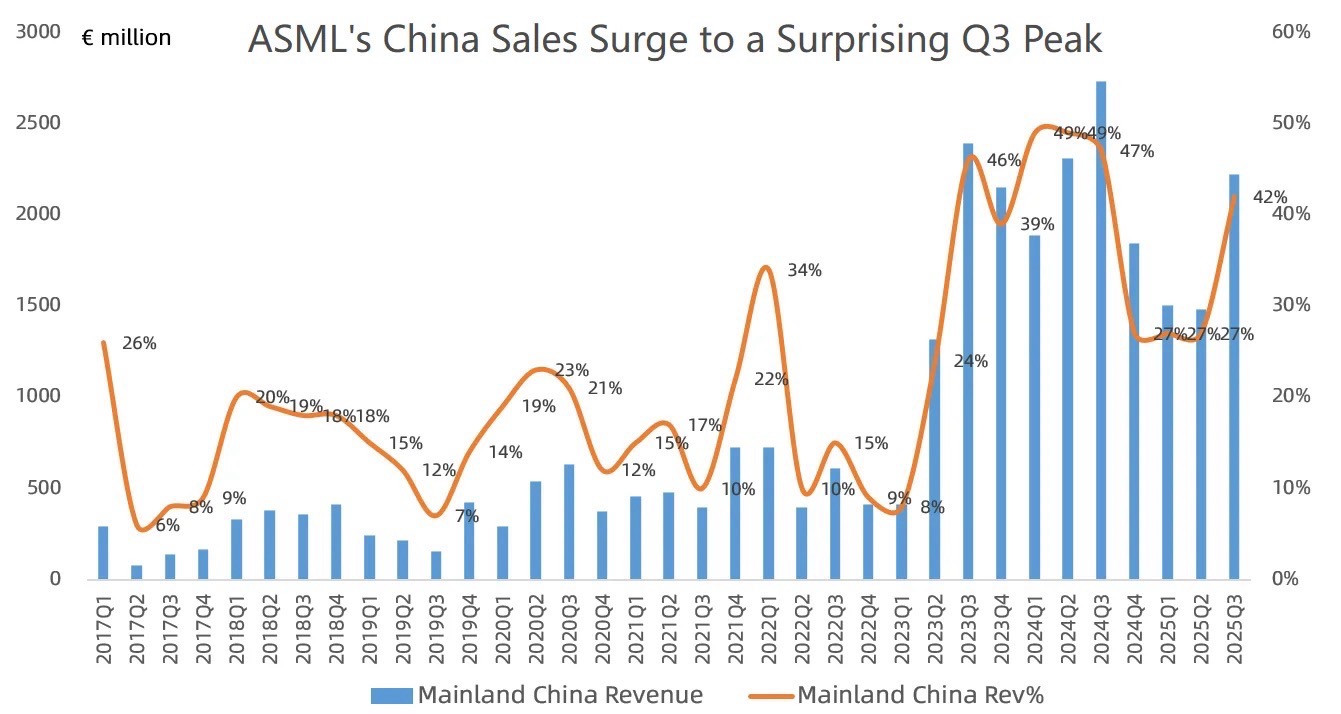
China remains a complicated story. Despite restrictions on high-end EUV systems, demand for older DUV machines from the region has surged, pushing China’s revenue share back up to 42%. However, management warns that 2026 will likely see a sharp decline in China-related revenue, due to tighter export controls and ongoing geopolitical tensions.
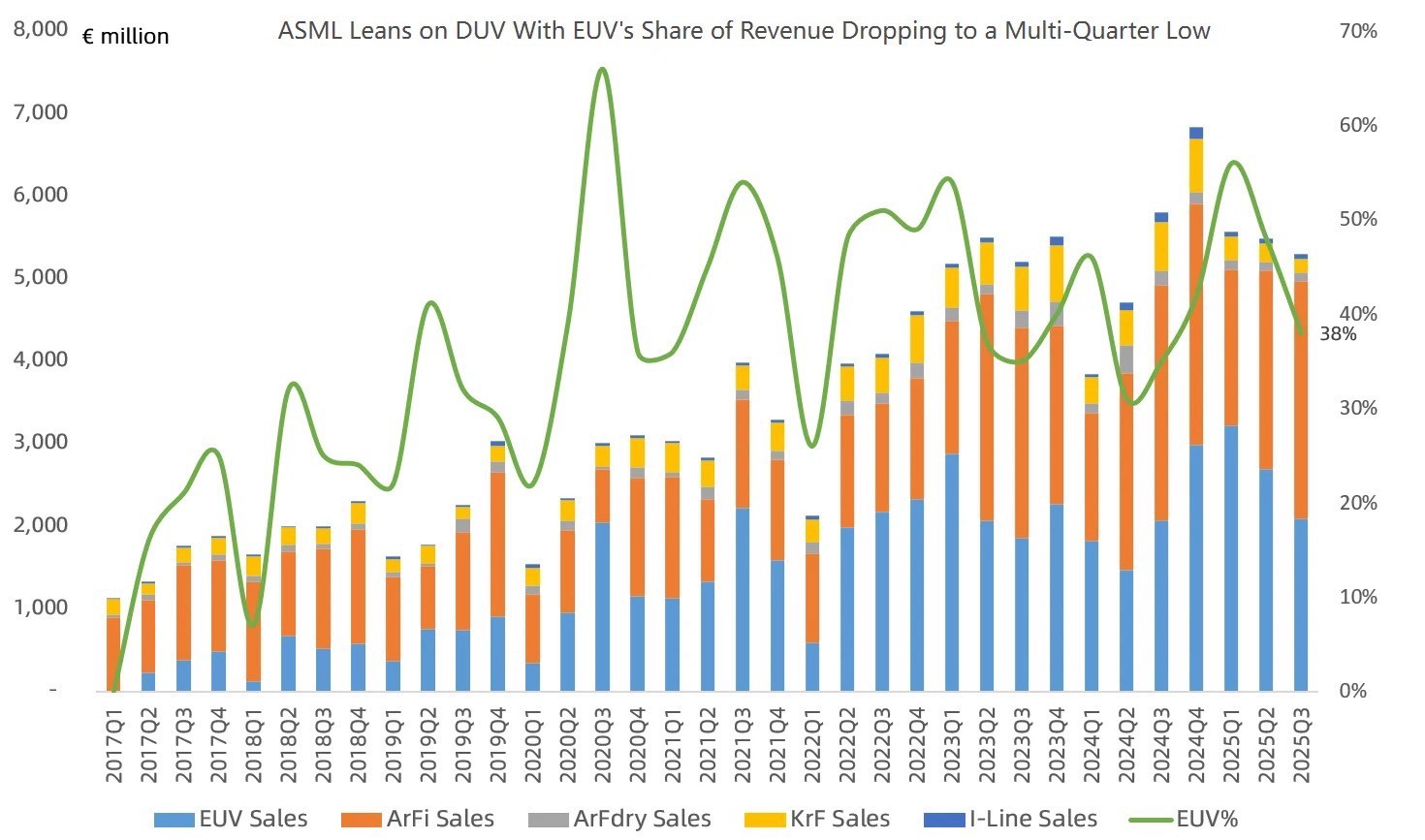
On the technology front, ASML shipped its first advanced packaging lithography system, which promises up to four times the efficiency of traditional steppers. It also recognized revenue for one High-NA EUV system, signaling that adoption is beginning for the next generation of cutting-edge tools. Management expects that EUV demand from advanced logic and memory customers will help offset the revenue gap from China next year.
What’s Really Driving the Story
To make sense of this, we need to see three overlapping dynamics at play:
1. AI and Memory — The Wind at ASML’s Back
The rise of large models, generative AI, and high-bandwidth memory (HBM) pushes chip makers toward more complex, dense designs. That means more EUV layers, more cycles, more demand for ASML’s machines. The memory sector’s stronger share in bookings is telling—this is no longer just logic demand, but broad compute expansion. 
2. China as a Double-Edged Sword
China has been a vital customer for ASML, especially for DUV machines (which are less restricted). But export controls and geopolitical tensions mean that the relationship is becoming more precarious. ASML expects a significant drop in China‐related demand in 2026. 
So far, they have defended against accusations of “overselling ahead of restrictions” by pointing out most machines shipped are in use—not stockpiled. 
3. High-NA EUV and Advanced Packaging are the Frontier
Delivering a first advanced packaging system and recognizing revenue from one High-NA EUV system are signs that ASML is pushing into its next technological stage. These systems carry higher margins and are harder to replicate. 
If adoption is smooth, they can become a growth engine that offsets weakness elsewhere.
Investment Lens: Opportunity with Caveats
Here’s how I see it, from bull to cautious:
Bull Case:
• ASML’s unique position gives it quasi-monopoly power, especially for advanced nodes.
• AI and memory demand continue to surge, elevating machine orders for years.
• The shift to High-NA EUV unlocks new margins and upgrades the company’s value proposition.
Base Case:
• Growth continues, but China headwinds and export controls cap upside.
• The company must execute well in delivering booked orders.
• Margins may fluctuate due to mix shifts (DUV vs EUV) and installation timing.
Bear Case:
• China demand falls faster than expected, and export restrictions tighten further.
• High-NA adoption lags, delaying revenue lift.
• Macro downturn causes chipmakers to postpone capital spending, gutting new orders.
From an investor standpoint:
• Short to Mid Term: Bookings strength offers support, but valuation will be vulnerable to policy news or delays.
• Medium Term (2026–2027): The pivot to EUV and High-NA will be critical inflection points.
• Long Term: If the AI‐compute cycle deepens, ASML remains one of the few hard-to-displace infrastructure plays.
If you believe compute needs will keep rising—especially for ASIC, AI, memory—then ASML is one of the clearest ways to gain exposure. But don’t ignore the policy risks; this isn’t a pure technology bet but also a geopolitical one.
Final Thought
ASML isn’t glamorous. It doesn’t churn out flashy CPUs or AI models.
But it builds the machines nobody else can. In the world of advanced chips, it is the silent backbone, the infrastructure behind every breakthrough.
As the AI wave rolls on, many will flock to algorithmic stars. But the real test will be which companies provide the foundation those stars run on.
ASML is arguably among the best positioned, but its future will depend on execution, geopolitics, and its ability to deliver on the technology of tomorrow.
That’s the story I’m watching—with both excitement and caution.