
ASML’s Latest Earnings Confirm New Memory Cycle

On the afternoon of October 15, Dutch lithography king ASML released its Q3 earnings report, with revenue at €7.516 billion, at the lower end of its Q2 guidance range and slightly below consensus expectations, though the gap was small. Earnings per share were €5.49, slightly above the expected €5.33, mainly due to expenses being lower than guided.
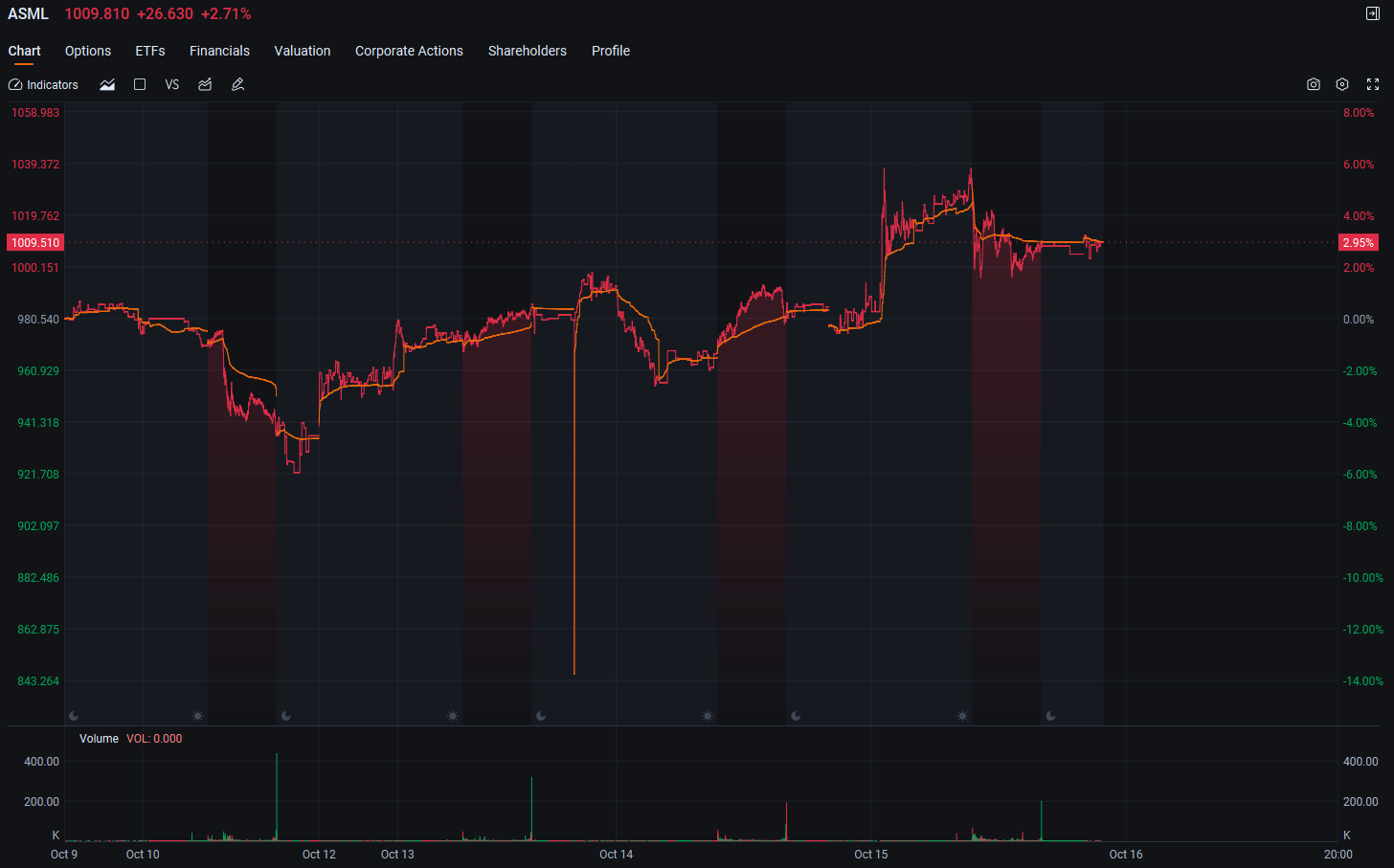
Stock price rose nearly 3% yesterday.
Overall, the earnings report was in line with expectations. Considering the industry-standard 24-month delivery cycle for ArFi (immersion lithography, DUV series) and 18-month cycle for EUV, Q3 aligns with the order cycles of Q3 2023 and Q1 2024, while peak performance from Q4 2023 and Q2 2024 will materialize next quarter.
Management’s guidance was relatively optimistic compared to Q2, projecting Q4 revenue between €9.2 billion and €9.8 billion, with a gross margin of 51%-53%, and maintaining a full-year growth rate of 15%.
After proactively lowering guidance in Q2 (Q1 guidance had a full-year growth ceiling of ~24%), ASML maintained its Q2 full-year outlook in Q3, while management shared one piece of good news and one piece of bad news:
- Good News: AI capital expenditure expectations are significantly more sustained, evident in new orders. Q3 net bookings reached €5.4 billion, slightly down QoQ but well above the industry’s €4.97 billion expectation and JPMorgan’s €3.92 billion guidance. Memory-related orders saw significant growth.
- Bad News: Management explicitly stated that demand from Chinese customers in 2026 will notably decline from a high base. This is within market expectations, with risks relatively manageable.
Detailed Earnings Analysis:
Revenue Slightly Below Expectations but Within Guidance Range
ASML’s revenue is relatively transparent, with YoY growth of 0.7% and a QoQ decline of 2.3%.
Product and revenue structures are stable, and fixed production cycles allow revenue projections, making expectations clear. Q3 revenue of €7.516 billion was slightly below the €7.68 billion consensus, but the gap was minimal.
On guidance, ASML maintained its 15% full-year growth expectation and was optimistic for Q4, projecting €9.2-9.8 billion.
At the upper end of €9.8 billion, full-year revenue would reach ~€32.7 billion, falling short of the initial €35 billion guidance but still a solid result amid U.S. geopolitical challenges.
New Orders Slightly Beat Expectations, Memory Market Cycle Lifts ASML
Q3 net bookings reached €5.4 billion, exceeding the €4.97 billion consensus.
Market expectations had been tempered by cooling enthusiasm in China, with stockpiling slowing and tariffs impacting EUV raw materials (e.g., rare earths) and demand, leading to lowered short-term forecasts.
However, AI-driven capital expenditure proved stronger than expected, particularly in the memory sector’s remarkable performance over the past six months.
JPMorgan previously noted delayed equipment orders for Samsung’s Pyeongtaek P4 factory. With P4’s completion and memory chip recovery, expected capacity releases could benefit ASML.
Order structure reflects this: Q3 end-use orders saw logic drop from 84% to 53%, while memory rose from 16% to 47%.
Consequently, fueled by rising memory chip demand, ArFi’s revenue share hit 52% in Q3, surpassing EUV for the first time since Q4 2023 and reaching a three-year high for ArFi.
The AI-driven memory market boom is a timely boost for ASML.
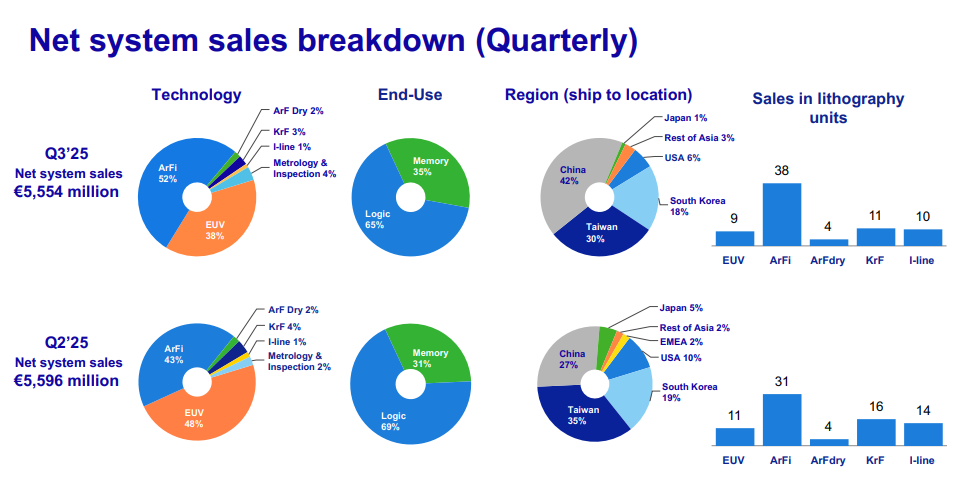
Tariffs have already raised concerns about downstream clients’ capex, and China, a key pillar of ASML’s revenue (50% in 2023, 30% over the past three quarters), is seeing declining demand for restricted products, clouding expectations.
With ASML’s market cap up 42% this year and valuations above 36x, markets were skeptical about sustaining such levels. The memory market’s positive offset has clearly provided relief.
Cost Control Outperforms, Boosting Margins Above Expectations
Beyond orders, profitability also lifted ASML’s results, with Q3 EPS slightly above consensus due to lower-than-guided expenses.
Q2 expense guidance for sales/admin and R&D was €310 million and €1.2 billion, respectively, but Q3 actuals were €303 million for sales/admin and €1.109 billion for R&D, with expense ratios at 4% and 14.8%, respectively. This freed up ~1% in gross margin, aligning with the margin beat.
Lithography Machine Prices Dip Slightly but Remain High
Q3 revenue structure showed lithography machine revenue at €5.554 billion and service revenue at €1.962 billion, accounting for 73.9% and 26.1% of total revenue, respectively, with service revenue still relatively high.
By product, EUV shipments totaled 9 units, and ArFi shipments hit 38 units, a historical high second only to Q2 2023’s 39 units.
Based on revenue structure, the average EUV price (including services) was ~€317 million, down 5.4% QoQ, and ArFi’s average price fell 3.4% QoQ, marking the first price drop after three quarters of growth, though still at elevated levels.
Additionally, the report highlighted that ASML delivered its first TWINSCAN XT:260 for advanced packaging. Per CEO Christophe Fouquet, this machine offers 4x higher production efficiency than existing solutions.
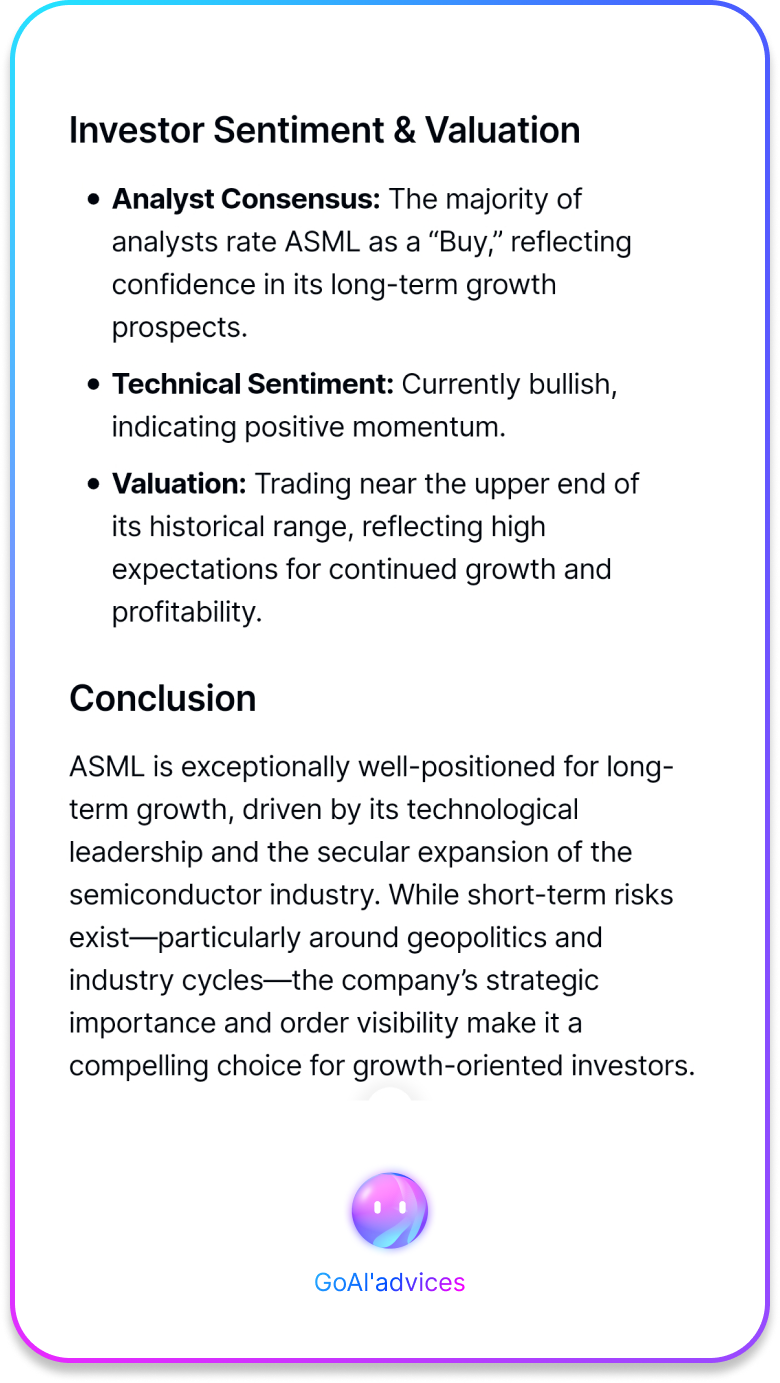
My outlook for ASML is largely aligned with GoAI: ASML, with its technological leadership and the long-term expansion trend in the semiconductor industry, is extremely well-positioned for sustained growth. Despite short-term risks, particularly from geopolitics and industry cycles, the company’s strategic importance and order visibility make it an attractive choice for growth-oriented investors.
Wall Street also remains bullish on ASML’s outlook, with Morgan Stanley and UBS raising target prices pre-earnings, citing AI chip capacity expansion as a growth driver.
Recent months saw U.S. tech giants like OpenAI, Nvidia, and Intel announce AI computing center collaborations, highlighting Silicon Valley’s intense focus on AI infrastructure. ASML’s key clients, Intel and Samsung, also show signs of performance recovery, potentially fueling ASML’s outlook.
However, markets seek clearer signals, such as Samsung securing next-gen HBM4 memory chip orders from Nvidia, which could drive a significant surge in ASML’s 2026 orders.