
Gold at $4,200: Rally or Mania?

Shearing sheep
October 16, 2025
GoGPT Summarizes Articles
Gold has done it again. The precious metal climbed above $4,200 per ounce on Wednesday, notching yet another record high. The rally continued into Thursday, with spot prices surpassing $4,240 in early Asian trading and hovering around $4,220 at the time of writing.
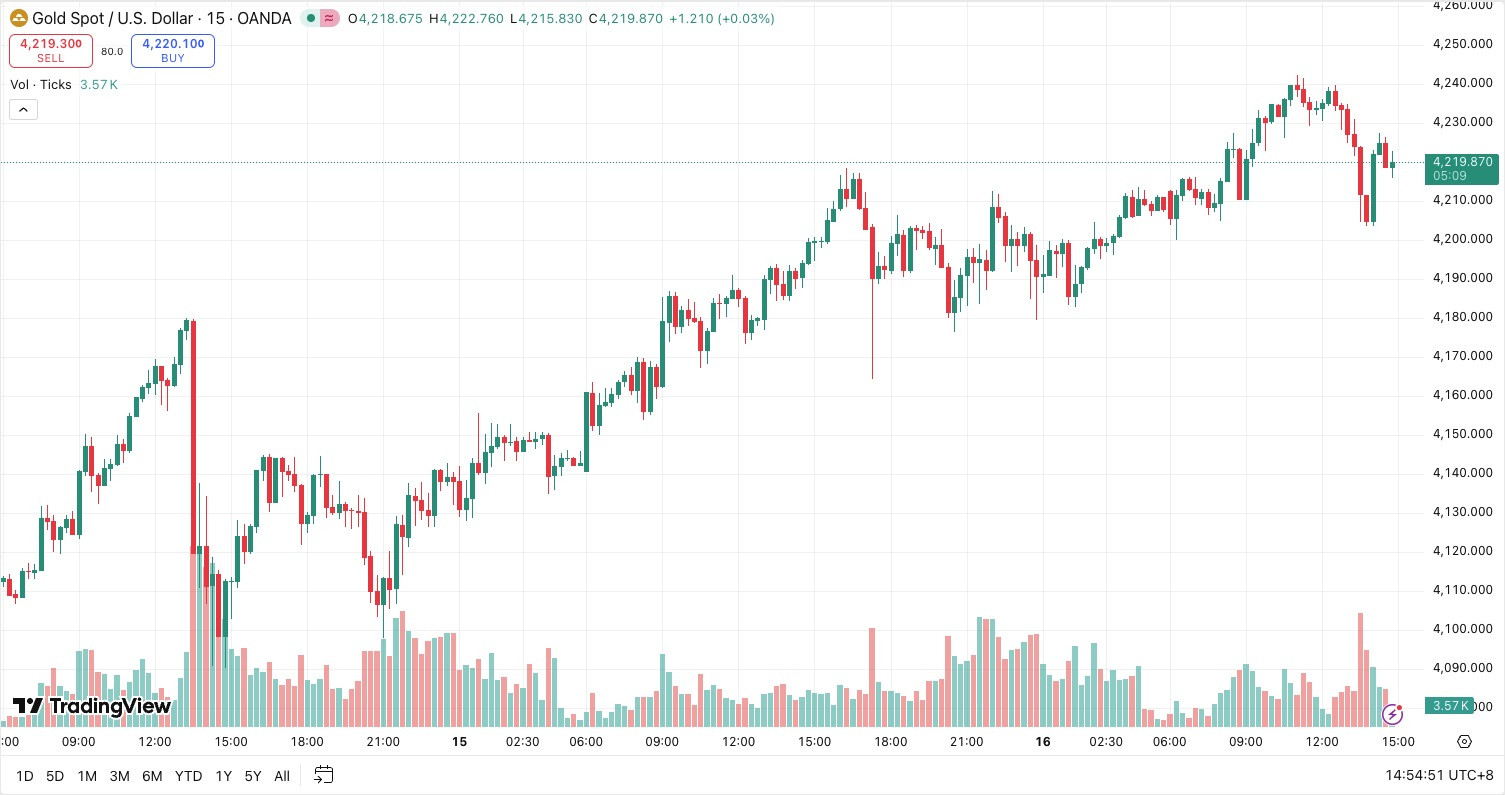
In just a month, gold has jumped nearly $600, an extraordinary pace even by the metal’s volatile standards. For some, that’s a flashing warning light.
Bank of America strategist Paul Ciana pointed out that since 1983, whenever gold has risen for seven consecutive weeks, it has tended to dip in the following month.
That pattern might repeat, but this time, several deeper factors suggest that gold’s momentum could remain intact.
The first driver is the macro backdrop.
Expectations of a Federal Reserve rate cut have grown stronger as U.S. growth cools and bond yields soften. Falling real yields make gold more attractive because the opportunity cost of holding a non-yielding asset declines.
At the same time, uncertainty over fiscal policy and the ballooning U.S. debt load have added to safe-haven demand. For global investors increasingly nervous about Washington’s policy direction, gold is serving as a kind of insurance—something that doesn’t depend on government promises or paper assets.
Another important shift is happening in global capital flows.
Analysts at JPMorgan recently made an eye-catching estimate: if foreign investors were to shift even half of their U.S. asset holdings into gold, prices could theoretically reach $6,000 per ounce.
That may sound extreme, but the point is clear—even small reallocations of large capital pools can have an outsized effect, given gold’s limited supply growth.
As more investors treat gold not as a speculative commodity but as a portfolio anchor, these structural flows could keep prices elevated for years.
Some fund managers are already positioned that way. John Merrill, founder of Tanglewood Total Wealth Management, said gold now accounts for about 12% of his portfolio, above his original 10% target, and he has no plans to trim.
Merrill doesn’t view gold as an inflation hedge—he says it’s been a poor one historically—but rather as a currency hedge and a “disaster hedge” in an era of rising sovereign debt and uncertain monetary policy.
That framing seems to resonate across institutional circles: gold is once again being treated less like a trade and more like an alternative form of money.
To be fair, not everyone is comfortable with the pace of the rally. Technical indicators are flashing “overbought,” and a short-term pullback would be entirely normal.
Even Michael Widmer, a commodities strategist at Bank of America, has warned of near-term correction risks, though he still expects gold to reach $5,000 per ounce by 2026, alongside silver at $65. The key, he argues, is that any decline will likely be gradual rather than sharp.
Analysts at Macquarie Bank share that view, adding that the broader precious metals complex—from silver to platinum—could see orderly retracements before another leg higher.
Indeed, the rally isn’t confined to gold. Since the start of the year, silver and platinum futures have surged more than 80% and 85% respectively, while palladium is up around 75%. Gold’s own year-to-date gain now exceeds 60%.
Still, compared with past bull markets, there appears to be room to run. After the 2008 financial crisis, for instance, gold prices rose by roughly 160% between 2008 and 2011, while silver skyrocketed over 400%.
That historical context matters. Today’s world may not mirror 2008, but the underlying anxiety feels similar: fiscal strain, policy uncertainty, and growing skepticism about the durability of fiat currencies.
What has changed is that gold’s role has quietly evolved—from a niche inflation hedge to a broader confidence hedge. It reflects investors’ doubts about the stability of the financial system itself, not just short-term economic cycles.
So, where does that leave us? I think gold’s long-term case remains strong, but the path forward won’t be a straight line. After such a steep rally, some cooling off seems almost inevitable.
If the Fed delays rate cuts or if the dollar rebounds sharply, gold could temporarily lose steam. But structurally, the factors driving this move—sovereign debt, policy uncertainty, and shifting capital preferences—aren’t going away anytime soon.
In my view, gold above $4,200 isn’t the end of the story. It’s the market’s way of signaling a deeper shift in how global investors perceive safety and value.
Whether that means $5,000 or even $6,000 in the next few years depends less on charts and more on trust—trust in currencies, trust in central banks, and trust in fiscal discipline.
And right now, that trust seems to be in shorter supply than gold itself.
#gold