
APAC Market Wrap - Oct 16

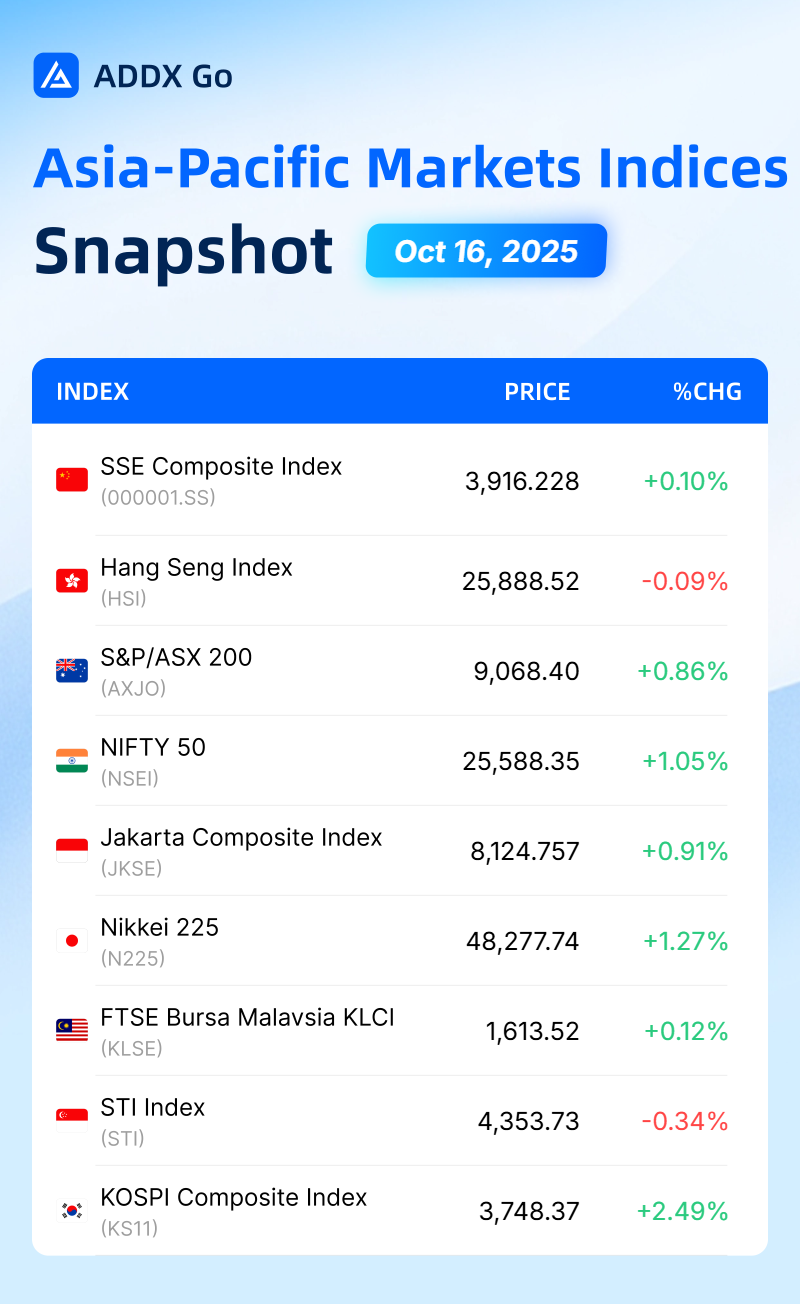
China Stock Market: At the close, the Shanghai Composite rose 0.1%, the Shenzhen Component fell 0.25%, and the ChiNext Index gained 0.38%.
By sector, coal, insurance, and port shipping led gains, while precious metals, semiconductors, and wind power saw the largest declines.
Hong Kong Stock Market: Hong Kong’s three major indices showed mixed performance. At the close, the Hang Seng Index fell 0.09% to 25,888.51 points, the Tech Index dropped 1.18% to 6,003.56 points, and the H-share Index rose 0.09% to 9,259.46 points.
On the market, pharmaceuticals, coal, and consumer electronics bucked the trend with gains, while semiconductors and gold stocks saw slight pullbacks.
Japan Stock Market: Japanese stocks climbed on Thursday as investors welcomed the International Monetary Fund’s backing of the Bank of Japan’s current dovish stance and looked past escalating US-China trade tensions.
The Nikkei 225 rose 434.77 points or 0.9% to open at 48,107.44.
By industry, information & communication, nonferrous metals, power & gas, and precision instruments rose, while other products, insurance, wholesale, services, and steel saw significant declines.
South Korea Stock Market: The KOSPI rose 2.49%.
By sector, electrical products, autos, chemicals, semiconductors, and conglomerates surged, while nonferrous metals, leisure equipment, biotechnology, furniture, and food declined.
Australia Stock Market: The S&P/ASX 200 rose 0.86% to 9,068.40 points.
Diversified financials, capital markets, and industrial distribution saw strong gains, while industrial products, aerospace, autos & parts, and waste management posted larger declines.
Singapore Stock Market: The Straits Times Index fell 0.37% to 4,352.27 points. Education, waste management, and tourism & leisure rose sharply, while forestry products, autos & parts, and non-alcoholic beverages saw larger declines.
Malaysia Stock Market: The FTSE Malaysia KLCI rose 0.05% to 1,612.29 points. Technology, communication & media, and consumer goods & services rose, while construction, real estate investment, and commercial trusts declined.
Key Events
G20 Risk Regulator Warns: “Significant Gaps” in Global Crypto Regulation
On Thursday, the G20’s risk regulator warned that “significant gaps” in regulating the fast-evolving cryptocurrency market could harm financial stability.
The Financial Stability Board (FSB), established post-global financial crisis, proposed crypto regulation recommendations in 2023 to integrate the market into mainstream financial frameworks.
In Thursday’s assessment report, the FSB noted that while regulatory progress has been made, international implementation and coordination remain “fragmented, inconsistent, and insufficient to address the global nature of crypto asset markets.”
Citigroup: Singapore October Private Home Sales Likely to Rebound from September Slump
Citigroup Research’s Brandon Lee stated in a report that Singapore’s October private home sales are expected to recover from September’s sharp decline.
Data shows September private home sales (excluding executive condominiums) by developers were 255 units, down 88% MoM, likely due to limited new project supply. However, a surge in new launches in October could support sales.
Binance Completes Acquisition of South Korean Crypto Exchange GOPAX
South Korean authorities announced on Thursday that Binance, the world’s leading cryptocurrency exchange, completed its acquisition of GOPAX, marking its first step into South Korea’s digital asset market.
The Financial Intelligence Unit (FIU) under South Korea’s Financial Services Commission approved the acquisition on Wednesday. GOPAX is South Korea’s fifth-largest crypto exchange.
South Korea: Forex Discrepancies with US in Tariff Talks Have Narrowed
South Korea’s Industry Minister Kim Jung-kwan said discrepancies with the US on forex markets in tariff negotiations have significantly narrowed.
Kim made the remarks before departing for Washington from Incheon Airport for further talks. Presidential Policy Chief Kim Yong-beom also expressed optimism about the negotiations.
Institutional Views
ANZ forecasts spot gold reaching $4,400 by the end of 2025 and peaking at $4,600 by June 2026. As the Fed ends its easing cycle, gold’s gains may slow in H2 2026.
Spot silver is expected to peak at $57.50 by June 2026. Growing concerns over Fed independence, political uncertainty, trade tensions, geopolitical risks, and rising debt will sustain strategic interest in gold.
ANZ warns that a hawkish Fed stance or stronger-than-expected US growth could pose downside risks.
Over the past month, gold rose ~15% with pullbacks under 2%, reflecting strong demand from institutional and retail investors. As concerns grow over US stock overvaluations and potential tech bubbles, gold is becoming a core part of diversified portfolios.
Assiri noted: “While these concerns may be overstated, the perception alone supports gold as a safe haven for investor anxiety.”
Barclays expects US economic growth to average ~2% QoQ from Q3 2025 to Q3 2026, reflecting steady expansion but a slower pace as fiscal stimulus fades and trade frictions persist.
The bank said recent tariffs will have a “chronic drag” on economic activity, with most firms expected to gradually pass on higher import costs rather than trigger immediate price spikes.
Gold prices continue to strengthen. China Post Securities’ chief analyst for nonferrous new materials, Li Shuaihua, said three short-term factors drive gold’s rise: first, the Fed’s September rate cut unleashed liquidity, attracting trading capital to gold; second, escalating global geopolitical conflicts boosted safe-haven sentiment; third, central banks’ accelerated reserve diversification to hedge dollar credit risks increased gold ETF holdings.
The US government shutdown further fueled market safe-haven demand.