
APAC Market Wrap - Oct 17

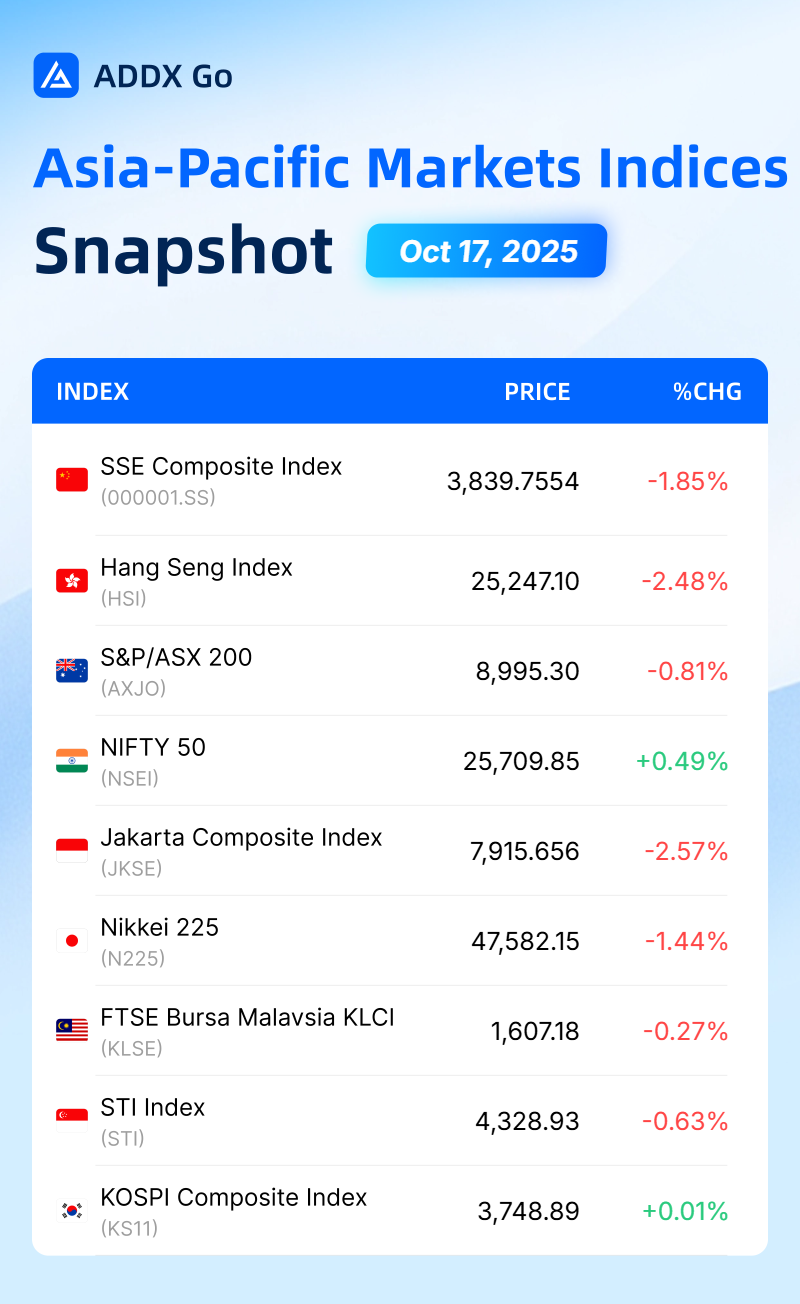
China Stock Market: At the close, the Shanghai Composite fell 1.95%, the Shenzhen Component dropped 3.04%, and the ChiNext Index declined 3.36%.
By sector, precious metals and gas led gains, while power grids, photovoltaics, wind power, and controllable nuclear fusion saw the largest declines.
Hong Kong Stock Market: This week, Hong Kong’s three major indices continued to weaken.
At the close, the Hang Seng Index fell 3.97% cumulatively to 25,247.10 points, the Tech Index dropped 7.98% to 5,760.38 points, and the H-share Index declined 3.70% to 9,011.97 points.
Today, the three indices remained in correction mode, closing down 2.48%, 4.05%, and 2.67%, respectively.
On the market, semiconductors, internet tech, and pharmaceuticals weakened, while bank stocks saw slight gains.
Japan Stock Market:The Nikkei 225 fell 1.44% after three trading days, closing at 47,582.15 yen, down 695.59 yen from the previous day.
By industry, seven sectors, including other products, food, and fisheries & agriculture, rose, while 26 sectors, including insurance, banking, securities & commodity futures, and power & gas, declined.
South Korea Stock Market: The KOSPI edged up 0.01%. By sector, utilities, electrical products, chemicals, and construction products surged, while nonferrous metals, life insurance, construction, communication equipment, and property insurance fell.
Australia Stock Market: The S&P/ASX 200 fell 0.81% to 8,995.30 points. Alcoholic beverages, packaging & containers, and pharmaceutical manufacturers saw strong gains, while aerospace, diversified financials, insurance, and apparel posted larger declines.
Singapore Stock Market: The Straits Times Index fell 0.63% to 4,328.93 points. Education, waste management, and tourism & leisure surged, while forestry products, autos & parts, and non-alcoholic beverages saw larger declines.
Malaysia Stock Market: The FTSE Malaysia KLCI rose 0.05% to 1,612.29 points. Medical distribution, medical services, apparel, and furniture rose, while software, asset management, and diversified media declined.
Key Events
Bank of Japan Deputy Governor: Rate Hikes to Continue if Economy Meets Expectations
On Friday, Bank of Japan Deputy Governor Shinichi Uchida said the BOJ will continue raising rates if economic and price trends align with expectations. He reiterated the bank’s stance of carefully analyzing data for policy decisions.
Echoing earlier comments this month, Uchida noted that despite US tariffs pressuring Japan’s exports, improving business sentiment suggests conditions for further rate hikes are forming.
“If our economic and price forecasts materialize, we will continue raising rates based on improvements in economic and price conditions,” Uchida said. “We will assess whether our forecasts hold without preconceptions, closely monitoring domestic and global economic, price, and financial market developments.”
Sources: Japan’s Q4 Aluminum Talks Drag On
Three sources directly involved in negotiations revealed that quarterly pricing talks between Japanese aluminum buyers and global producers are unusually protracted, with both sides struggling to bridge a significant gap for primary metal shipments from October to December. Japan, Asia’s top importer of the metal, pays a premium over the London Metal Exchange (LME) spot price each quarter, setting the regional benchmark.
Starbucks Evaluates Bids for China Business, Valued Over $10 Billion
Starbucks is reviewing bids from five potential partners to bring in a strategic partner for its China operations to address intensifying market competition. A company spokesperson said: “We’ve received strong interest from multiple high-quality partners who share our confidence in Starbucks’ long-term growth potential in China.”
The five bidders have submitted preliminary offers, and Starbucks is evaluating them. The deal is expected to exceed $10 billion, including brand licensing fees, upfront investments by potential partners, and Starbucks’ retained stake in its China business. The news was first reported by the Financial Times.
Starbucks views China as one of its most important overseas markets but faces fierce competition from local brands. Chains like Luckin Coffee have rapidly expanded, leveraging low prices and convenience to attract young consumers, forcing Starbucks to accelerate digitalization and product innovation.
US Beef Prices Hit Record High
As US beef prices reached a record high, on Friday Eastern Time, President Trump said his administration is working to lower domestic beef prices.
“We’re addressing the beef issue, and I think we’ve reached an agreement on beef,” Trump told reporters at the White House.
“Beef is the only product we’d say is slightly or even overly expensive, but its price will come down soon. We’ve done some things; we’ve worked some magic.” He provided no further details.
Institutional Views
In a commodity outlook report, HSBC said gold’s upward momentum is expected to persist into 2026, driven by strong central bank buying, US fiscal concerns, and expectations of further monetary easing. The report highlights robust investor sentiment and sustained official diversification as key supports.
Structural and macro factors will drive gold’s rally into 2026, with US fiscal deficits as a major demand driver. Investors increasingly view gold as a hedge against debt sustainability risks and potential dollar weakness.
HSBC expects central bank gold buying, especially by emerging markets, to remain high, with ongoing accumulation unlikely to slow amid geopolitical fragmentation and reduced dollar reliance. However, HSBC warns that fewer-than-expected Fed rate cuts could hinder gold’s trajectory.
ANZ analysts said gold’s rally is expected to continue in the coming months, as the metal serves as both a “risk hedge” and a “strategic asset.” However, the strong rally may face short-term pullbacks. “While this rally is often compared to the 1980s gold peak, it is more structurally driven, meaning high prices may persist longer,” analysts noted.
ANZ forecasts gold reaching $4,400/oz by year-end and peaking at $4,600 by June 2026. However, as the Fed ends its easing cycle and US growth and trade tariff outlooks clarify, gold prices may see modest pullbacks in H2 2026.
UBS Global Emerging Markets Equity Chief Strategist Sunil Tirumalai recently stated that UBS continues to assign an overweight rating to Chinese stocks within emerging markets, favoring them over Indian stocks.
Analysts from JPMorgan and Goldman Sachs estimate that US initial jobless claims likely fell last week, though many remain unemployed due to weak hiring. They project seasonally adjusted claims for the week ending October 11 dropped to 217,000 from 235,000 the prior week.
The results showed: “Most respondents believe the Fed’s monetary policy independence is likely to be materially weakened.” Of those, 41% said it was “somewhat likely,” and 21% said “very likely.” When asked about potential impacts, respondents broadly expected lower Fed benchmark rates, faster GDP growth, rising financial asset prices, and sustained higher inflation.