
Fear Gauge Surges: Is the U.S. Stock Market’s Calm Period Over?

With renewed trade war threats, a string of regional bank loan defaults, and growing skepticism about the AI bubble, the U.S. stock market has entered its most turbulent phase since April, driven by multiple uncertainties. The sharp volatility has left investors on edge, and the once-hot trades are now facing risks…
From a weekly perspective, despite sharp declines last Friday, the three major U.S. indices closed higher this week, with the S&P 500 still near its all-time high. However, the abrupt end to one of the calmest market periods in years has left traders uneasy, with many betting that volatility may persist.
In this context, one of the biggest winners appears to be the Cboe Volatility Index (VIX). Known as the “fear gauge” for U.S. stocks, the VIX measures implied volatility of S&P 500 options, reflecting market expectations for volatility over the next 30 days. When market fear spikes, traders typically pay higher premiums for options to protect portfolios, causing the VIX to surge during market sell-offs.
On Friday, the VIX hit an intraday high of 28.99, its highest since late April. Although it settled around 20 at close, it remained at a rare high for the year.
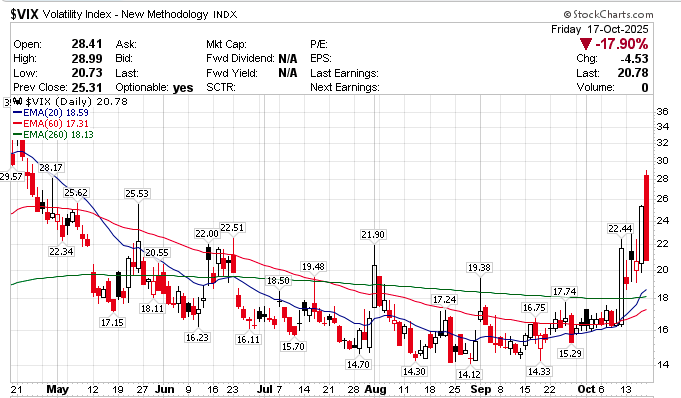
Meanwhile, Cboe Global Markets data shows investors are heavily buying options contracts that would profit if the VIX surges to 47.5 or 50.
Jordan Rizzuto, Chief Investment Officer at GammaRoad Capital Partners, noted, “The market’s worry list is actually growing. In this environment, we should expect higher stock market volatility.”
U.S. Stock Volatility Awakens
Clearly, the resurgence of stock market volatility comes as investor sentiment is highly tense: recent plunges in regional bank stocks have sparked concerns in the credit market, the U.S. economy may be weaker than it appears, and renewed trade war threats could lead to a recession.
Some investors are also questioning the rationality of the frenzy over AI-related stocks, which drove markets from April lows to record highs.
A week ago, when Trump threatened new tariffs, U.S. stocks were on track for record levels. However, his social media post triggered the worst single-day drop since April, ending the S&P 500’s streak of 33 consecutive trading days without a daily move exceeding 1%—the longest calm period since January 2020.
Trade frictions led to continued sharp market swings this week, even after strong earnings from major banks like JPMorgan and Bank of America signaled economic resilience.
On Thursday, Zions Bancorp disclosed significant bad debt losses and fraud allegations against a borrower group linked to multiple lenders, further fueling a sharp drop in the regional banking sector—already hit by high-profile bankruptcies of auto supplier First Brands and auto finance company Tricolor.
Although many analysts suggest the issues in regional bank loan portfolios appear isolated, and tax cuts and deregulation could further boost corporate finances, a defensive sector rotation is clearly underway amid the sudden surge in volatility:
While banks and energy firms have been the worst-performing S&P 500 sectors in October, relatively stable, high-dividend sectors like utilities, healthcare, and consumer staples have led the market.
Meanwhile, some high-risk investments took heavy hits. Bitcoin prices fell ~8.7% this week, marking its worst weekly performance since February. Opendoor Technologies, a hyped-up meme stock earlier this year, also plunged 5.4%.
How Wall Street Sees It
As a turbulent week ends, some industry insiders believe the recent market dip doesn’t necessarily signal a prolonged sell-off—after such a sharp rally, this correction may even be welcome.
Matt Wittmer, portfolio manager at Allspring Global Investments, said his firm remains overweight in financials like JPMorgan and Citigroup, maintaining positions largely unchanged during the recent nerve-racking market moves.
“When events like this happen, I think it’s healthy. It shows the market isn’t getting too far ahead of itself,” Wittmer said.
However, many market participants worry the market is particularly vulnerable—earlier this year’s sustained rally has significantly inflated valuations, pushing the largest large-cap stocks to historic highs.
They also fear that sharp volatility could gradually expose issues masked during the market’s prolonged calm.
GammaRoad’s Rizzuto noted that the current high valuations and concentrated gains in tech giants are reminiscent of past speculative periods, like the late 1990s dot-com bubble, which ended in market crashes.
“This isn’t a prediction that history will repeat, but the similarities are striking,” Rizzuto emphasized.
Regarding the SPY (S&P 500 ETF), as shown in the finance card above, its current price is $664.39, reflecting a 0.56% increase from the previous day’s close of $660.64, with intraday highs of $665.755 and lows of $658.14. The year-to-date performance shows a significant rise, consistent with the broader market’s strength earlier this year, though recent volatility underscores the shifting dynamics described.