
Why U.S. Markets Feel Fragile and What Investors Can Do

This morning, U.S. equity futures were on a rollercoaster. S&P 500 futures fell as much as 1.4% and Nasdaq 100 futures dropped around 1.6% before bouncing back. Elevated tech valuations and narrow market participation are making the market increasingly fragile. In this piece, we’ll explore what’s driving the volatility and offer some practical ideas for investors.
Fed Comments and Government Shutdown Risks Shake Markets
Federal Reserve Governor Christopher Waller, long seen as a dovish voice, recently sounded more hawkish, raising concerns about sustained rate hikes. At the same time, the possibility of a U.S. government shutdown continues to loom, feeding investor caution.
Put simply, higher interest rates plus fiscal uncertainty make the market feel like a tightly stretched string—any small tug can trigger a shock.
Regional Banks Face Renewed Pressure
In recent days, some U.S. regional banks have seen their shares drop sharply, reviving memories of the Silicon Valley Bank collapse. Two banks disclosed loan issues linked to alleged fraud, reminding investors of the fragility in certain pockets of credit.
For context, regional banks are smaller, have concentrated client bases, and less capital flexibility than larger banks. When trouble hits, markets often overreact because investors fear localized problems could spread quickly.
U.S.-China Tensions Keep Markets on Edge
Trade frictions continue to worry investors. Micron recently announced plans to halt server-chip shipments to Chinese data centers, directly affecting its share price. Expectations that the upcoming APEC summit might ease tensions have dimmed.

Yet, there was a surprising twist. President Trump stated in an interview that high tariffs on Chinese goods are “unsustainable” and expects to meet President Xi in two weeks. The news quickly lifted futures, highlighting just how sensitive markets are to macro headlines.
AI Sector Sentiment Adjusts
TSMC raised revenue guidance on strong AI demand, but profit-taking followed. Importantly, there was no clear timeline for CoWoS packaging expansion, a key step in high-end AI chips, prompting caution about the pace of AI infrastructure growth.
On the consumer side, Deutsche Bank notes that paid ChatGPT subscriptions in Europe have stalled since May. The message is clear: technology has massive potential, but monetization paths remain uncertain. Think of AI as a $500 billion potential giant—it could reshape industries, but how to turn that into sustainable profits is still evolving.
High Valuations and Market Narrowness Are Core Issues
Current valuations remain high:
-
The Magnificent Seven tech giants trade at forward P/E of around 30
-
S&P 500 at roughly 22
-
S&P 400 mid-caps at 15.7
-
S&P 600 small-caps at 14.9
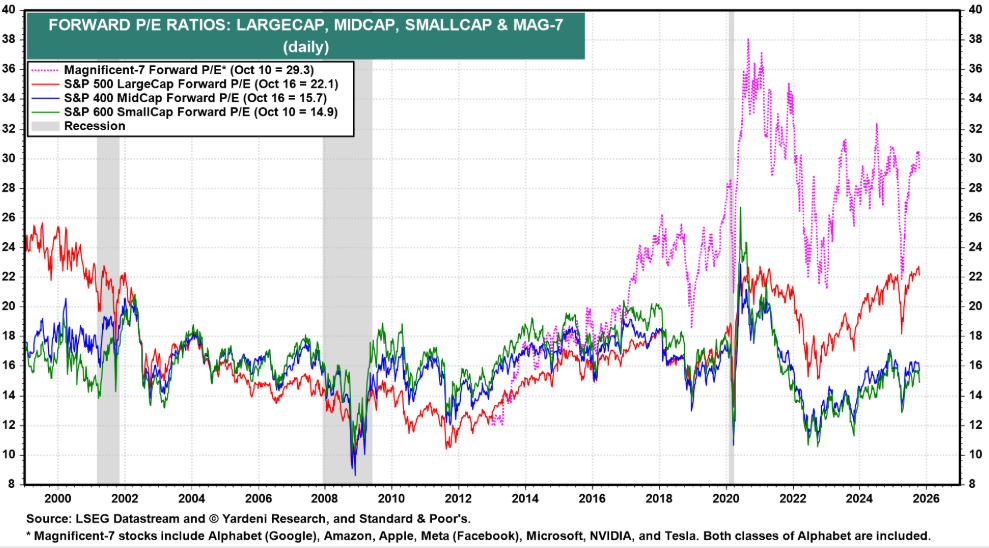
High valuations reflect optimistic growth expectations and amplify downside risk.
Market breadth is also weak. Since April’s rebound, AI leaders have outperformed while many other sectors lag. Only about 40% of S&P 500 constituents are above their 50-day moving averages. In other words, a few leaders are holding up the index, while most stocks could drag it down in a downturn.
What Investors Can Do
Rotate Into Non-AI Opportunities
Look for sectors with improving earnings trends and reasonable valuations, such as certain industrials, consumer discretionary, or med-tech sub-sectors. A simple screening approach:
-
EPS revision momentum: recent upgrades or outperformance
-
Valuation percentile: below historical or peer median
Control Risk While Staying Long AI
If you remain bullish on AI but want to manage volatility:
-
Index ETF puts or put spreads: predefined cost downside protection
-
Stock collar: hold shares, sell calls, buy puts—limits extreme losses while retaining upside exposure
Conclusion
Market fragility is the result of overlapping forces: macroeconomic pressure, policy uncertainty, trade tensions, AI sector dynamics, and high valuations.
For investors, understanding fragility matters more than trying to predict every swing. In the short term, volatility is inevitable. But with sector rotation and disciplined risk management, it’s possible to protect yourself while staying exposed to long-term opportunities.
Markets are like a turbulent river—you can’t control the current, but you can steer your boat.