
APAC Market Wrap - Oct 20

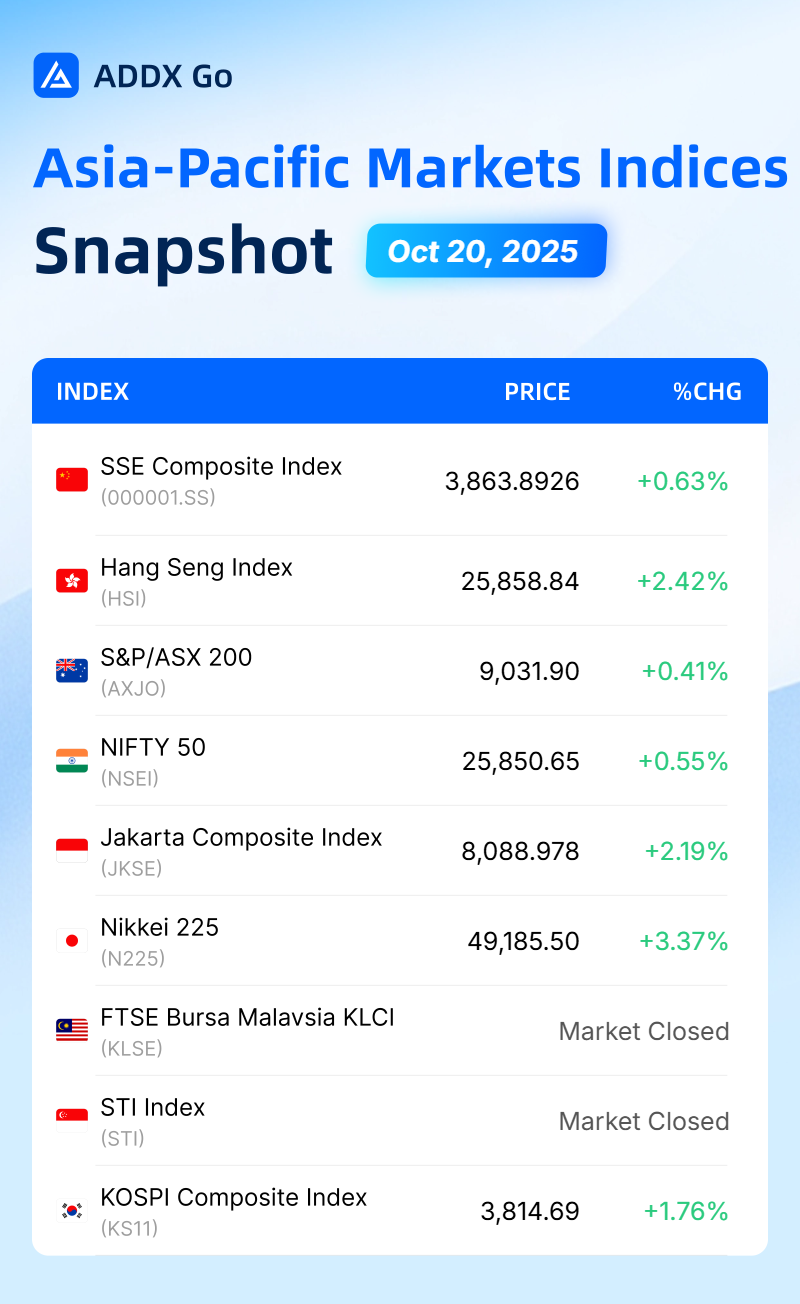
China Stock Market: At the close, the Shanghai Composite rose 0.63%, the Shenzhen Component gained 0.98%, and the ChiNext Index climbed 1.98%.
By sector, lab-grown diamonds, coal, and gas led gains, while nonferrous metals saw the largest declines.
Hong Kong Stock Market: Boosted by warming market sentiment, Hong Kong’s three major indices rebounded collectively. At the close, the Hang Seng Index rose 2.42% to 25,858.83 points, the Tech Index gained 3% to 5,933.17 points, and the H-share Index increased 2.45% to 9,232.67 points.
Market performance showed strength in internet tech, coal, pharmaceuticals, and semiconductors, with slight pullbacks in gold and wind power stocks.
Japan Stock Market: Japanese shares soared on Monday ahead of a vote to choose the country’s next prime minister, while easing US-China trade tensions lifted investor sentiment.
The Nikkei 225 rose 3.37%, or 1,603.35 points, to end at 49,185.50.
By sector, banking, information & communication, and electrical equipment saw significant gains.
South Korea Stock Market: The KOSPI rose 1.76%. By sector, electronics, aerospace, electrical equipment, and diversified consumer services surged, while shipping, trading companies, utilities, and energy equipment & services declined.
Australia Stock Market: The S&P/ASX 200 rose 0.41% to 9,031.900 points. Credit services, commercial services, furniture, and banking saw modest gains, while semiconductors, apparel, industrial distribution, and education posted larger declines.
Singapore Stock Market: Closed today.
Malaysia Stock Market: Closed today.
Key Events
Australia Aims to Be US Solution to China’s Rare Earth Restrictions
As the U.S. and other nations push to diversify critical mineral supply chains, Australian Prime Minister Anthony Albanese will meet President Donald Trump on Monday at around 11 a.m. Washington time.
The meeting’s core goal is to secure a critical minerals cooperation agreement with the U.S. Additionally, Albanese is expected to seek U.S. commitment to continue fulfilling the AUKUS agreement, under which the U.S. will assist in providing nuclear submarines to Australia.
Vietnam Stock Market Sees Largest Drop in Six Months Amid Corporate Bond Violations
Impacted by regulatory findings on bond issuance violations, Vietnam’s stock market fell sharply on Monday, marking its largest single-day drop since April.
The VN Index plummeted up to 5.6%, the biggest decline since April 22. Real estate and banking stocks led losses, including heavyweights like Vingroup, Vinhomes, and Vietcombank.
On Friday, Vietnam’s Government Inspectorate released findings on 67 bond-issuing companies (including five banks), highlighting “multiple violations,” such as misuse of raised funds, inadequate disclosures, poor capital management, delayed principal/interest payments, and premature project sales.
Trading Stocks During Commutes! Korea’s “12-Hour Trading” Platform Addicts Investors
South Korea’s alternative stock trading platform Nextrade, launched in March, has captured nearly one-third of the country’s daily $2.4 trillion stock trading volume in just over six months, highlighting explosive demand for “round-the-clock” trading.
Data shows Nextrade, leveraging extended trading hours and lower fees, accounted for nearly 30% of Korea’s stock market turnover last month, up from under 4% at its March debut. Popular stocks like Doosan Energy now see higher trading volumes on Nextrade than on the 70-year-old Korea Exchange.
Trump Issues “Tariff Ultimatum” to India: Buy Russian Oil, Face Huge Tariffs!
Last week, President Trump claimed Indian Prime Minister Modi promised to reduce Russian oil purchases. However, India’s Foreign Ministry response and actual procurement data contradicted Trump’s claim.
On Sunday Eastern Time, Trump reiterated that Modi assured him India would stop buying Russian oil, warning that failure to comply would result in India facing “huge” tariffs.
Institutional Views
Deutsche Bank: Gold’s Share in Global Reserves Rises to 30%
Deutsche Bank’s latest report shows gold’s share in global “foreign exchange and gold” reserves has risen to 30%, while the dollar’s share dropped from 43% to 40%. Analysts note that for gold to match the dollar’s share, with current holdings unchanged, gold prices would need to rise to ~$5,790 per ounce.
CICC: Recent U.S. Bank Failures Don’t Pose Systemic Financial Risk
CICC’s report states that the recent risks at two U.S. banks, in terms of scale and severity, are less significant than prior incidents and reflect localized credit risk events rather than systemic threats. However, these events highlight rising credit risks in a high-interest-rate environment.
A decline in credit market risk appetite and tighter lending conditions could lead to further liquidity tightening, though likely mild unless clear recession signals emerge.
Western Securities: Gold’s “Golden Era,” Long-Term Bull Market Ahead
Western Securities strategist Cao Liulong wrote that while gold prices keep hitting record highs, market opinions remain divided, with some warning of crowded trades and short-term overbought risks. However, central bank gold buying is the biggest driver of sustained highs.
After the Bretton Woods collapse in the 1970s, the U.S. established the “petrodollar” system by the early 1980s, leveraging its industrial strength and global dominance. Today, with U.S. manufacturing hollowed out, a collapse of the petrodollar system would likely leave no single reserve currency, potentially ushering in a long-term gold bull market.
Huatai Securities: U.S. Banking Sector Faces Long-Term Consolidation Pressure
Huatai Securities’ report notes that recent credit risk events at two U.S. regional banks have sparked market volatility. The rapid expansion of the U.S. private credit market and ongoing issues with commercial real estate loan quality deserve attention.
However, with healthy corporate cash flows, ample bank liquidity, and limited exposure to troubled assets, systemic credit risk spread is manageable. In the medium to long term, the large number of U.S. small and mid-sized banks, facing rising deposit costs and homogeneous competition, may see higher asset quality risks, with their business models challenged. Long-term, the U.S. banking sector faces consolidation pressure.