
The Fed Payments Innovation Conference Signals Big Opportunities for Blockchain and Crypto Stocks

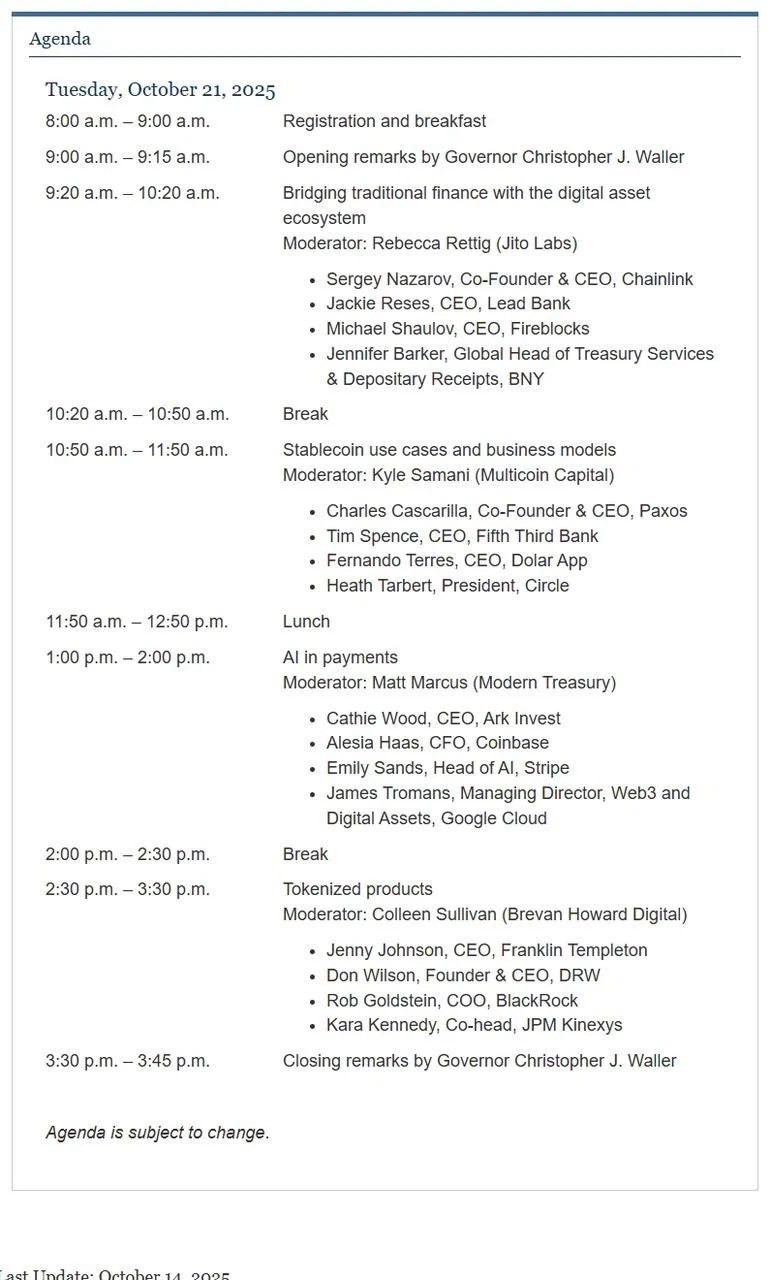
On October 21, 2025, the Federal Reserve will host the Payments Innovation Conference in Washington, D.C., bringing together leading voices in finance and cryptocurrency.

The agenda spans stablecoins, AI in payments, asset tokenization, and the convergence of traditional finance (TradFi) and decentralized finance (DeFi). Investors are watching closely: this could be the moment when regulatory clarity and technological innovation unlock the next wave of upside for U.S. crypto-linked stocks.
Conference Highlights and Themes
Fed Governor Christopher Waller will open and close the event, emphasizing the role of innovation in meeting evolving consumer and business payment needs. Panels will cover bridging traditional and digital finance, real-world applications of stablecoins, AI-driven payment tools, and tokenized products. Speakers come from Circle, Coinbase, Chainlink, Ark Invest, BlackRock, and JPMorgan, reflecting both established financial institutions and crypto-native companies.
Waller recently said, “Innovation in payments has always been driven by changing consumer and business demands. We want to explore how new technologies can improve safety and efficiency, and hear from those shaping the future of payments.”
Regulatory Context and Implications
The conference serves as a platform for aligning policy and industry priorities following the July enactment of the GENIUS Act, which defined stablecoin issuers, reserve requirements, and redemption protocols. With the basic framework set, regulatory attention now focuses on three priorities: granular risk management, integration with existing clearing systems like FedNow and RTP, and creating a supervised, competitive partnership between compliant stablecoins and the banking system—without expanding government control.
Waller has emphasized private-sector-led innovation to reduce payment costs, signaling a focus on efficiency while treating central bank digital currencies (CBDCs) cautiously. Forward-looking guidance on 2026 rules and supervisory philosophy will likely shape the landscape for crypto finance.
Industry-wise, the most immediate beneficiaries will be compliant stablecoin issuers, custody and auditing providers, compliance and risk management services, and banks or card networks experimenting with tokenized settlements. Short-term, stablecoins could speed up cross-border B2B and merchant transactions, narrowing gaps in cost and speed compared to traditional systems. Medium-term outcomes depend on clarity around redemption, reserve composition (cash or Treasuries), banking involvement, and master account access. Banks face potential revenue pressure from high-quality reserves drawing deposits, but tokenized deposits and on-chain settlements can mitigate risks.
Crypto-native firms face higher compliance costs but could benefit from market premiums for regulatory-compliant operations. Investors should watch for signals on interoperability standards, cross-border recognition, systemic monitoring, and the adoption of AI-driven risk controls and anti-money laundering as core infrastructure.
Stocks Positioned to Benefit
If the conference confirms the role of stablecoins in mainstream finance, it could accelerate real-world asset (RWA) tokenization and AI-driven efficiencies, indirectly supporting crypto-related equities. Positive regulatory signals may boost the narrative around “on-chain collateral” and institutional digital asset treasuries (DATs) on Ethereum and Bitcoin.
Key U.S.-listed stocks tied to these themes include:
• Stablecoin-related: $Circle(CRCL.US)$
• Crypto exchanges: $Coinbase(COIN.US)$, $Robinhood(HOOD.US)$, $Bullish(BLSH.US)$, $Gemini Space Station(GEMI.US)$
• RWA platforms: $Figure Technology Solutions(FIGR.US)$
• Bitcoin holders: $Strategy(MSTR.US)$, $Cantor Equity Partners Inc(CEP.US)$, $Trump Media & Technology(DJT.US)$
• Ethereum holders: $Bitmine Immersion Technologies(BMNR.US)$, $SharpLink Gaming(SBET.US)$, $Dynamix(ETHM.US)$
• Solana holders: $Upexi(UPXI.US)$, $Sharps Technology(STSS.US)$, $DeFi Development(DFDV.US)$
• Binance holders: $CEA Industries(BNC.US)$, $Windtree Therapeutics(WINT.US)$, $Nano Labs(NA.US)$
• HYPE holders: $Sonnet BioTherapeutic(SONN.US)$, $Galaxy Digital(GLXY.US)$, $Hyperion DeFi(HYPD.US)$
• WLFI holders: $ALT5 Sigma(ALTS.US)$
• XRP holders: $MicroBuss$, $VivoPower(VVPR.US)$, $Galaxy Digital(GLXY.US)$
• Dogecoin holders: $Bit Origin(BTOG.US)$
Mordor Intelligence forecasts that the tokenized assets market will surpass $2 trillion by 2025 and could exceed $13 trillion by 2030. While funding fragility and external shocks remain concerns, the collaborative approach between regulators and industry suggests the opportunities in reshaping the U.S. payments system outweigh the risks.
Investment Insights and Analysis
1. Policy signals drive market reaction: Clear guidance from the Fed and emphasis on private-sector-led stablecoin adoption could support early movers and compliance-focused platforms.
2. AI and tokenization improve efficiency: Firms leveraging AI for payment risk management and cross-border settlements are likely to capture value as transaction speed and cost become competitive differentiators.
3. Risk management remains critical: Reserve composition, compliance costs, and redemption rules will continue to influence volatility. Investors need to balance short-term swings with long-term structural trends.
4. Cross-market synergies: Stablecoin issuers, RWA platforms, and crypto holders may see correlated upside if regulatory clarity and market adoption advance, creating multiple pathways for growth.
In short, the Payments Innovation Conference offers both a regulatory and technological compass for investors assessing the U.S. digital finance ecosystem. Understanding sector-specific logic and policy direction will be key to identifying structural opportunities amid market volatility.