
Tesla Q3 Earnings Preview: Can AI and Robotaxis Offset Margin Pressure?

Shearing sheep
October 22, 2025
GoGPT Summarizes Articles
Tesla ($TSLA) is set to report its third-quarter 2025 earnings after the market closes on Wednesday, and it’s shaping up to be one of the most closely watched moments of the earnings season. As the first of the “Magnificent 7” tech giants to release results, Tesla’s performance could set the tone not just for the EV industry, but also for investor sentiment across the broader technology and innovation space.
Yet this time, the story is less about cars and more about what comes next — artificial intelligence, robotaxis, and the push toward becoming a full-fledged robotics company. Let’s take a detailed look at what to expect, what’s at stake, and how Tesla’s results could reshape its narrative going into 2026.
A Quarter of Records — and Red Flags
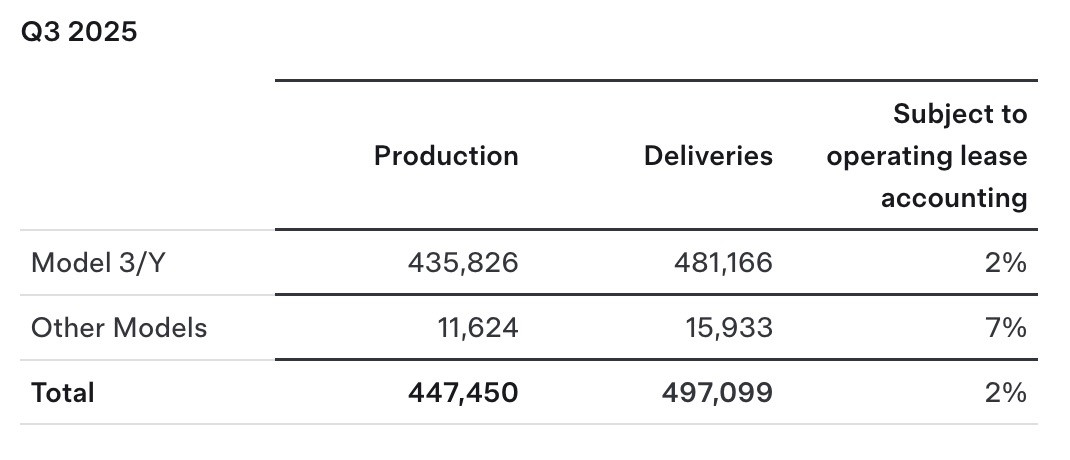
On the surface, Tesla looks like it’s firing on all cylinders. The company reported record vehicle deliveries of 497,099 units in Q3, outpacing consensus estimates and surpassing its own production of 447,450 vehicles. Revenue is expected to land between $26.1 and $26.6 billion, up about 4–6% year-over-year, marking a modest recovery after several quarters of slower growth.
But behind that top-line growth is a more complicated story. Analysts expect Tesla’s earnings per share to fall sharply to around $0.56, down roughly 22% from $0.72 a year ago. The problem isn’t demand — it’s profitability. Tesla has been cutting prices aggressively across its Model Y and Model 3 lineup to maintain sales momentum, and those price reductions have eaten into margins.
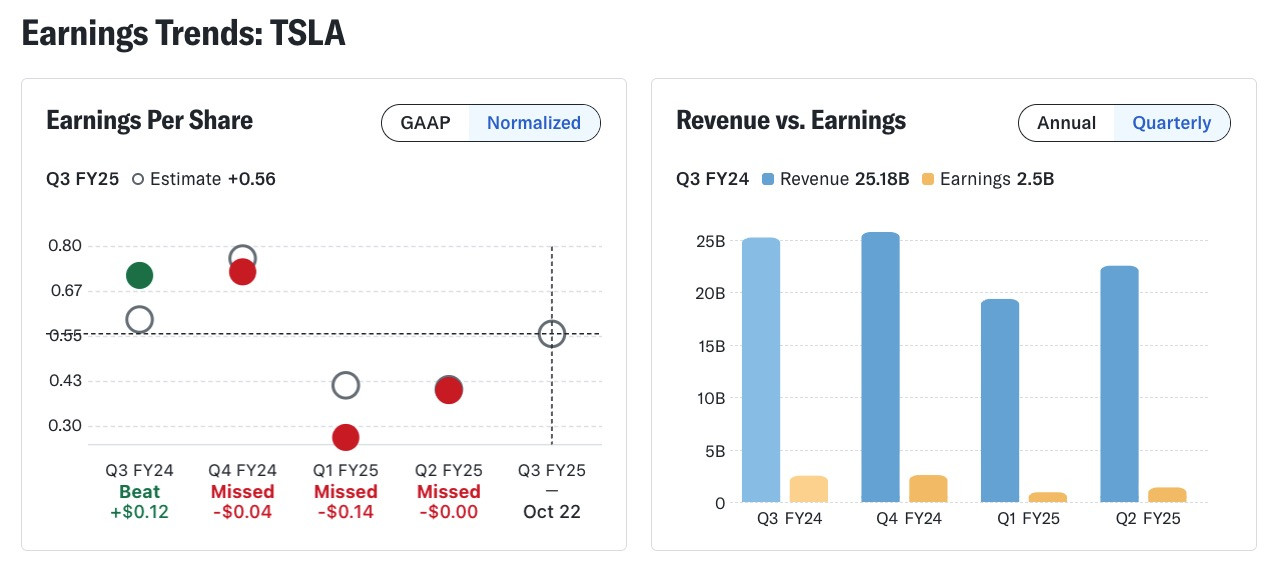
The company’s automotive gross margin (excluding regulatory credits) is now expected to shrink to just 16–17%, less than half of its 2021 peak. In other words, Tesla is selling more cars than ever, but making far less money per vehicle.
Why the Record Deliveries May Be Misleading
That Q3 record delivery number deserves context. The main driver wasn’t necessarily an organic rise in demand, but a “push-forward” effect created by the expiration of the U.S. federal EV tax credit. Many buyers rushed to complete their purchases before losing access to the $7,500 incentive at the end of September.
Cantor Fitzgerald analyst Andres Sheppard noted that this “push-forward effect” will likely lead to a weaker Q4, as Tesla faces a post-credit slump in orders. This dynamic isn’t unique to Tesla — other EV makers like Rivian and Lucid have also experienced similar demand swings tied to government subsidies — but it means that Q3’s record could represent a short-term high point rather than a sustainable trend.
If demand falls off sharply in Q4, Tesla will be forced to either raise prices (hurting sales) or keep discounting (hurting profits). Neither scenario is ideal for investors who’ve already seen the company miss revenue and EPS estimates in multiple recent quarters.
Energy: The Unsung Hero
While the automotive business faces margin compression, Tesla’s Energy Generation and Storage segment continues to grow steadily — and could be one of the company’s long-term profit anchors.
In Q3, Tesla reportedly deployed a record 12.5 GWh of battery storage, driven largely by surging demand from AI data centers and commercial power projects. As the global AI boom drives power consumption higher, companies are increasingly turning to energy storage solutions to stabilize their electricity use. Tesla’s Megapack business, which supplies utility-scale battery systems, is perfectly positioned to benefit.
This part of the business also enjoys higher profit margins and lower cyclicality compared to vehicle manufacturing. Although it’s still a smaller slice of Tesla’s total revenue, it’s becoming an important hedge against the volatility of car sales — and could help smooth out earnings over time.
AI, Robotaxis, and the Next Chapter of Tesla
For many investors, the upcoming numbers are secondary. The real question is: what comes next?
Wedbush’s Dan Ives has been vocal about this shift in focus, calling 2025 “the beginning of Tesla’s AI era.” In his view, the robotaxi and autonomous driving platforms could represent a $1 trillion valuation opportunity over the coming years. His price target remains one of the most bullish on the Street at $600 per share, implying significant upside if the company can execute on its AI and robotics roadmap.
Tesla’s long-promised Full Self-Driving (FSD) system remains central to this story. Investors will be listening for concrete updates on:
-
The progress of FSD adoption in the U.S., China, and Europe
-
Timelines for the Robotaxi rollout in Texas and California
-
Any new details about the CyberCab and RoboVan projects
-
Developments on the Optimus humanoid robot, which Tesla claims has a potential market worth $9 trillion
The company’s ability to show measurable progress — not just ambition — will determine whether investors continue to treat Tesla as an AI growth play rather than a cyclical automaker with a shrinking margin profile.
New Models and the Pricing Paradox
Goldman Sachs analyst Mark Delaney expects Tesla’s new, lower-cost versions of the Model 3 and Model Y to help attract price-sensitive buyers. However, he warns that the “degree of differentiation” between the cheaper variants and existing models is smaller than expected. In short, Tesla is offering price cuts and small design tweaks, not a revolutionary new low-cost model — at least not yet.
At the 2023 Investor Day, Tesla had hinted at a “next-gen vehicle” that would cost 50% less than the Model 3. But so far, that car remains theoretical. Instead, consumers are getting incremental variants, suggesting delays in the affordable EV roadmap. That could limit Tesla’s ability to capture the mass-market segment where competitors like BYD are already gaining ground.
The Musk Question: Visionary or Distraction?
No Tesla earnings preview is complete without mentioning Elon Musk. This quarter marks the company’s first report since details of his $1 trillion pay package became public — a plan that ties compensation entirely to performance milestones and stock appreciation.
Some investors see this as a motivational structure; others see it as excessive. More importantly, Musk has hinted that if his ownership stake isn’t increased, he might take key AI projects outside Tesla. That’s a serious risk, considering much of the stock’s premium valuation hinges on his personal involvement in its AI and robotics initiatives.
Freedom Capital Markets strategist Jay Woods noted that “the focus may shift away from auto sales and be more about robotics, autonomous driving, and AI.” But that transition only works if Musk stays fully engaged and if Tesla delivers tangible progress on those fronts.
Valuation and Market Expectations
Tesla stock currently trades around $442, up 9.6% year-to-date and nearly 100% higher from its March lows. However, it’s also well above the average analyst price target of $365, meaning optimism is already baked into the price.
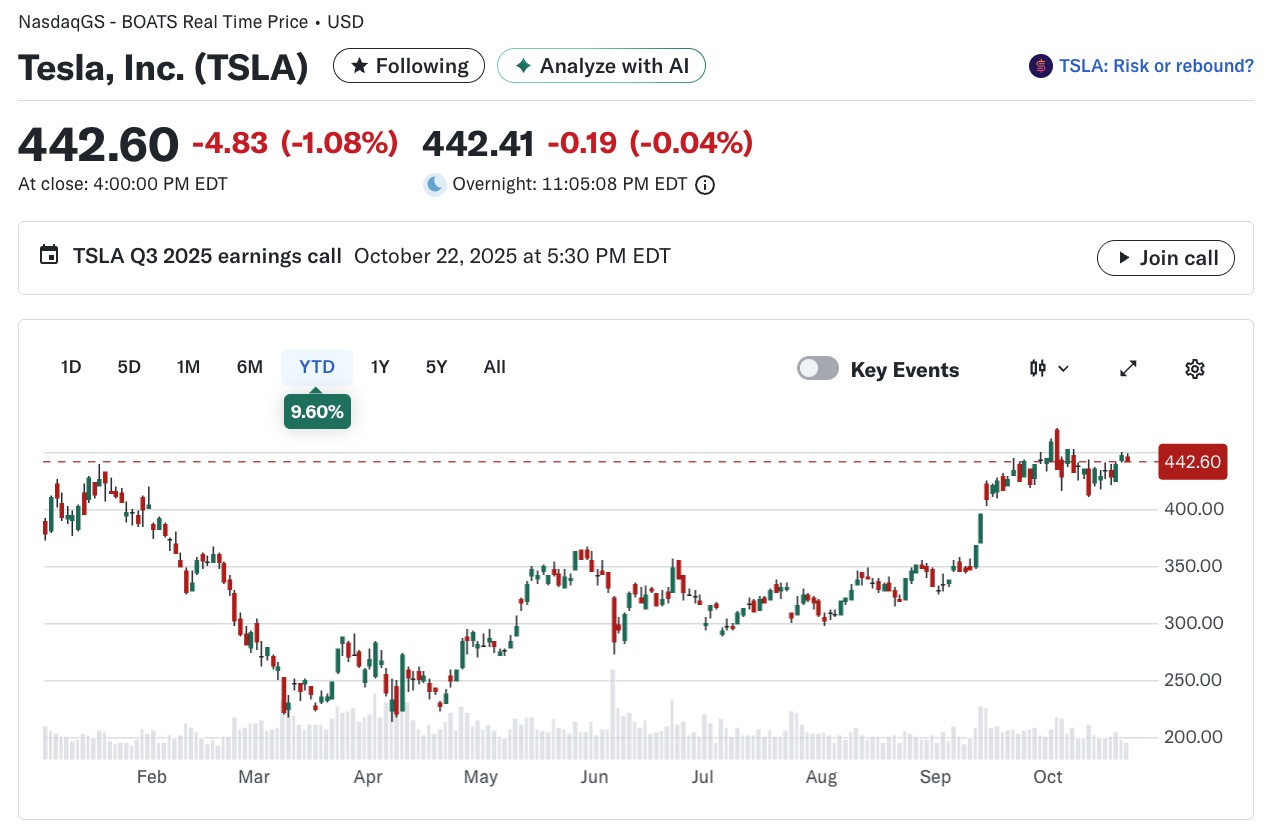
Options markets imply an 8% or greater post-earnings swing, highlighting how divided investor sentiment has become. Bulls believe Tesla’s AI pivot will eventually justify the premium. Bears argue that the company is overvalued relative to its current earnings power, with its core car business now competing in a price war that erodes profitability.
Bottom Line
Tesla’s Q3 earnings report won’t just tell us how many cars it sold or how much profit it made. It’s going to test whether investors still believe in the company’s transformation — from an EV pioneer to a leader in autonomous systems and robotics.
Expect strong sales numbers, weaker profit margins, and a lot of attention on Musk’s comments about AI timelines and product launches. But ultimately, the market’s reaction will hinge on one question: Is Tesla still an innovation story worth paying a premium for — or is the EV chapter closing faster than the next one is opening?
#Q3 Earnings Season: Key Insights and Market Movers#$Tesla Inc. Common Stock(TSLA)