
APAC Market Wrap - Oct 23

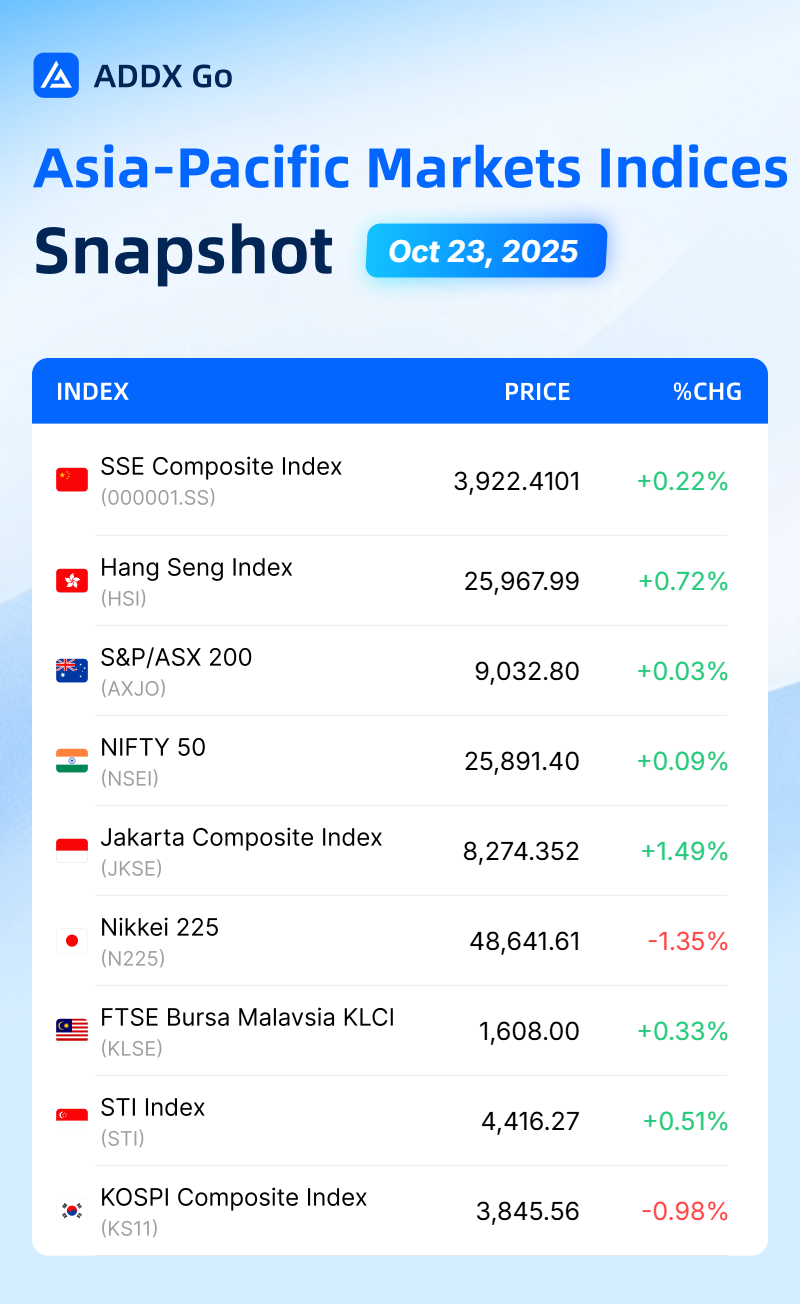
China Stock Market: At the close, the Shanghai Composite rose 0.22%, the Shenzhen Component gained 0.22%, and the ChiNext Index rose 0.09%.
By sector, Shenzhen SOE reform, coal, and energy metals led gains, while lab-grown diamonds, construction machinery, and oil and gas saw the largest declines.
Hong Kong Stock Market: Hong Kong’s three major indices collectively strengthened today.
At the close, the Hang Seng Index gained 0.72% to 25,967.98 points, the Tech Index rose 0.48% to 5,951.45 points, and the H-share Index increased 0.83% to 9,300.74 points.
Market performance showed strength in internet tech, consumer electronics, semiconductors, insurance, and brokerage stocks, while most gold stocks weakened.
Japan Stock Market: The Nikkei 225 closed down 0.02% after three trading days, settling at 49,307.79 yen, a decline of 8.27 yen from the previous day.
By industry, 26 sectors, including transportation equipment, construction, textiles, and retail, rose, while 7 sectors, such as information and communication, nonferrous metals, banking, and securities and commodity futures, declined.
South Korea Stock Market: The KOSPI rose 1.56%. By sector, diversified utilities, chemicals, air freight, and aerospace & defense surged, while panels, securities, construction, electronics, and internet declined.
Australia Stock Market: The S&P/ASX 200 rose 0.03% to 9,030.700 points. Semiconductors, oil, and chemicals saw modest gains, while apparel, diversified media, biotechnology, and other sectors posted larger declines.
Singapore Stock Market: The FTSE Straits Times Index (STI) rose 0.51%. Education, waste management, tourism & leisure, and other sectors surged, while forestry products, autos & parts, and non-alcoholic beverages saw larger declines.
Malaysia Stock Market: The FTSE Malaysia KLCI rose 0.33% to 1,612.29 points. Transportation & logistics, healthcare, and financial services rose, while construction, energy, and utilities saw slight declines.
Key Events
Japan Risks Black Swan! Coalition Collapse Amplifies Trade Tensions and Market Worries
Japanese financial assets faced selling pressure on Tuesday. Following the Komeito Party’s announcement last Friday to exit the LDP coalition, tensions in Japan’s capital markets persisted this week.
Analysts noted that the coalition collapse was unexpected and could trigger a “black swan” event—an opposition coalition might form, preventing new LDP leader Sanae Takaichi from becoming prime minister.
Seoul Housing Overheating May Delay Rate Cuts, Economists Expect Bank of Korea to Stay Put
By the end of September, Seoul apartment prices rose for the 35th straight week, with gains accelerating despite government measures to curb demand. This poses challenges for the Bank of Korea, which has kept rates unchanged in its last two meetings due to real estate-related financial stability risks.
Morgan Stanley’s chief Korea economist Kathleen Oh said the bank expects the BOK to pause rate cuts in October and resume in November, differing from prior views of action this month. Despite little change in fundamentals since August, the housing rebound suggests policymakers will wait to assess new housing measures.
Japan’s “Crypto Reserve Pioneer” Stock Crashes, Enterprise Value Falls Below Bitcoin Holdings
Japanese listed company MicroPlanet Inc.’s enterprise value fell below its Bitcoin reserve value for the first time, reflecting waning global investor interest in “digital asset reserve companies.”
MicroPlanet, originally a hotel business, pivoted to Bitcoin holdings in April 2024, when markets priced its stock at a premium over its Bitcoin net asset value (NAV).
Samsung Electronics Reclaims Global Memory Chip Sales Crown in Q3
Tuesday data showed Samsung Electronics regained the top spot in global memory chip sales from SK Hynix in Q3.
Per Counterpoint Research, Samsung’s memory chip sales (DRAM and NAND flash) reached $19.4 billion in Q3, up 25% QoQ, while SK Hynix’s sales hit $17.5 billion, up 13% QoY.
Sources: PayPay’s U.S. IPO in December Could Value It Over $20 Billion
Two sources say that as SoftBank prepares for a December U.S. IPO of Japanese payment app PayPay, investors expect a valuation exceeding ¥3 trillion ($20 billion). Since mid-September, SoftBank has been meeting institutional investors to discuss the IPO’s potential valuation, with ¥2 trillion as a baseline but likely surpassing ¥3 trillion.
Institutional Views
CICC: OpenAI’s “Procurement Contract + Equity” Model Benefits AI Ecosystem
CICC’s report notes that OpenAI’s recent partnerships with AI supply chain companies over the past two months have helped secure stable computing resources and enhance model capabilities. The “procurement contract + equity” model with Nvidia and AMD fosters a closed-loop AI ecosystem, supporting industry development and EPS for hardware and semiconductor sectors.
Recommended investments: commercial GPUs, ASICs, Ethernet, storage, and advanced processes.
Huatai Securities: Sustained Port Fees Could Lift Global Oil and Bulk Shipping Rates
Huatai Securities’ analysis of U.S.-China port fee hikes suggests short-term fleet redeployments to cut costs could disrupt supply chains and raise rates. Long-term, Chinese shipping faces higher levies than U.S. counterparts. Container shipping may see short-term price hikes to offset costs but faces oversupply pressure.
Oil and bulk shipping, in an upcycle, can pass fees to clients. Sustained fees could systematically elevate global oil and bulk shipping rates. Chinese oil and bulk shippers may benefit relatively, while container shipping could be hit harder.
Bank of America: Raises 2026 Gold Price Target to $5,000/oz
Bank of America raised its 2026 gold and silver price targets to $5,000/oz (average $4,400/oz) and $65/oz (average $56/oz), respectively. Extreme imbalances in the physical silver market may normalize, amplifying volatility.
HSBC: Dollar Likely to Weaken Again, Possibly Bottoming Early Next Year
Despite debates over whether the dollar has bottomed, HSBC believes it will weaken further. HSBC’s global FX research head Paul Mackel said historical patterns show the dollar weakens when the Fed restarts easing without a U.S. recession, a trend hard to break.
Standard Chartered: Strong U.S. Economic Momentum Could Limit 2026 Rate Cuts
Standard Chartered analysts Nicholas Chia and Steve Englander note that while the Fed is expected to cut rates through 2025, strong U.S. economic momentum could reduce 2026 cuts. This could push up the dollar and Treasury yields long-term.
They believe markets may scale back expectations of ~63bps of 2026 cuts, especially if U.S. growth and productivity exceed forecasts.
Nomura: Australian Markets Overprice RBA Rate Cuts
Nomura’s chief economist Andrew Ticehurst said the RBA’s September minutes show uncertainty about spare economic capacity and neutral cash rate levels.
The RBA will remain data-driven, and its August dovish stance on “possible further cuts” is outdated. Ticehurst notes markets are overpricing further RBA rate cuts.