
Intel Reports Strong Q3 2025 Profit Growth Amidst Strategic Progress

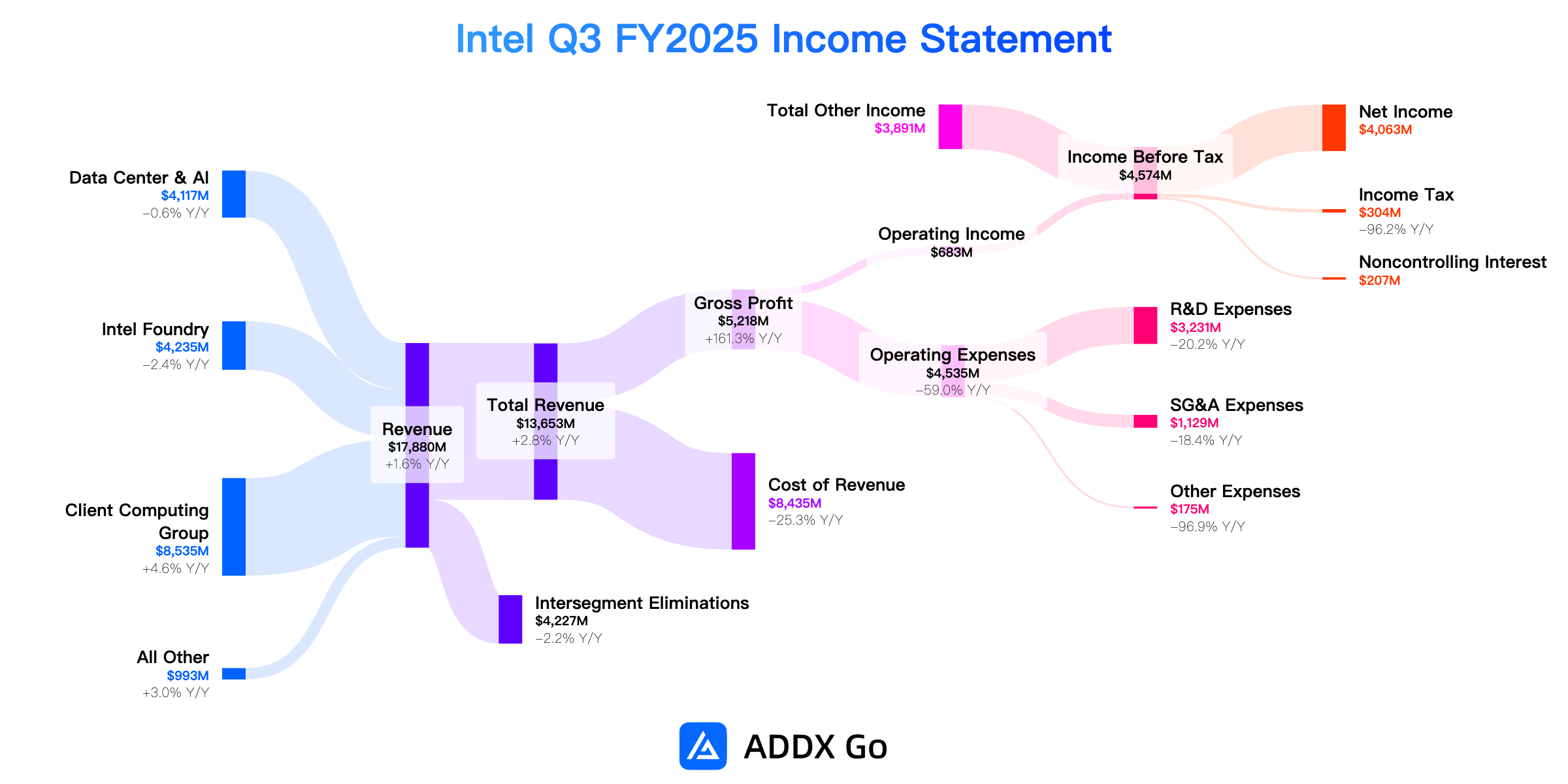
Intel (INTC.US) reported third-quarter 2025 financial results with non-GAAP diluted earnings per share of $0.23, significantly surpassing the analyst estimate of $0.01. Revenue for the quarter reached $13.7 billion, representing a 3% year-over-year increase, though falling short of the analyst estimate of $13.14 billion. The company's Q3 results demonstrate improved execution and steady progress against its strategic priorities, positioning it well for future growth in the AI-driven computing landscape.
Key Business Drivers and Performance
Intel's Client Computing Group (CCG) reported revenue of $8.5 billion, marking a 5% increase year-over-year. The Data Center and AI (DCAI) segment experienced a slight decline of 1%, with revenue totaling $4.1 billion. Despite the mixed performance across segments, total Intel Products revenue grew 3% to $12.7 billion.
The company highlighted significant strategic collaborations and investments, including an agreement with the U.S. Government for $8.9 billion in funding, of which $5.7 billion was received in Q3 2025. Furthermore, Intel announced a collaboration with NVIDIA to develop custom data center and PC products, alongside NVIDIA's $5.0 billion investment in Intel common stock and SoftBank Group's $2.0 billion investment. These actions underscore Intel's critical role in the technology ecosystem and its operational flexibility.
Management Outlook
For the fourth quarter of 2025, Intel forecasts revenue between $12.8 billion and $13.8 billion. The company expects non-GAAP diluted earnings per share of $0.08 for the upcoming quarter. This guidance excludes the results of Altera following the sale of a majority ownership interest in Q3 2025.
Operational Changes and Market Trends
Intel announced that its Fab 52, located in Chandler, Arizona, is now fully operational, manufacturing Intel 18A wafers. This facility is part of Intel's substantial investment exceeding $100 billion to expand its domestic operations and enhance advanced semiconductor manufacturing capabilities. Management noted that current demand is outpacing supply, a trend they anticipate will continue into 2026.