
Intel Stock Surges Post-Earnings

In the third quarterly report since taking the helm, Intel CEO Lip-Bu Tan proved that his strategy of slashing costs while securing external investments is paying off, steering the company back on track to recovery amid the AI chip demand boom.
In Q3 this year, Intel’s revenue achieved year-over-year positive growth for the first time in a year and a half, regaining momentum after two consecutive quarters of flat performance. Earnings per share (EPS) swung from a loss to a profit, far exceeding Wall Street’s modest profit expectations.
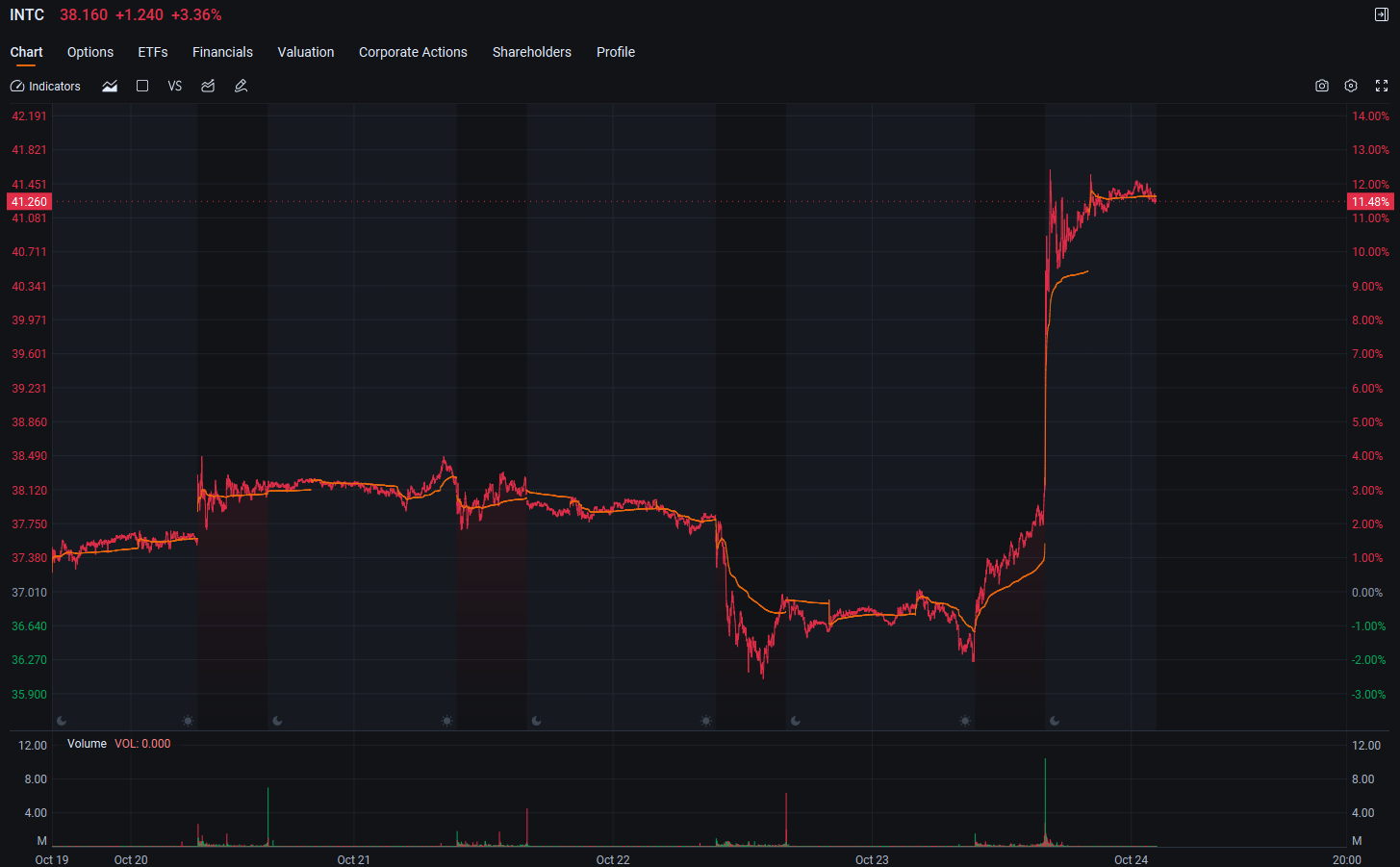
After closing up ~3.4% on Thursday, Intel’s stock surged further in after-hours trading, rising as much as 9%. In overnight U.S. trading, it was up nearly 8%. Over the past three months, Intel has secured a series of investment or equity commitments from SoftBank, the Trump administration, and Nvidia. Since announcing a $2 billion SoftBank investment on August 18, Intel’s stock has risen over 30%, up 86% year-to-date.
Earnings Highlights: Revenue and Profit Both Up, Stock Soars After Hours
According to the earnings report, Intel’s Q3 revenue reached $13.7 billion, up 3% year-over-year. This not only beat analysts’ expectations of $13.2 billion but marked the first YoY growth since early 2023. EPS turned from a $0.10 loss to a $0.23 profit, far surpassing the expected $0.01.
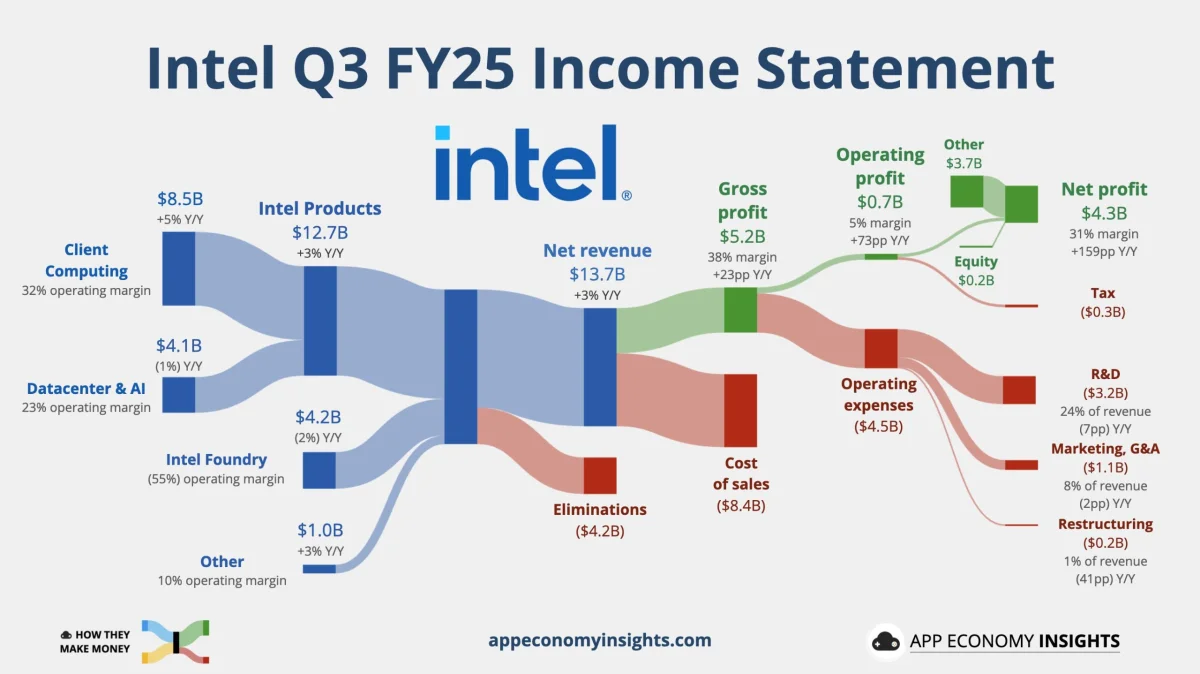
Gross margin rose significantly to 40.0%, up 22 percentage points from last year, hitting a high since Q1 2024. The Client Computing Group (CCG) performed strongly, with revenue up 5% to $8.5 billion, driving overall growth.
Intel CFO Dave Zinsner attributed the improved financials to two factors: steady core demand, with traditional computing recovering under AI momentum and product mix shifting toward higher-margin categories; and strict cost controls, bolstered by $5.2 billion in gains from the Altera deal and Mobileye share sale.
In Q3, Intel received $5.7 billion in U.S. government funding, a $2 billion common stock investment from SoftBank, and a $5 billion Nvidia commitment to Intel’s common stock. These capital injections significantly bolster Intel’s financial strength, supporting further expansion in AI chips and the PC market.
PC Boom Fuels Intel’s AI Bet
Intel announced it is abandoning its decades-old “Tick-Tock” chip development cadence to focus fully on AI server chips. This was revealed during the Q3 2025 earnings call, marking Intel’s most significant strategic shift in modern history—made as the PC market braces for its largest growth since 2021.
Previously, Intel alternated every two years between shrinking transistors (tick) and introducing new architectures (tock), delivering predictable performance leaps for consumers and enterprises. Now, Intel declares its 18A process a “long-life node” to support at least three generations of client and server products, signaling the end of rapid updates and a focus on manufacturing efficiency over generational breakthroughs.
CEO Tan said on the call that Intel will prioritize limited capacity for AI server shipments over entry-level PC processors. With Windows 10 nearing end-of-life, the PC market is poised for a refresh cycle, but Intel is betting on AI servers, where profit potential far exceeds consumer chips.
In AI chips, Intel is also adjusting course. The company will launch new AI accelerators annually, targeting the over $100 billion AI server market to compete head-on with Nvidia and AMD. Intel’s new strategy means consumers won’t see significant performance leaps every two years, but updates may be more groundbreaking.
Meanwhile, Intel is more cautious in its foundry business. CEO Tan said the company won’t expand capacity without “confirmed external demand,” meaning potential clients must pre-pay for manufacturing orders. While risky, Intel currently prioritizes cash flow over partnership convenience.
The earnings report also offered a glimmer of hope: the 14A process is progressing smoothly, with better performance and yields than 18A at a similar stage, suggesting Intel has learned from its 18A challenges.
Overall, abandoning Tick-Tock is not just a manufacturing shift but a strategic pivot from consumer to data center priorities. The rapid expansion of the AI server market makes this bet reasonable, but PC users may question whether Intel can recapture its past era of steady, predictable innovation. Success hinges on whether Intel can execute this transformation more smoothly than in the past.
What’s Next—Still a Buy?
Fueled by investments from the U.S. government, Nvidia, and SoftBank, chipmaker Intel’s stock has surged 86% in under three months. Now, investors are looking beyond raw performance to the company’s future potential.
In recent weeks, several analysts have downgraded Intel. Bank of America last week cut its rating from “Neutral” to “Underperform,” warning in a client note that the stock has “risen too far, too fast.”
Market enthusiasm continues to drive Intel’s valuation: its forward 12-month P/E ratio now stands at 63x, up from ~20x in January, placing it among the top 15 most expensive S&P 500 components.
This surge is particularly striking—nearly a year after Intel was removed from the Dow Jones Industrial Average, replaced by its AI darling rival, Nvidia, which joined the index in 1999.
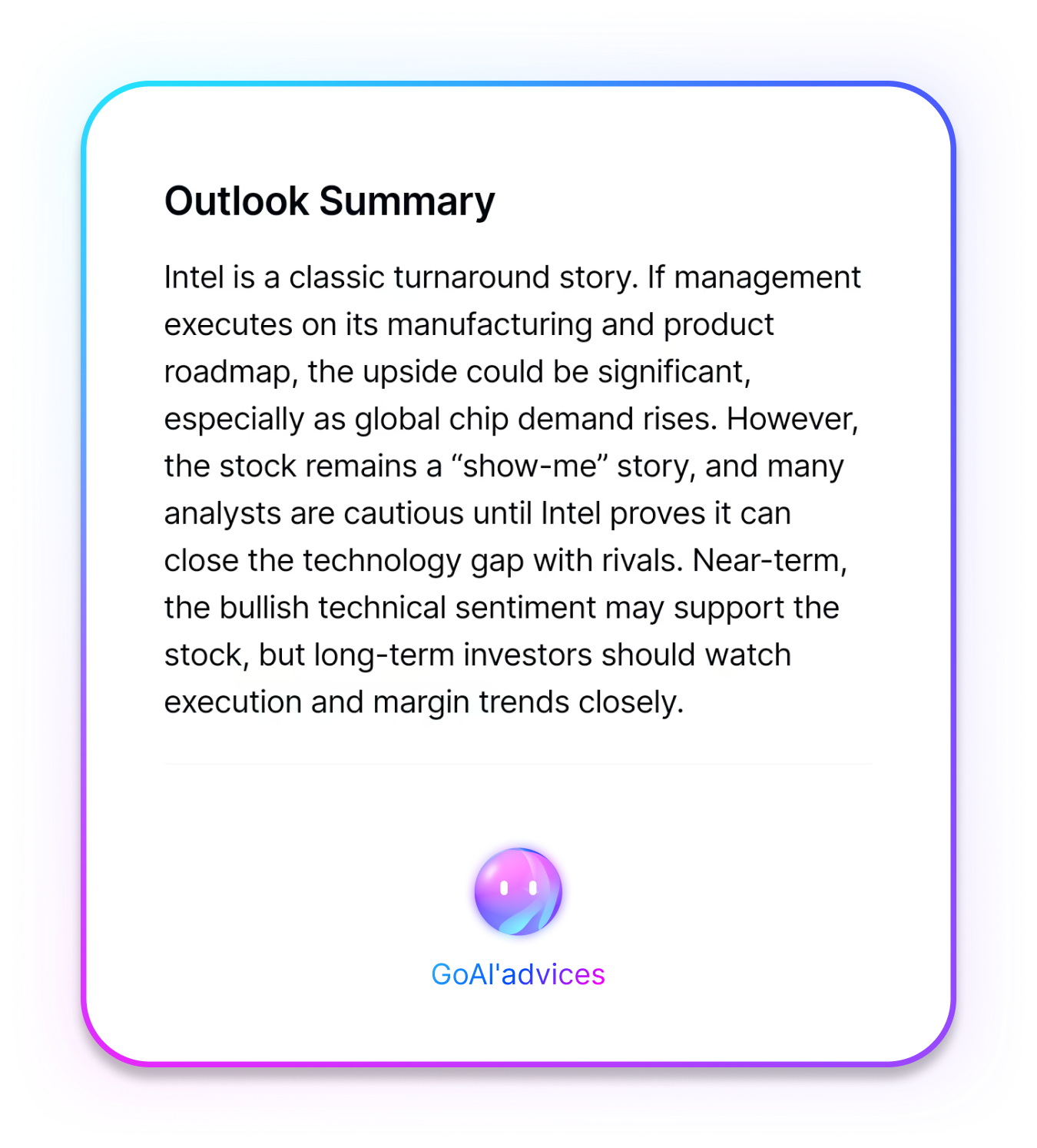
My take on Intel: Investing in Intel isn’t about recent performance—it’s about future potential. In the short term, the stock is more event-driven, heavily influenced by news announcements.
This earnings report was a neutral catalyst at best. A true breakout would require a major event.$INTC