
JPMorgan Sees $5,055 Gold by End-2026, but Its Quant Team Warns of a 2006-Style Pullback

Shearing sheep
October 24, 2025
GoGPT Summarizes Articles

Gold just suffered its worst single-day selloff in over a decade, but JPMorgan doesn’t seem shaken. In fact, the bank’s commodity strategists have turned even more bullish, forecasting that gold will average $5,055 per ounce by the end of 2026 — a 15% rise from its recent record highs. Silver, meanwhile, is expected to reach $56 per ounce over the same period.
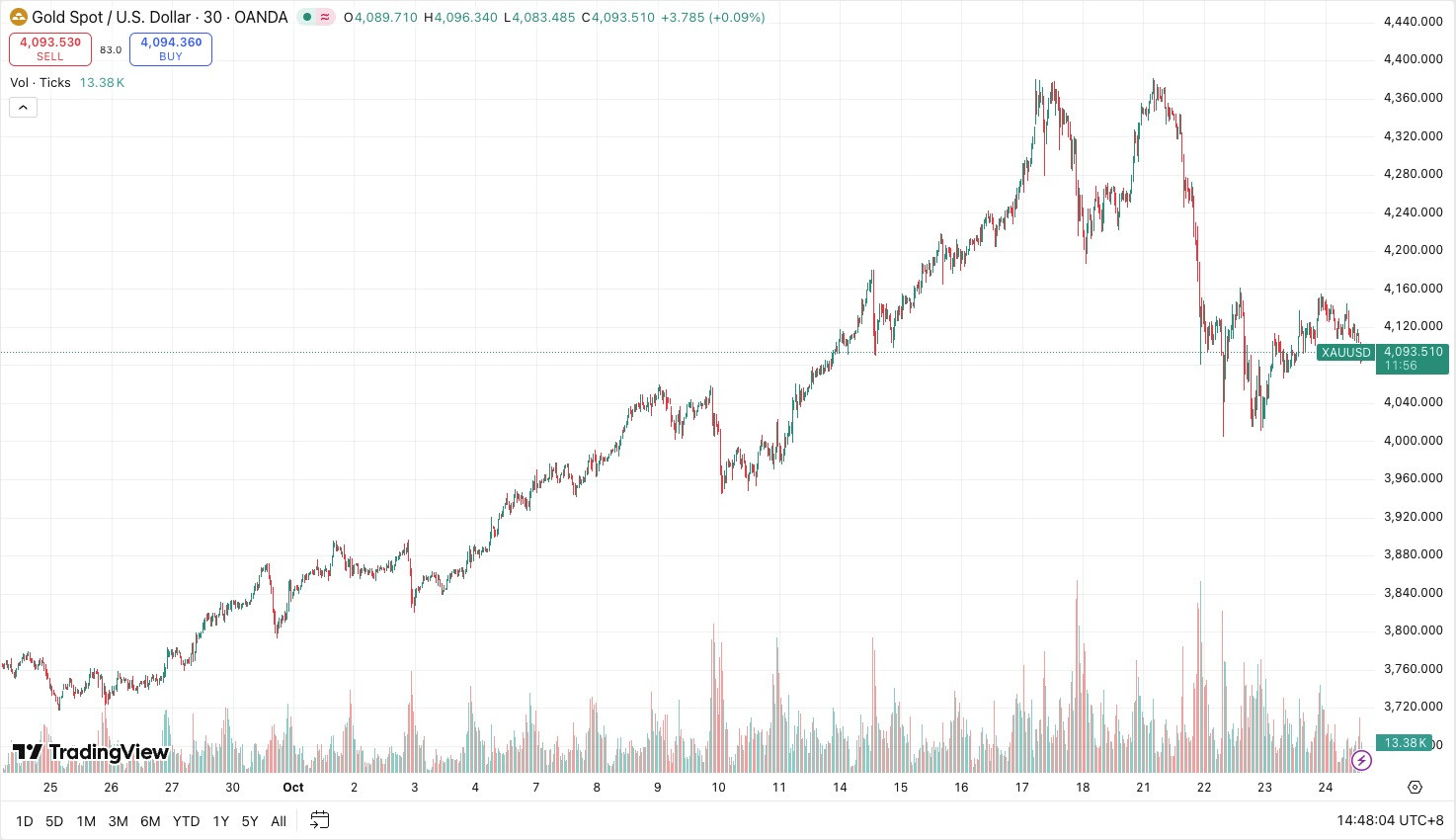
At a time when traders are nervous about whether the rally has gone too far, JPMorgan’s message is clear: the correction is healthy, not fatal. But interestingly, not everyone at the bank agrees — while the commodities team calls the pullback “a breather in a long-term uptrend,” JPMorgan’s quantitative and derivatives team is warning that the current setup resembles the 2006 peak, when gold soared too fast, then fell 30% in a matter of weeks.
A “Healthy” Correction in a Structural Bull Market
The selloff that shook the market earlier this week erased roughly 12 years’ worth of calm in a single session. But according to Gregory Shearer, head of JPMorgan’s metals strategy, this retreat is exactly what the market needed after a parabolic surge since August.
“Prices are simply returning to early-October levels,” Shearer wrote, noting that gold had jumped more than 30% in just two months, largely fueled by ETF inflows and speculative positioning. Between August and October, global gold ETFs added 268 tons — equivalent to $33 billion of inflows — marking one of the strongest accumulation phases since 2020.
Shearer’s team argues that the structural story behind the rally remains intact: investors and central banks are both buying for reasons that go far beyond short-term price swings. “This is not just about Fed policy,” the report says. “It’s about diversification, debt sustainability, and trust in monetary institutions.”
From a technical perspective, gold has now fallen to its first major support zone around $3,950–$4,000, where Shearer expects “physical buyers to re-emerge.” The report specifically highlights renewed Chinese demand, with local gold prices once again trading at a premium to London spot — a sign that physical buying is returning to the market.
Why JPMorgan Raised Its Target
JPMorgan’s decision to lift its long-term gold target to $5,055 per ounce rests on the assumption that demand from both investors and central banks will remain robust through 2026. Their model forecasts average quarterly purchases of 566 tons, a level not seen since the mid-2010s.
Key assumptions include:
-
Central bank buying remains elevated, at roughly 760 tons per year. Although below the record levels of 2022–2023, that’s still far above the pre-pandemic average of 400–500 tons. The report points out that many emerging-market central banks — especially in Asia and the Middle East — still hold less than 10% of their reserves in gold, leaving room for diversification.
-
ETF inflows persist, with another 360 tons expected by the end of 2026, driven by rate cuts, inflation concerns, and worries about U.S. fiscal stability.
-
Geopolitical tension continues to underpin safe-haven demand, as global trade frictions and sanctions reshape the investment landscape.
In Shearer’s view, the story isn’t about the U.S. dollar “collapsing,” but about global portfolios shifting gradually toward real assets. “We’re seeing investors — especially outside the U.S. — trim small portions of dollar exposure and reallocate into gold,” the report notes.
Silver Joins the Party
JPMorgan also upgraded its outlook for silver, expecting it to rise to $56 per ounce by late 2026. While the bank warns of short-term weakness due to inventory normalization in London, it believes the gold-silver ratio will revert to around 85–90, implying stronger relative gains for silver once gold’s next leg higher begins.
The Quant Team Sounds a Cautionary Note
While Shearer’s team is focused on the fundamentals, JPMorgan’s quantitative and derivatives group, led by Yangyang Hou, sees trouble brewing beneath the surface. In their own report released the same day, they compared the recent run-up to the 2006 bull market, when gold climbed 60% in ten months before collapsing 30%.
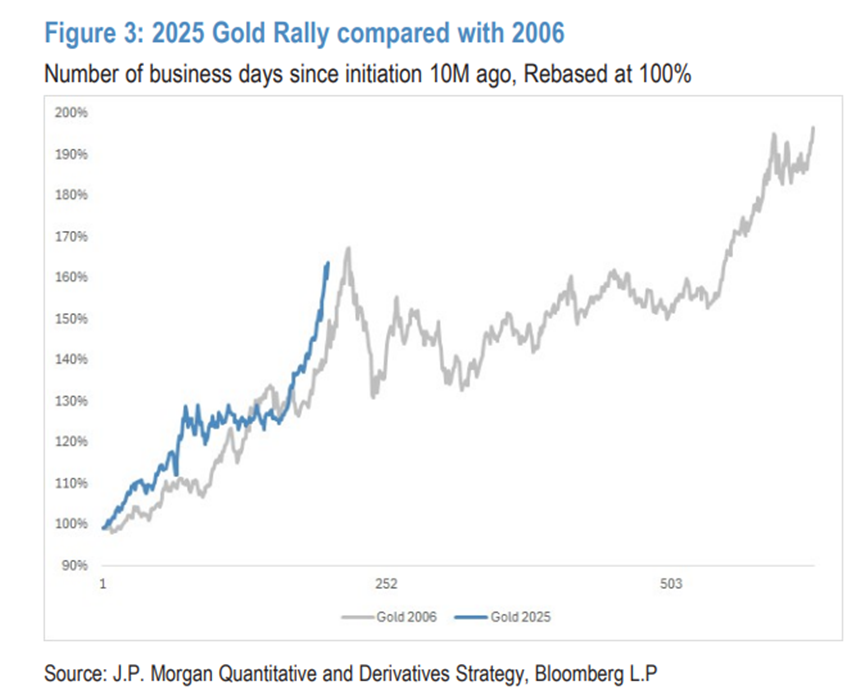
The warning centers on market positioning. The team found a record imbalance in “short gamma” positions within gold ETF options (notably GLD). This means dealers are heavily exposed to sudden price reversals due to the large volume of short-term call options bought by speculative traders.
According to the quant strategists, the net short gamma level recently hit a 10-standard-deviation extreme — an almost unheard-of level of one-sided positioning. That setup, they argue, makes the market “fragile and prone to violent unwinds.”
Even though much of that exposure expired with October options, volatility remains elevated, with both implied and realized measures at their highest percentile readings since 2020.
What Could Go Wrong
Even JPMorgan’s bullish commodity desk admits that the biggest risk to their thesis is a sharp slowdown in central-bank purchases. These flows don’t necessarily drive prices higher but provide a powerful floor for the market. A pullback here, especially if combined with weak physical demand, could leave gold exposed.
The bank also flags two additional risks:
-
Jewelry demand has softened under high prices. While total jewelry spending rose 21% year-on-year in value terms last quarter, it fell 14% in volume, showing consumers are buying less gold per dollar spent.
-
Scrap supply tends to surge when gold prices rise. JPMorgan estimates that a 10% rise in gold typically leads to a 166-ton increase in recycled supply. Given prices are up more than 50% year-on-year, the headwind could be substantial.
A Split View Inside JPMorgan
The split between JPMorgan’s commodity and quant teams reflects the broader debate now gripping the market. Are we still early in a multi-year bull market driven by de-dollarization and global diversification? Or have speculative flows pushed gold too far, too fast — setting up a correction similar to 2006?
Natasha Kaneva, the bank’s global head of commodities, sits firmly on the bullish side. She calls gold JPMorgan’s “highest-conviction long trade”, with a longer-term target of $6,000 by 2028. Kaneva believes rate cuts and stagflation fears will keep real yields suppressed, supporting higher gold prices for years to come.
Still, she admits the rally has been “so fast that fear is natural.” Her advice? Don’t panic — “buyers are many, sellers are few.”
My Take
JPMorgan’s $5,000 target is bold but not baseless. The macro setup — slowing growth, high debt, deglobalization, and steady central-bank buying — certainly supports a strong floor for gold. But the pace of the recent rally does echo past overheated cycles.
If the Fed starts cutting in 2026 as JPMorgan expects, gold could indeed test those lofty levels. Yet in the near term, the quant team’s concerns make sense: extreme positioning rarely ends quietly.
Short-term traders should be cautious — volatility could spike fast. But for long-term investors viewing gold as a hedge against systemic risk, this may just be another shakeout before the next leg higher.
#gold