
UnitedHealth Q3 Earnings Preview: Can America’s Health Giant Balance Growth and Profit?

Shearing sheep
October 27, 2025
GoGPT Summarizes Articles
UnitedHealth Group ($UNH) is set to report its third-quarter 2025 results before the U.S. market opens on October 28. The market expects a familiar story: strong revenue growth paired with declining profitability.
Consensus estimates suggest revenue of roughly $113 billion, up 12% year-on-year, but earnings per share (EPS) are expected to plunge over 60% to around $2.81. The story behind those numbers is simple but important — rising utilization and cost pressures are outpacing the company’s ability to convert revenue into profit.
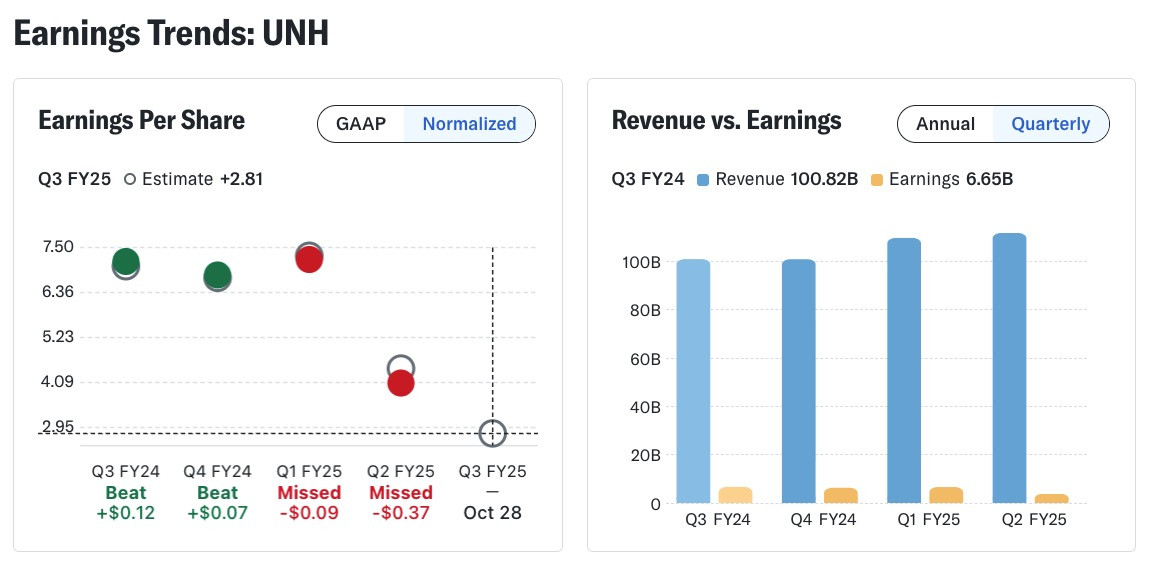
For the largest health insurer and managed care provider in the U.S., the question this quarter isn’t whether it can keep growing. It’s whether it can do so sustainably.
The Heart of the Issue: Rising Medical Costs and the MLR Line
At the core of UnitedHealth’s profitability problem is the medical loss ratio (MLR) — the share of premium revenue spent on patient care. It’s the industry’s key measure of cost discipline.
In Q2 2025, the company’s MLR surged into the low 90% range, meaning every additional percentage point increase directly erodes operating profit. Management pointed to unexpected spending in behavioral health services, where utilization and per-visit costs have climbed faster than anticipated.
For Q3, analysts will watch closely to see if the MLR stabilizes near 91%, a critical psychological threshold. A reading above that would indicate that cost inflation is still spreading — not only in behavioral health but also in other areas like outpatient care and chronic disease management. A lower MLR, however, would suggest that UnitedHealth’s cost-control efforts are finally taking effect, perhaps through better claims management and revised provider contracts.
In short, this metric will decide whether the company’s profit erosion is temporary or structural.
Segment Breakdown: Can Optum Shield the Pain?
UnitedHealth’s business operates through two major engines: UnitedHealthcare (UHC) — the insurance division — and Optum, its healthcare services arm. While UHC remains the backbone, Optum now contributes about 60% of total revenue and has become the company’s main buffer against volatility.
OptumRx (Pharmacy Benefit Management)
The pharmacy benefit management (PBM) segment continues to be the group’s earnings stabilizer, with projected operating income of about $1.6 billion in Q3. The focus this quarter is on two levers:
-
Drug procurement negotiations with pharmaceutical manufacturers, particularly around high-cost specialty drugs;
-
The specialty drug mix, since lower exposure to expensive therapies can lift margins.
Any improvement in either metric will directly support Optum’s profit contribution — crucial when other divisions are under pressure.
OptumHealth (Care Services)
OptumHealth, responsible for care delivery and value-based care models, faces a more complex environment. Analysts forecast operating income around $394 million, weighed down by Medicare Advantage payment cuts and contract adjustments.
Investors will want to see tangible evidence that the division’s transition from “fee-for-service” to “value-based” care is working — in other words, lower hospital admission and ER rates among chronic disease patients. If these operational KPIs show progress, it would validate management’s claim that OptumHealth can eventually become a cost stabilizer rather than a liability.
OptumInsight (Data Analytics and Consulting)
This smaller unit, expected to post about $793 million in operating income, continues to deliver steady profits through risk adjustment analytics and digital tools for healthcare providers. While its size limits its ability to offset UHC volatility, its stable cash flow helps smooth group earnings.
UnitedHealthcare (UHC): Membership Retention and Margin Watch
UHC remains the heart of UnitedHealth’s business model, covering Medicare Advantage, Medicaid, and commercial plans. As of Q2, the company reported around 9.8 million Medicare Advantage members, representing a 28.5% market share.
Membership stability will be a key signal this quarter. If Q3 data show stable or modestly growing enrollment, it will suggest that UHC is holding onto its base despite cost headwinds. A decline could hint at member switching, which would raise further doubts about long-term pricing power.
Meanwhile, profitability recovery in UHC will be closely linked to the overall MLR trend. Any uptick in segment margin will likely boost investor sentiment, suggesting that cost normalization is underway.
2026 Guidance: Investors Want a Roadmap
Perhaps the biggest wildcard in this report is guidance.
Last quarter, UnitedHealth stunned the market by cutting its full-year 2025 adjusted EPS forecast from $27.50 to “at least $16.00”, citing $6.5 billion in unanticipated medical costs. The company then withdrew its full-year range altogether, citing “uncertainty” in utilization trends.
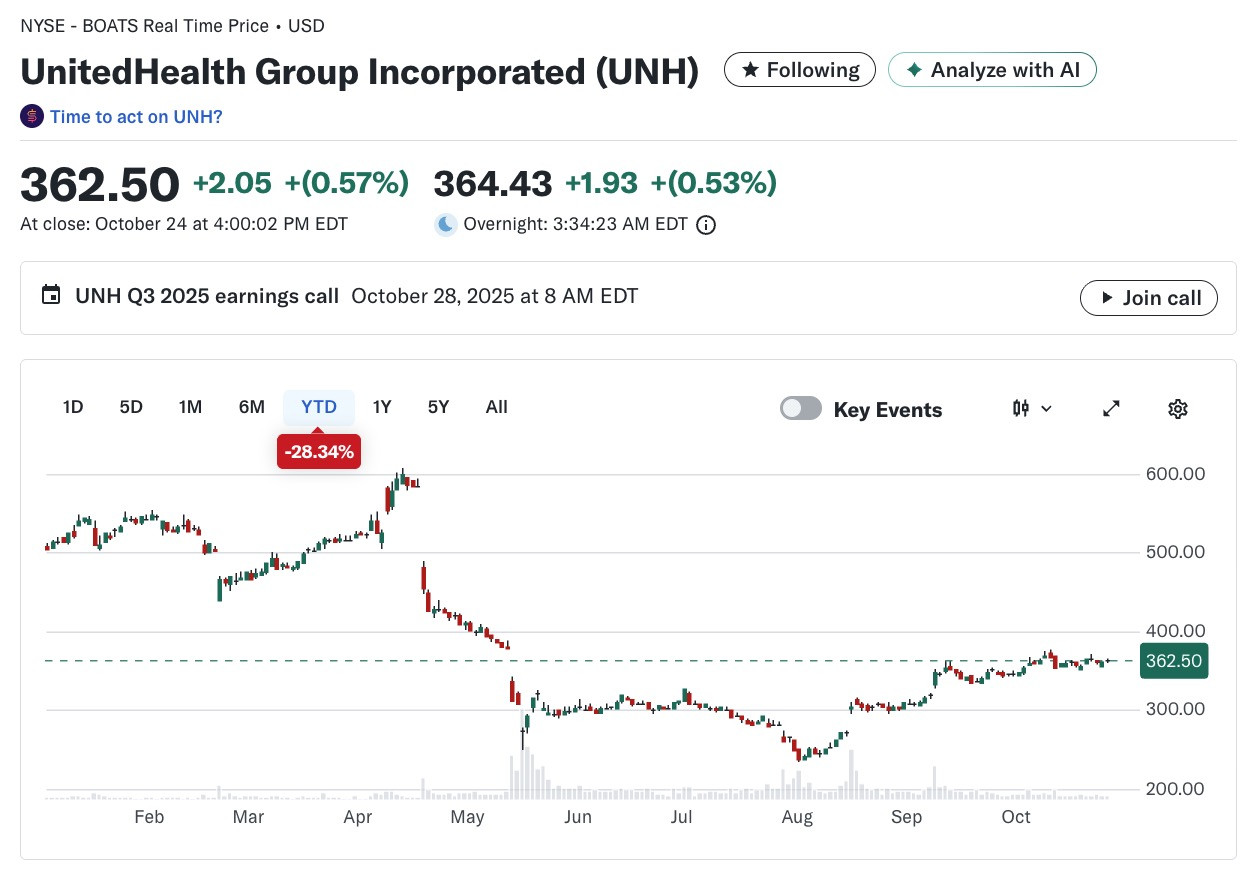
That decision triggered a sharp selloff and raised concerns that management might have lost near-term visibility. If the Q3 call offers a clearer 2026 outlook — with measurable cost assumptions and EPS targets — it could go a long way toward restoring market confidence. On the other hand, if the company maintains a cautious or ambiguous tone, investors may remain on edge about the true earnings trajectory.
External Pressures: Regulation and Competition
Medicare Risk Coding Probe
UnitedHealth remains under federal investigation for its Medicare Advantage risk coding practices, where revenue depends on how accurately (or aggressively) patient health risks are scored. Regulators suspect that some insurers might have overstated risk factors to receive higher reimbursements.
As of Q2, UnitedHealth provided no update on the investigation. Any indication in Q3 that the inquiry has expanded — or that preliminary findings are near — could pressure the stock short term. Even without fines, potential revenue clawbacks remain a risk that investors can’t ignore.
Industry Landscape
Competition in Medicare Advantage remains intense. Humana has seen its plan ratings drop, with only about 20% of members enrolled in 4-star or higher-rated plans (versus UnitedHealth’s 78%), putting it under greater regulatory and cost pressure. Meanwhile, Elevance Health benefits from a higher share of commercial insurance customers, making it less exposed to Medicare-driven margin compression.
If UnitedHealth’s MLR ends up lower than Elevance’s 91.3% from last quarter, it will reaffirm its position as the industry’s cost-control benchmark. But if the gap narrows, the company’s pricing and efficiency edge may be in question.
The Bigger Picture: Scale vs. Precision
For years, UnitedHealth’s story has been about scale — the biggest insurer, the widest network, the most diversified health business. But in 2025, scale alone is no longer the advantage it used to be.
The company’s new challenge is precision — managing cost per patient, optimizing care outcomes, and aligning business units so that one division’s strength offsets another’s weakness. In that sense, this quarter’s results will serve as a litmus test of operational finesse rather than financial muscle.
Bottom Line
UnitedHealth’s Q3 report will likely confirm what many already suspect: revenue growth remains robust, but profits are being squeezed by medical inflation and behavioral health utilization. Investors will focus less on whether earnings beat or miss by a few cents, and more on whether management can show a credible path toward margin recovery in 2026.
If cost trends stabilize and the company reinstates clear guidance, sentiment could improve sharply. But if cost pressures persist and commentary stays vague, the market may continue to discount the stock despite its strong fundamentals.
For now, UnitedHealth’s financials tell a simple story of a healthcare giant caught between booming demand and rising complexity — a reminder that in modern healthcare, growth without control is growth at a cost.
#Q3 Earnings Season: Key Insights and Market Movers#$UNITEDHEALTH GROUP INCORPORATED (Delaware)(UNH)