
APAC Market Wrap - Oct 27

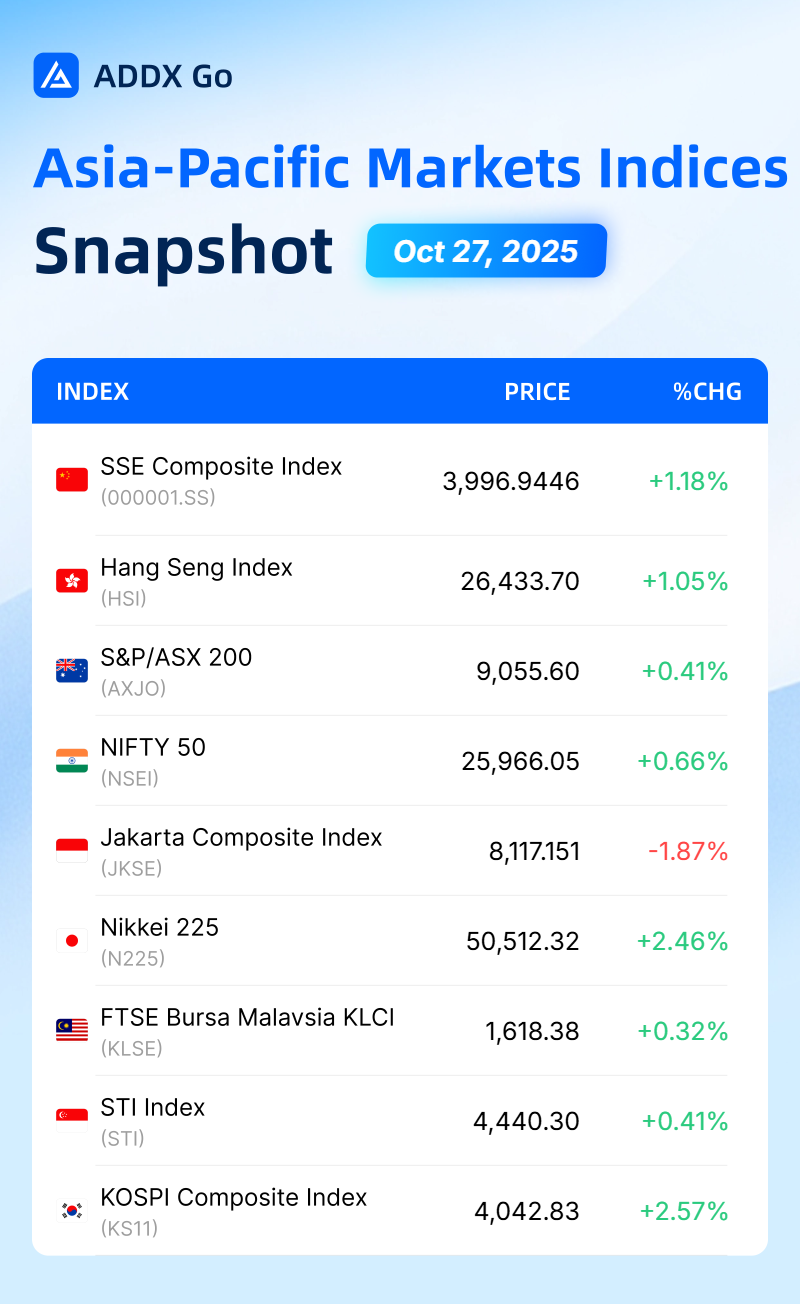
China Stock Market: At the close, the Shanghai Composite rose 1.18%, the Shenzhen Component gained 1.51%, and the ChiNext Index surged 1.98%.
By sector, memory chips, CPO, and controllable nuclear fusion led gains, while games and wind power equipment saw the largest declines.
Hong Kong Stock Market: Hong Kong’s three major indices rose collectively today, with positive market sentiment.
At the close, the Hang Seng Index rose 1.05% to 26,433.70 points; the Tech Index gained 1.83% to 6,171.08 points; the H-share Index increased 1.10% to 9,467.22 points.
Market performance showed strength in brokers, insurance, semiconductors, pharmaceuticals, internet tech, and consumer electronics.
Japan Stock Market: The Nikkei Average surged 2.46% to close at 50,512.32 points (trading volume ~1.92 billion shares), up 1,212.67 yen, successfully breaking the 50,000-point mark.
Easing concerns over escalating U.S.-China trade friction, expectations for the Koizumi administration’s policies, and anticipation of two U.S. rate cuts this year drove broad buying from the open.
All 33 industry sectors rose, with non-ferrous metals, precision instruments, securities & commodity futures, and information & communication leading gains.
South Korea Stock Market: The KOSPI rose 2.57%. By sector, health management, bioengineering, and conglomerates surged. Diversified consumer services, non-metallic minerals, leisure equipment, food, and steel declined.
Australia Stock Market: The S&P/ASX 200 rose 0.41% to 9,055.600 points. Non-alcoholic beverages, semiconductors, and industrial distribution rose sharply; aerospace, biotechnology, and agriculture saw larger declines.
Singapore Stock Market: The FTSE Straits Times Index (STI) rose 0.13%. Furniture, semiconductors, and aerospace gained; medical equipment, education, electricity, and waste management declined.
Malaysia Stock Market: The FTSE Malaysia KLCI rose 0.32%. Plantations, technology, and communication & media rose; consumer goods & services, energy, and real estate saw slight declines.
Key Events
Amazon Says India E-Commerce Exports Top $20 Billion Despite U.S. Tariffs
Amazon said on Monday it has helped Indian sellers achieve cumulative exports exceeding $20 billion, with nearly $7 billion this year. Indian small operators are working to offset the impact of new U.S. import tariffs implemented in August.
Amazon remains confident in long-term growth and set a new target: driven by global demand for cosmetics, toys, furniture, and apparel, to raise India’s e-commerce exports to $80 billion by 2030.
Since August 27, the U.S. doubled tariffs on certain Indian goods to 50% in response to India’s purchases of Russian oil, affecting thousands of Indian artisans and small businesses.
Gold Boom Heats Up Hiring—Hedge Funds, Traders Vie for Talent
As interest in gold surges, trading firms, hedge funds, and banks are aggressively hiring specialist gold traders, sparking a talent war and driving up pay in this traditionally niche market.
Sources say major commodity traders Trafigura Group and Gunvor Group have recruited precious metals trading teams this year, while rivals IXM and Mercuria Energy Group Ltd. are also seeking talent. Headhunters and executives note many hedge funds, banks, and industrial refineries are entering or expanding in precious metals.
Capital, Power, Talent—U.S. Manufacturing Losing to AI
The AI data center boom is fully squeezing U.S. manufacturing.
Data center construction spending surged 18% this year, while factory construction shrank 2.5%; power prices in data center hubs rose 267% over five years; one in five construction contractors shifted to data center projects. Tech firms get tariff exemptions, while manufacturers bear the heaviest taxes. Experts warn AI frenzy has blinded policymakers to policy downsides.
U.S. manufacturing revival faces an unexpected rival—AI data centers are crowding out traditional industry in capital, power, and labor, threatening Trump’s core industrial revival goals.
South Korea Stocks Up Nearly 65% This Year—Fastest in G20
Data released Monday shows South Korea’s benchmark index rose fastest among G20 major indices this year, driven by foreign investors snapping up semiconductors and other blue-chips.
Per Yonhap Infomax, the KOSPI rose 64.27% (1,542.1 points) from year-end to last Friday.
The KOSPI is the only G20 index up over 60% in that period. The runner-up, Japan’s Nikkei 225, gained 25.98%.
Analysts say the rapid rise was fueled by strong foreign buying of blue-chips, including semiconductors.
Institutional Views
BofA: Singapore 2026 Growth Likely Below Trend, Core Inflation Hard to Top Historical Average Short-Term
Bank of America economists said in a report Singapore’s 2026 economic growth may remain below trend at ~2%.
They noted September industrial output was unusually strong due to record pharma production, but this is likely a one-off. The surge was driven by biopharma R&D, not actual drug output, so unsustainable.
Growth may fall short of the Monetary Authority of Singapore’s baseline. Core inflation could stay below the 1.5%-2% historical average through 2027.
Mizuho: Dollar Downside Limited—USD Already Priced In Fed Cuts
Mizuho macro observer Jordan Rochester said with U.S. September inflation soft, currency market reaction may not be as big as imagined. The dollar index fell less than 0.1%.
Risk-sensitive SEK outperformed USD among G10. Mizuho analysis: bearish dollar positions are fully built. No FX positioning data due to shutdown, but Fed cut expectations are already fully reflected in USD pricing.
Fitch: Inflation ~3% Seen as “Good News”—Urgent to Resume Normal Data Releases
Fitch U.S. economics head Olu Sonola on September CPI: Striking that ~3% inflation is now “good news,” though far above Fed target.
If inflation holds ~3% in coming months, the Fed would actually be satisfied. Tariff pass-through remains mild; focus has shifted to weakening labor. Key is resuming normal data releases soon. The Fed views current moves as “insurance cuts,” hoping for clearer labor picture post-shutdown by December.