
APAC Market Wrap - Oct 28

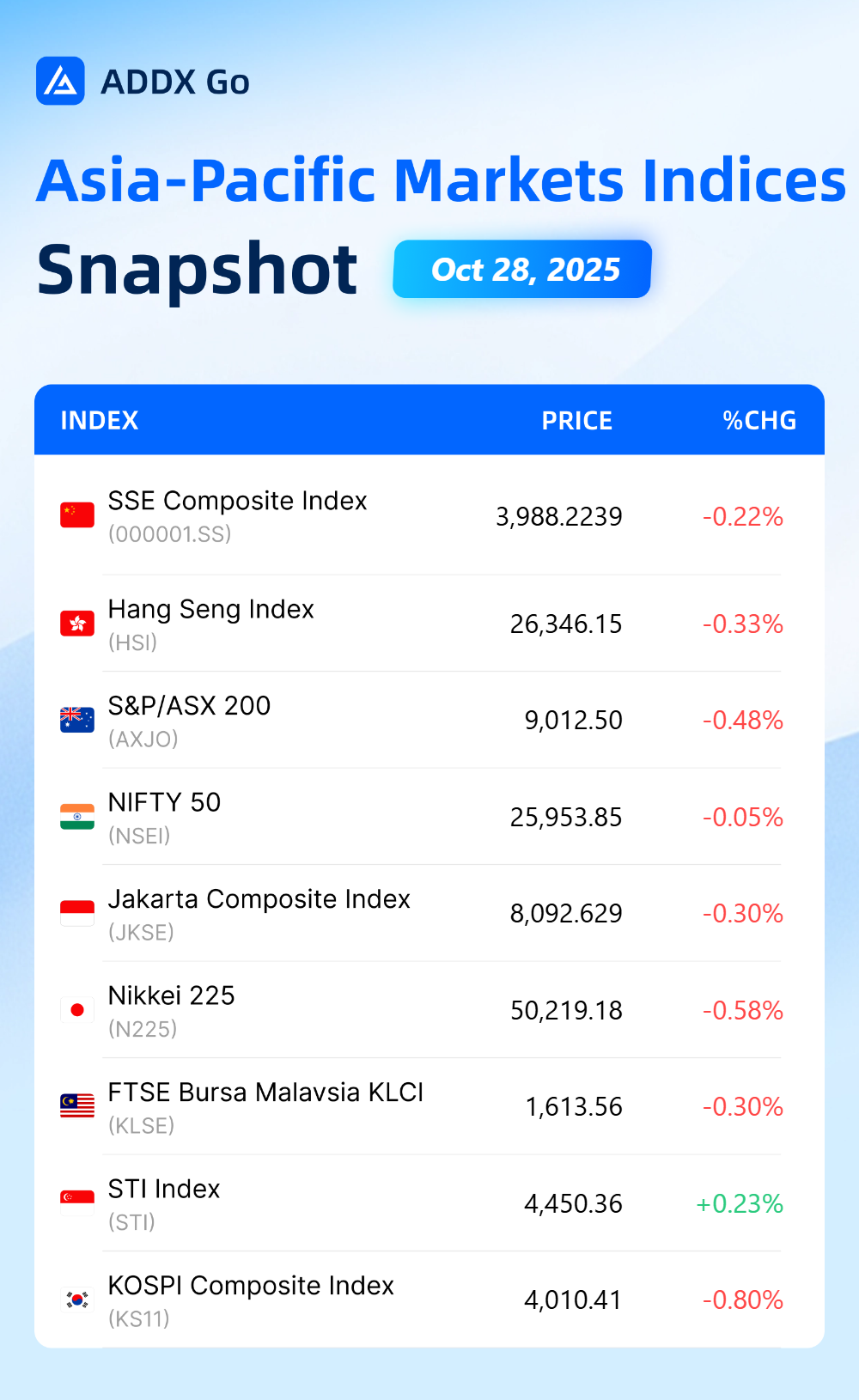
China Stock Market: At the close, the Shanghai Composite fell 0.22%, the Shenzhen Component dropped 0.44%, and the ChiNext Index declined 0.15%.
By sector, Fujian, military industry, and ports & shipping led gains; non-ferrous metals, wind power equipment, and oil & gas saw the largest declines.
Hong Kong Stock Market: Hong Kong’s three major indices fell collectively today. At the close, the Hang Seng Index dropped 0.33% to 26,346.14 points; the Tech Index fell 1.26% to 6,093.44 points; the H-share Index declined 0.97% to 9,375.79 points.
Market performance showed banks and insurance dividend stocks bucking the trend higher, while gold, pharmaceuticals, and consumer electronics weakened.
Japan Stock Market: The Nikkei Average fell 0.58% to close at 50,219.18 yen, down 293.14 yen.
By sector, 32 of 33 industries declined except information & communication, with metal products, construction, textiles, and glass & ceramics seeing the sharpest drops.
South Korea Stock Market: The KOSPI fell 0.80%. By sector, airlines, publishing, electrical products, and utilities rose sharply; conglomerates, aerospace, semiconductors, and non-ferrous metals declined.
Australia Stock Market: The S&P/ASX 200 fell 0.48% to 9,012.500 points. Non-alcoholic beverages, semiconductors, and industrial distribution rose sharply; aerospace, biotechnology, and agriculture saw larger declines.
Singapore Stock Market: The FTSE Straits Times Index (STI) rose 0.13%. Auto & parts, aerospace, cyclical retail, and restaurants gained; biotechnology, agriculture, metals & mining, other energy, and industrial products declined.
Malaysia Stock Market: The FTSE Malaysia KLCI fell 0.30%. Construction, transport & logistics, and real estate rose; healthcare, energy, and industrial products saw slight declines.
Key Events
Malaysia Says U.S. Trade Deal Will Boost Palm Oil Export Edge
The Malaysian Palm Oil Board said a new trade deal between PM Anwar and U.S. President Donald Trump includes tariff exemptions for certain products, further enhancing Malaysia’s palm oil market access.
Trump and Anwar signed a trade and critical minerals deal Sunday. It exempts tariffs on $5.2 billion in products (~12% of Malaysia’s U.S. exports), covering palm oil, cocoa, and pharmaceuticals.
Rice Shortage Followed by Egg Fears? Japan Sees Avian Flu, Egg Prices Near Record Highs
The World Organisation for Animal Health reported a severe avian flu outbreak at a northern Japan poultry farm last week. The new outbreak reignites concerns over rising poultry product prices, especially eggs.
JA Zen-Noh Egg data shows Tokyo medium egg wholesale prices at ¥325/kg on the 27th , nearing the 2023 spring egg shortage record of ¥350/kg .
Rising feed costs and summer heat reducing output are main drivers of recent egg price hikes; the outbreak may worsen the situation. Some criticize eggs becoming “luxury items” in Japan.
Bank of Korea Considers First Gold Reserve Increase in Over a Decade
The Bank of Korea is considering its first gold reserve increase in over a decade, potentially joining the global central bank buying wave pushing gold to record highs.
“We plan to consider adding gold from a medium- to long-term perspective,” said Heung-Soon Jung, head of reserve investment at the BOK’s reserve management group. Jung spoke Tuesday at an LBMA/LPPM event in Kyoto. The BOK last added gold in 2013.
This offers rare insight into central bank gold attitudes. While central bank buying has driven gold higher recently, officials rarely discuss it publicly.
Trump Keeps 15% Tariffs on Japan & Korea; Both Pledge $900B Investment
U.S. President Trump continues his Asia trip, visiting Japan and Korea.
As long-term U.S. allies, Japan and Korea negotiated 15% tariffs (lower than many countries), but still a rise from near-zero, dampening their economies.
To secure exemptions, Japan pledged $550B and Korea $350B in U.S. investments.
Institutional Views
Morgan Stanley: USD Positioning Turns Positive, but Mid-Term Outlook Still Weak
Morgan Stanley strategists say USD positioning turned positive for the first time since Q1 2025. “Investors seem increasingly confident in the U.S. outlook.”
Events outside the U.S. reduce non-USD appeal, including political uncertainty in Japan and France. Doubts rise on further USD downside hedging.
Mid-term, USD risks renewed weakness. If data shows no meaningful recovery—especially jobs—markets may price more Fed cuts. Global pessimism elsewhere may be fully priced or overestimated; further FX hedging possible.
Morgan Stanley: Fed to Cut Aggressively, USD May Weaken Over Next Year
Morgan Stanley strategists say the Fed likely cuts more than the ECB, softening USD over the next year. U.S. growth edge may fade as another pressure.
“Our expected U.S. slowdown reflects lagged tightening, lower net migration, milder fiscal support, and short-term tariff drag.” U.S. policy uncertainty on trade and Fed independence also points to USD weakness. Meanwhile, fiscal sustainability concerns outside the U.S. are expected to ease.
Barclays: Fed Meeting May Reveal Policy Splits
Barclays expects a 25bps Fed cut this week but potential internal divisions. Governor Milan may push for larger cuts; others may favor holding rates. Barclays also expects a signal to end balance sheet runoff by December.