
AI Spending Out of Control? Meta Loses Over $214.7 billion in Market Cap Overnight, Price Targets Slashed by Investment Banks

On Thursday Eastern Time, Meta's stock faced massive selling pressure. The reason: just the day before, the company raised its capital expenditure forecast for the third time this year, sparking analyst panic over "out-of-control" AI spending.
Meta closed down 11.33% on Thursday, marking its largest single-day drop in three years and evaporating $214.7 billion in market cap. Per Dow Jones Market Data, this ranks as the 10th-largest single-day market cap loss in U.S. corporate history and Meta's second-largest ever—trailing only its $232 billion loss on February 3, 2022.
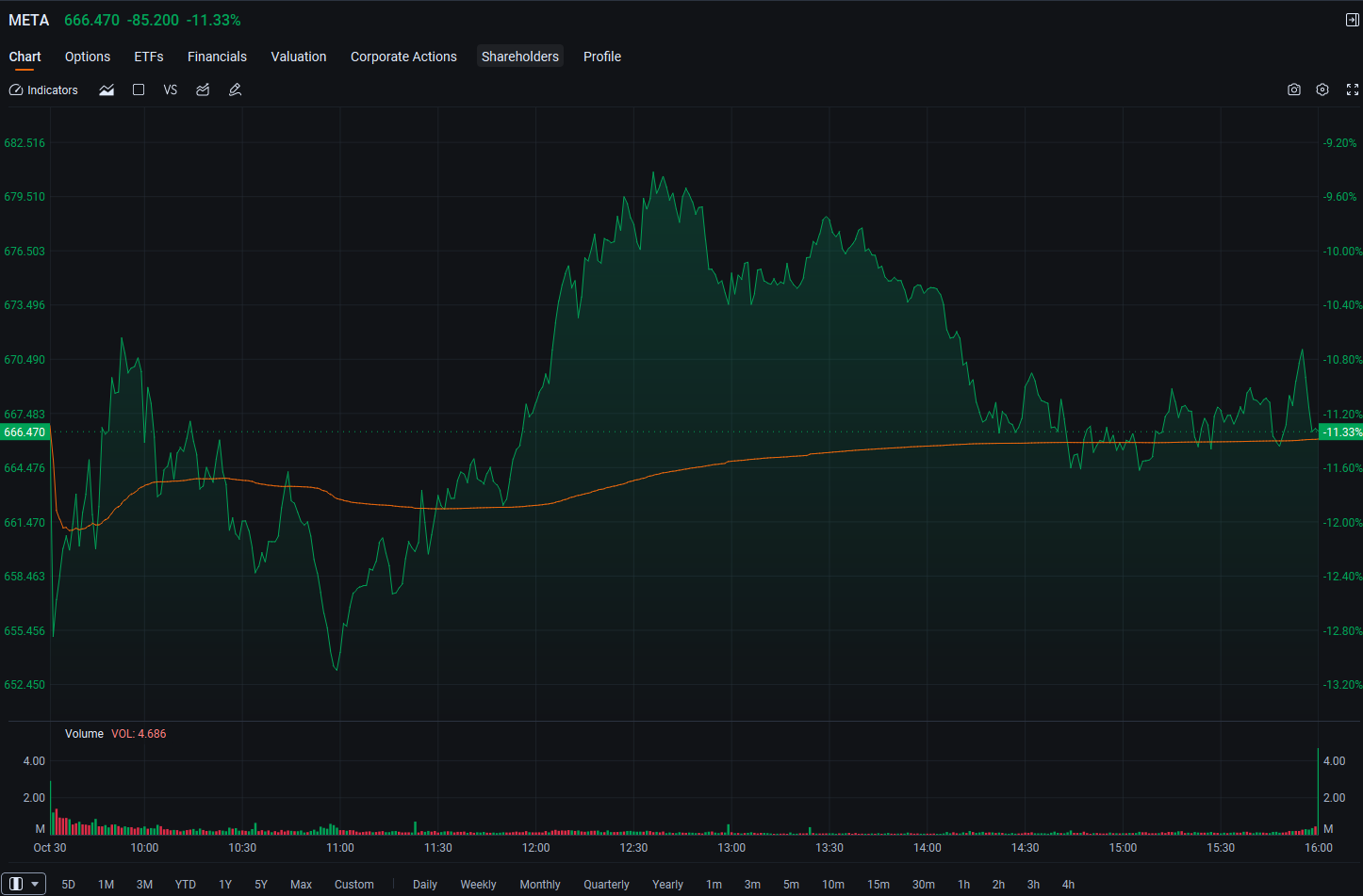
Meta released its Q3 2025 earnings after Wednesday's close. In the report, the company raised 2025 capex guidance to $70B–$72B, up from the prior $66B–$72B range. It also warned that next year's capex growth could "materially increase", driven largely by ongoing AI infrastructure investments.
CEO Mark Zuckerberg called the spending a way to keep pace with AI demand, adding that if the company overbuilds AI infrastructure, it can absorb the extra capacity in the future.
Zuckerberg also noted that Meta's AI ad tools have achieved over $60B in annualized revenue. He stressed this shows the investments are at least paying off, which is critical.
However, this failed to ease investor fears of overspending.

Some analysts compared Meta's latest spending plans to its prior Wall Street-disapproved initiatives—like massive metaverse investments. On October 27, 2022, similar spending concerns triggered a ~25% plunge in the stock.
The issue isn't just the scale of Meta's AI push, but whether the specific types of AI investments it's aggressively pursuing will yield corresponding financial returns—still uncertain.
Investment Banks Slash Meta Price Targets
Notably, while Microsoft and Alphabet also reported increased AI spending on the same day, market anxiety was particularly intense toward Meta.
This stems partly from Meta's less clear AI monetization path compared to Google/Alphabet. Additionally, one-time tax expenses caused Q3 earnings to significantly miss expectations; meanwhile, its Reality Labs metaverse unit posted an operating loss of over $4B this quarter.
Post-earnings, multiple investment banks lowered Meta's price targets.
BofA Global Research analyst Justin Post cut his target from $900 to $810 but reaffirmed a Buy rating.
KeyBanc Capital Markets analyst Justin Patterson lowered his target from $905 to $875, maintaining Overweight.
TD Cowen analyst John Blackledge reduced his target from $875 to $810, keeping Buy.
Additionally, Morgan Stanley's Brian Nowak, Goldman Sachs' Eric Sheridan, Citi's Ron Josey, and Cantor Fitzgerald's Deepak Mathivanan also cut targets while maintaining Buy or Overweight ratings.
Some banks downgraded the rating outright.
Oppenheimer downgraded Meta from Outperform to Perform on October 30, citing growing uncertainty over the company's aggressive AI investments.
Oppenheimer likened Meta's massive AI spending to prior high-cost, low-return projects.
“Investing heavily in superintelligence with unclear revenue prospects echoes the 2021–2022 metaverse spending,” Oppenheimer analysts wrote. They referred to Meta's recently formed Superintelligence Labs, focused on developing AI surpassing human cognition.
Oppenheimer noted Meta's implied Q4 operating and capex are ~7% above Wall Street expectations; the company expects 2026 capex growth "materially greater" than 2025, and expense growth "significantly faster" than 2025's 23%—both exceeding forecasts.
Oppenheimer believes: “Unless performance outlook clarifies before 2027, investors will struggle to justify Meta's P/E,” as high spending has offset strong revenue growth. Analysts contrasted Meta with Alphabet, calling the latter "reasonably valued with predictable earnings."
Benchmark also downgraded Meta from Buy to Hold on Thursday. Analysts said they expect the stock to "at best trade sideways" until it finds reasonable ROI justification for "runaway capex so far."
Analysts wrote that while Meta's ad business dominates, the company "still needs to prove investments beyond ads will pay off."
Benchmark said Meta's AI investments in other areas—like robotics and its Llama foundational model—have "less certain prospects" due to competition from equally capitalized rivals like OpenAI, Google, and Tesla.$META