
Exxon Mobil Q3 Earnings Preview: Refining Margins in Focus as Oil Prices Stay Weak

Shearing sheep
October 31, 2025
GoGPT Summarizes Articles

Exxon Mobil ($XOM) will report its third-quarter 2025 earnings before the U.S. market opens on Friday, October 31. As the largest American oil and gas company, Exxon sits at the center of global energy markets that have been anything but stable this year, shaped by uneven oil prices, trade tensions, and cautious demand growth. Investors are eager to see whether improved refining margins and cost control can help offset the drag from lower crude prices and restructuring expenses.
Expectations Heading into Earnings
Wall Street expects Exxon to post earnings of $1.83 per share, down 4.7% year over year, on revenue of about $83.6 billion, which would represent a 7.1% decline from the same period in 2024. The softer outlook largely reflects weaker commodity prices and higher operating costs, both of which have weighed on margins across the oil sector this year.
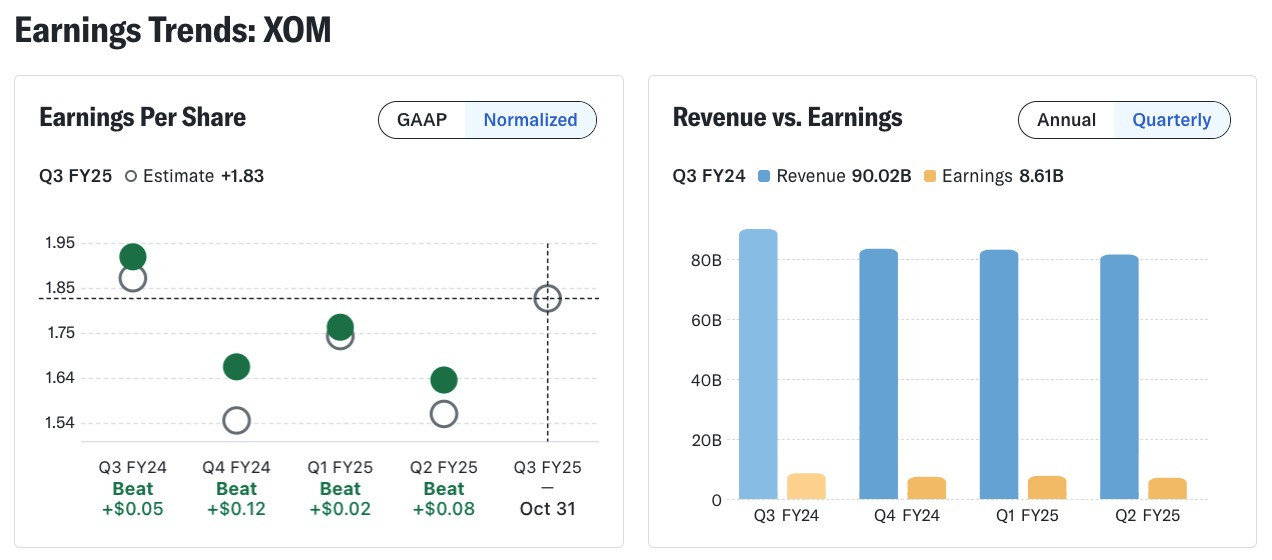
Still, not all signs are negative. Exxon has hinted that changes in crude oil prices could boost Q3 earnings by up to $300 million compared to Q2. Refining margins — a key profit driver for integrated oil majors — are also expected to add between $300 million and $700 million to quarterly earnings, while the chemicals segment could contribute an additional $100 million to $300 million. On the flip side, restructuring efforts and one-time charges may reduce earnings by $400 million to $600 million.
Looking Back: A Mixed Q2 Performance
Exxon’s second-quarter results back in August painted a mixed picture. On one hand, the company delivered its highest Q2 upstream production since the Exxon–Mobil merger more than 25 years ago, alongside record sales of high-value products in its Product Solutions division. On the other hand, weaker energy prices took a toll: total revenue fell 12.4% year-on-year to $81.5 billion, missing estimates, while adjusted EPS dropped 23.4% to $1.64. Even so, profits still came in 10% above analyst expectations, signaling that operational efficiency remains a bright spot.
The market response was cautious — XOM shares fell around 1.8% after the report — but analysts largely saw the pullback as short-term. The company’s diversified operations and disciplined cost control have helped it weather previous oil downturns, and the same may hold true this time.
A Tough Year for Big Oil
Exxon’s results should also be viewed within the broader energy market context. Across the energy industry, the story of 2025 has been one of price volatility and cautious outlooks. The International Energy Agency recently forecast a global oil surplus of about 4 million barrels per day in 2026, citing sluggish demand and increasing output from OPEC+ producers. Meanwhile, average Brent crude prices in Q3 were down 13% year-over-year, though slightly higher than in Q2. U.S. natural gas prices, by contrast, were up 37% from last year’s levels, offering some relief to producers with gas-heavy portfolios.
These trends have split performance among oil majors. European peers like Shell and TotalEnergies are seeing stronger refining results this quarter, but both remain below last year’s earnings levels. Chevron, which reports alongside Exxon, faces its own integration challenges following the $55 billion Hess acquisition, which could result in a $200–400 million loss this quarter.
In short, the macro backdrop remains cloudy, and even operational improvements can only do so much when crude prices stay muted.
Analysts’ Sentiment and Long-Term Outlook
Despite near-term pressure, analysts remain moderately optimistic about Exxon’s long-term prospects. According to MarketBeat data, 27 analysts cover the stock, with 15 rating it a “Strong Buy,” 1 a “Moderate Buy,” 10 a “Hold,” and 1 a “Strong Sell.” The average price target stands at $126.12, implying an 8–9% upside from current levels.
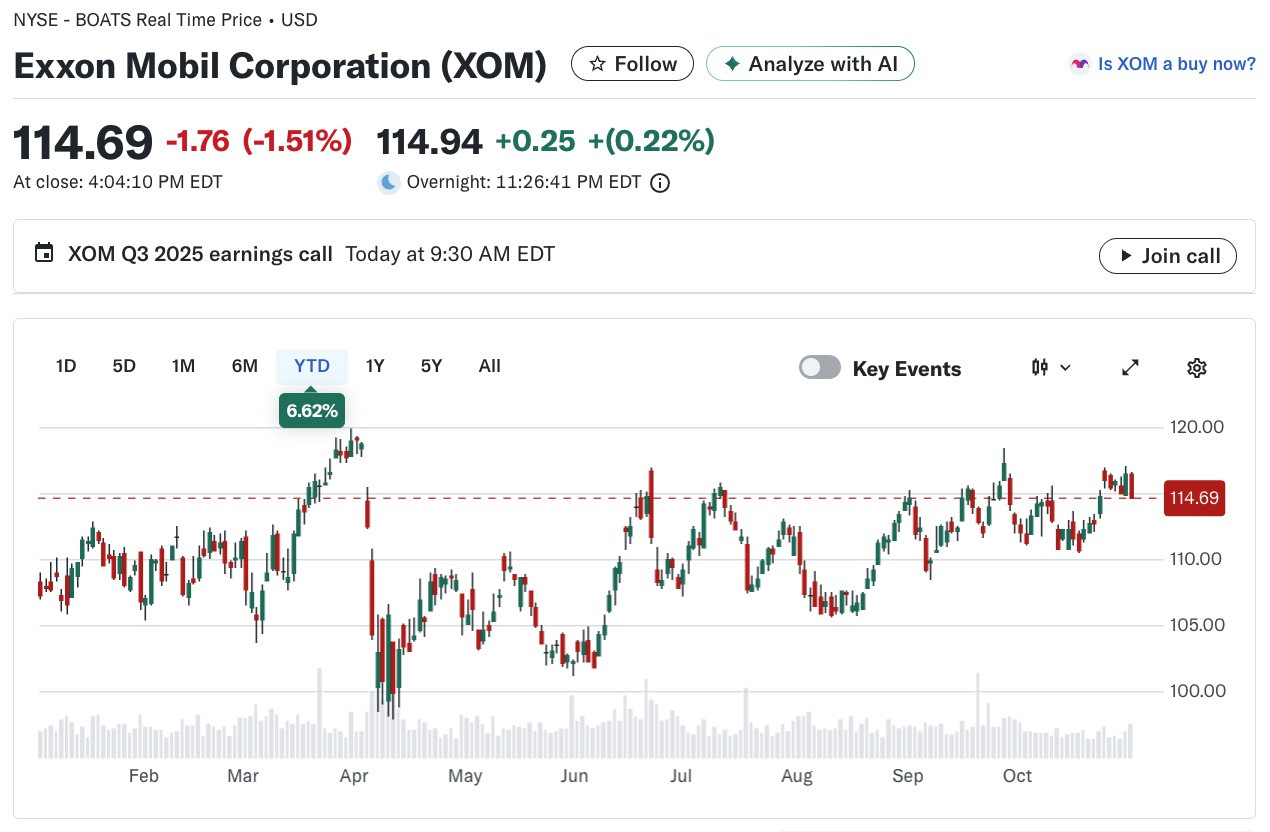
Full-year forecasts reflect a similar pattern. Analysts expect 2025 EPS of $6.79, down 12.8% from last year, but see a 10.5% rebound to $7.50 in 2026 as refining demand stabilizes and capex efficiency improves. Exxon’s balance sheet remains one of the strongest in the sector, and its dividend — currently yielding around 3.4% — continues to attract income-focused investors.
What to Watch on Friday
When results drop, investors will focus on several key themes:
-
Refining margins and cost efficiency: Can Exxon maintain the margin rebound seen in Q3 and translate it into stronger cash flow?
-
Capex and acquisition strategy: With roughly $2.5 billion in annual spending on early-stage projects, will management hint at scaling back?
-
Guidance for 2026: As the global energy market prepares for oversupply, investors want clarity on Exxon’s capital discipline and return priorities.
-
Energy transition positioning: Any mention of carbon capture or hydrogen investments could signal how the company is balancing fossil fuel strength with long-term transition goals.
Exxon is expected to provide a broader strategic update in December, so this quarter’s call could set the tone — especially as AI-driven energy demand and electrification trends reshape long-term projections for oil and gas.
Bottom Line
Exxon Mobil enters this earnings season under familiar pressure: balancing short-term oil price volatility with long-term shareholder returns. The company’s diversified structure and operational discipline provide a cushion, but the real question is whether refining strength can keep offsetting weaker commodity prices.
For investors, this quarter might not deliver fireworks, but it could offer valuable clues about how Exxon plans to navigate a tougher, more uncertain energy market heading into 2026.
#Q3 Earnings Season: Key Insights and Market Movers#$Exxon Mobil Corporation(XOM)