
Airbnb Reports Strong Q3 2025 Revenue and Exceeds Analyst EPS Estimates

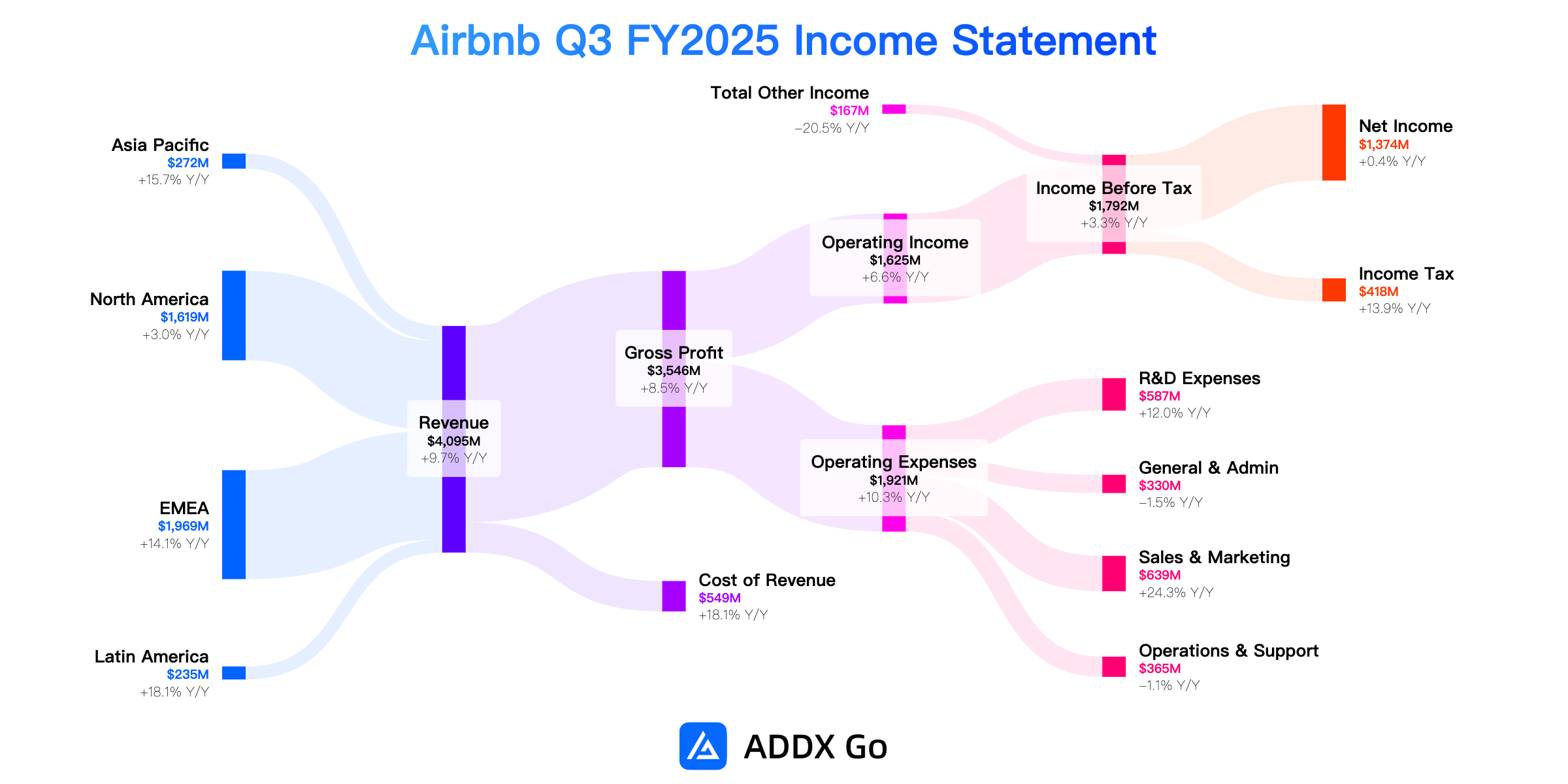
Airbnb (ABNB.US) reported strong financial results for the third quarter of 2025, with revenue increasing by 10% to $4.095 billion compared to the prior year. Net income for the quarter also saw a slight increase to $1.374 billion. The company's diluted EPS of $2.21 exceeded the analyst estimate of $2.29, indicating a solid performance against expectations for the reporting period of Q3 2025.
Revenue Performance and Key Drivers
Revenue growth was primarily driven by an increase in the number of check-ins related to Nights and Seats Booked, alongside a modest increase in the Average Daily Rate (ADR). Nights and Seats Booked increased by 9% to 134 million for the quarter, reflecting growth across all regions, with Latin America and Asia Pacific showing the strongest percentage increases due to international expansion efforts. Gross Booking Value (GBV) also rose by 14% to $22.892 billion, aligning with the increased booking activity.
Share Repurchase Program Update
During the third quarter of 2025, Airbnb continued to return capital to shareholders, repurchasing 6.7 million shares of Class A common stock for $857 million. This was part of the company's existing share repurchase programs, which, as of September 30, 2025, still had $6.6 billion available for further repurchases. In August 2025, the board of directors authorized an additional $6.0 billion for share repurchases, underscoring confidence in the company's financial position.
Impact of Legislative Changes and Tax Matters
The company's provision for income taxes increased by 14%, primarily due to the recognition of a $213 million valuation allowance against deferred tax assets related to Corporate Alternative Minimum Tax (CAMT) credits. This followed the enactment of the One Big Beautiful Bill Act (OBBBA) in July 2025, which included provisions impacting domestic U.S. research and development expenses and foreign derived intangible income taxation. The company concluded it was no longer probable that historic CAMT credits would be utilized, leading to this significant accounting adjustment.