
"Big Short" Guy Shuts Down Fund and Spills Details on Shorting Nvidia, Palantir

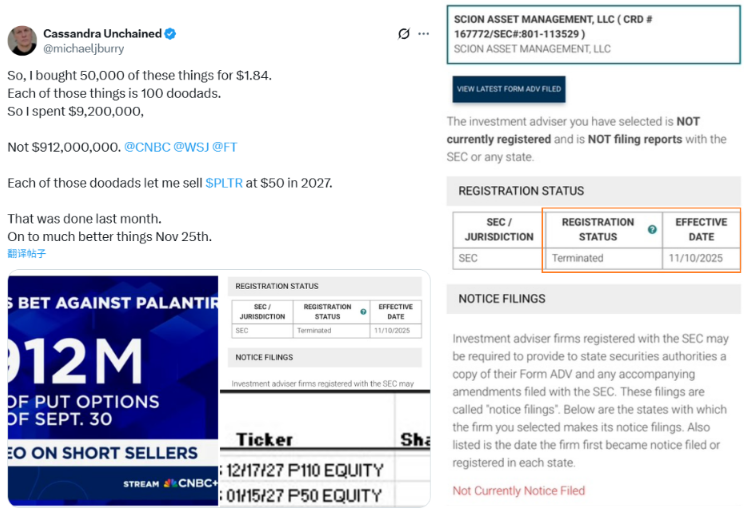
Michael Burry—the dude who called out sky-high valuations on U.S. AI giants and became the talk of the market—just announced yesterday that his Scion fund has deregistered with the SEC.
People are glued to Burry because he nailed the 2008 subprime crash. His story even got turned into the Oscar-winning flick *The Big Short*, making him one of the faces of that whole market meltdown.
Over the past couple weeks, his Scion fund dropped its 13F early, showing put options on AI heavyweights Palantir (software side) and Nvidia (hardware side). Then he kept posting on social media, hammering that the market's in bubble territory and accusing tech giants of quietly stretching out depreciation on their compute chips to soften the hit from massive capex on the income statement.
On the 11th, Burry teased that more details were coming November 25. In hindsight, his posts questioning depreciation timing lined up exactly with wrapping up the fund deregistration.

After that, he dropped a still from *The Big Short* on social media, basically saying "this moment is that moment," and that the truth will come out.
Side note: Burry seems pissed at headlines claiming he's "short a billion dollars," so he just went ahead and shared some actual short details.
The screenshot he posted shows 50,000 Palantir puts expiring Jan 15, 2027, strike $50—that's control over 5 million shares. He says he paid $1.84 each, so total cost: $9.2 million. The media had been freaking out over the notional value, which was a wild $912 million.
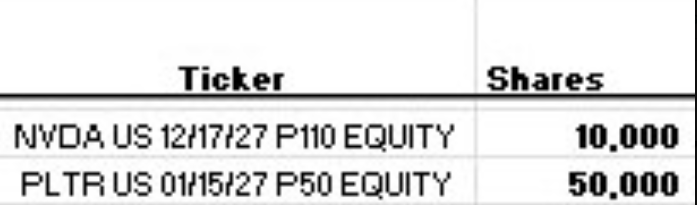
He also has 10,000 Nvidia puts expiring Dec 17, 2027, strike $110, but didn't say what he paid. As of Wednesday's close, those are worth about $9.65 million.
Why's Burry closing shop? Depends who you ask (and what they're holding).
The EndGame Macro team figures, reading between the lines of his posts, he's casting himself as the 2005 version of himself—buried in subprime prospectuses, watching junk mortgages get repackaged as AAA. Now he sees trillion-dollar market caps propped up by capex and accounting tricks.
So he's bowing out—probably doesn't want to grind through another manic bubble endgame. When your call is *that* far from market reality, the straight-up move as a fiduciary is to hand the money back.