
Nvidia Q3 Earnings Preview: Blackwell Ramps, Networking Surges, China Pressure Builds

Shearing sheep
November 18, 2025
GoGPT Summarizes Articles
With Nvidia ($NVDA) set to report its Q3 FY2026 earnings after the bell on November 19 (US ET), the market is once again bracing for what could be one of the most consequential AI-sector updates of the year.
Current consensus expects revenue of about $54.98B (+56.7% YoY) and EPS of $1.25 (+54.3% YoY).
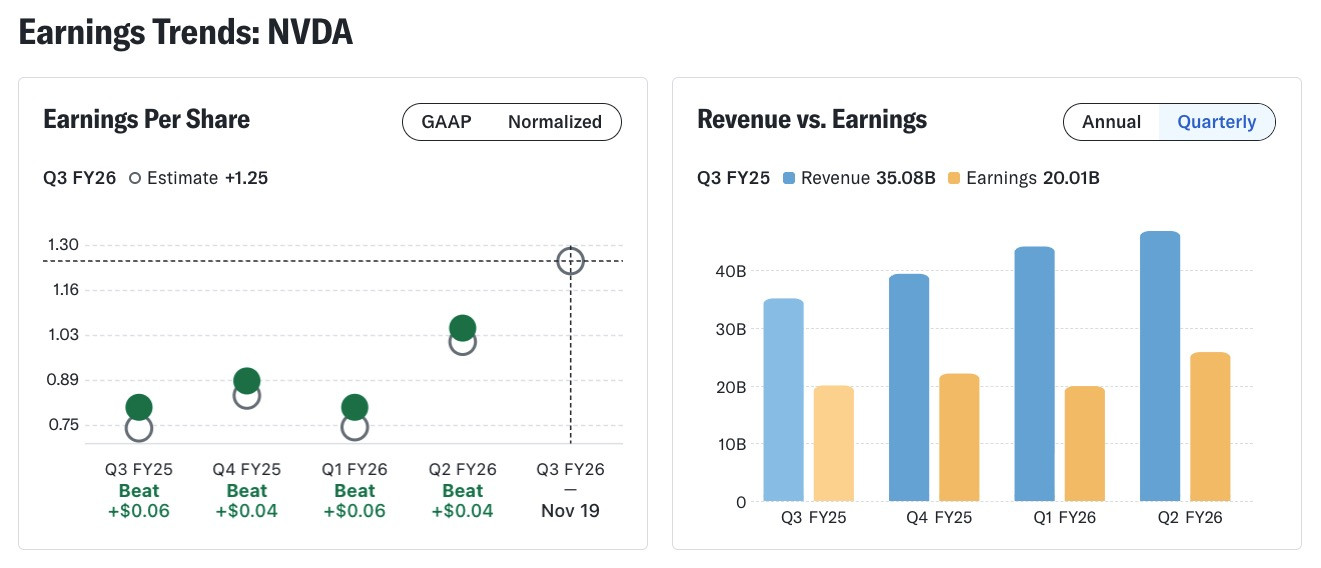
But beyond the headline numbers, the real story going into this quarter isn’t just whether Nvidia beats — it’s how the market reacts, and what management says about supply, China, and the Blackwell cycle that is now in full swing.
Analysts across the Street have been unusually busy in recent weeks. On one side, they’re calling for another quarter of blockbuster growth driven by Blackwell chips and a long-awaited catch-up in networking.
On the other, concerns over China market share erosion and AI-investment fatigue are starting to creep into the narrative. This earnings call could easily turn into a stress test for Nvidia’s status as the core infrastructure provider of the AI boom.
If we look purely at the fundamentals, the top line is likely to look exceptional. GF Securities estimates Q3 revenue at around $55.9B, slightly above consensus, thanks largely to the surge in Blackwell shipments — roughly 1.4 million units for the quarter. Hopper sales add a small supplementary lift.
The more interesting part is actually Q4 guidance: many institutions expect acceleration rather than cooling. GF sees Q4 revenue potentially reaching $64.5B, and even conservative guidance in the $62.5B range would still be above the market’s $61.7B consensus.
The drivers are straightforward: expanding Blackwell capacity, incremental growth from the RTX Pro line, and continued Hopper shipments. In short, the multi-line growth engine remains intact.
Profitability expectations also continue moving higher, and analysts are openly bullish about Nvidia’s earnings power over the next five years.
Market consensus points to a 22% EPS CAGR and 20% revenue CAGR through 2030, with net margins rising from an estimated 54% in FY2026 to over 58% by FY2028. The long-term average margin is expected to stabilize around 57%, which is extraordinary for any hardware-anchored business.
The logic behind these margins is well known: a growing mix of high-margin data-center products, system-level solutions, and recurring software revenue — all protected by the deep moat of CUDA.
CUDA’s lock-in effect now resembles Windows or iOS: once a hyperscaler or enterprise builds on the stack, switching is almost impossibly costly. If Nvidia leans harder into software monetization later in the decade, the margin ceiling could rise even further.
There’s also a new chapter emerging on the networking side. Nvidia previously disclosed that its Spectrum-X networking stack had reached a $10B+ annualized run rate, and with 1.6T optics and system-level integration scaling up, this business is evolving from a “nice add-on” to a genuine secondary growth engine.
Nvidia plans to significantly expand Ethernet switch capacity in 2026, and this could directly pressure incumbent networking providers. Analysts at GF expect the networking business to grow more than 90% YoY in FY2027, driven by NVLink Fabric demand and stronger NVL72/144 system shipments.
On top of that, TSMC appears to be accelerating CoWoS equipment installation into late 2026, which should help alleviate packaging constraints — historically one of Nvidia’s biggest bottlenecks.
But it’s not a clean upside story. China remains the most visible risk heading into the print. According to Bernstein, Nvidia’s share of the Chinese AI-chip market has fallen from 66% in 2024 to an expected 54% in 2025, with further downside possible.
Export controls mean Nvidia simply cannot ship its leading performance tiers into China, leaving the door wide open for Huawei, Cambricon, Hygon, and other Chinese chipmakers. Huawei has even published a full Ascend roadmap through 2028 — something unheard of a few years ago.
Bernstein expects China’s AI-chip localization rate to hit 55% in 2027, up from just 17% in 2023. While China isn’t Nvidia’s largest revenue contributor, the long-term shift matters for total addressable market assumptions.
Other risks worth watching include funding momentum for key customers like OpenAI, competitive pressure from Google TPU and custom ASICs, and the increasingly real problem of electricity constraints limiting data-center expansion in some regions. These are not immediate threats, but they do shape the tone of guidance.
Then there’s the market psychology. Gene Munster highlighted a kind of no-win scenario for Nvidia this quarter: a very strong guide may re-ignite fears of overinvestment and bubble-like spending in AI infrastructure; a modest guide may be read as early signs of normalization.
Either way, volatility risk is elevated. Munster still expects long-term estimates to move higher — he sees 2026 revenue growth forecasts rising from 39% to around 45%, especially after Jensen Huang projected that demand for Blackwell and Rubin chips could reach $500B by 2026 at the infrastructure-spending level.
But in the short term, investor sentiment has cooled as well, with SoftBank selling its Nvidia position and Meta warning that its 2025 spending will outpace revenue growth.
Morgan Stanley, however, is taking the opposite tone. Its analysts believe next week’s report will be Nvidia’s strongest in several quarters, and potentially the one that breaks the “growth has peaked” narrative.
Their latest checks point to a meaningful acceleration in demand, while earlier rack-integration issues have been resolved. Supply, not demand, remains the limiting factor.
Morgan Stanley raised its price target to $220, projecting FY2027 revenue of nearly $300B and noting that order visibility now stretches into 2027 for some ODMs. One Taiwanese manufacturer, Quanta, is planning to double its AI-server capacity next year simply to keep up with orders.
So where does all this leave us heading into earnings?

Nvidia is almost certainly going to post another very strong quarter. Blackwell shipments and Q4 guidance will dominate the conversation, and networking could deliver a pleasant upside surprise.
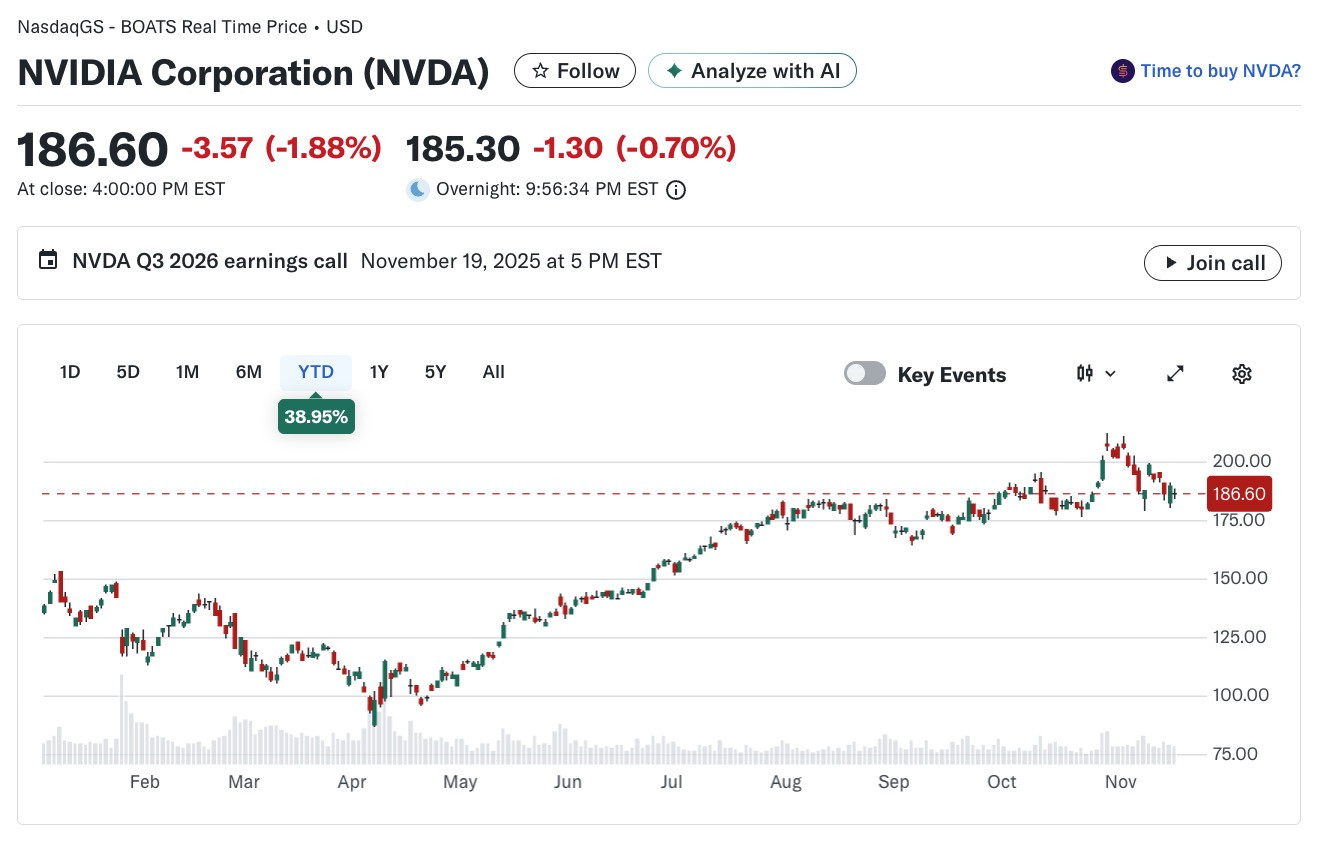
But at the same time, the China share-loss narrative is real, AI-spending skepticism is growing louder, and the stock’s reaction may depend more on guidance tone than the actual numbers.
The big picture hasn’t changed: Nvidia remains the core supplier of the AI infrastructure cycle, with a multi-year runway supported by software lock-in, expanding vertical integration, and accelerating demand from hyperscalers and enterprises. But the path forward may be bumpier, not because fundamentals are weakening, but because expectations have become harder to manage.
This week’s call won’t just tell us how Nvidia performed — it will tell us how confident the company is about navigating the next multi-year wave of AI build-outs, competition, and geopolitics. And that, more than the beat itself, is what the market will trade on.
#$Nvidia Corp(NVDA)