
NVDA's Q3 2026 Revenue Surges 62%, Exceeding Analyst Estimates Amidst Strong Data Center Demand

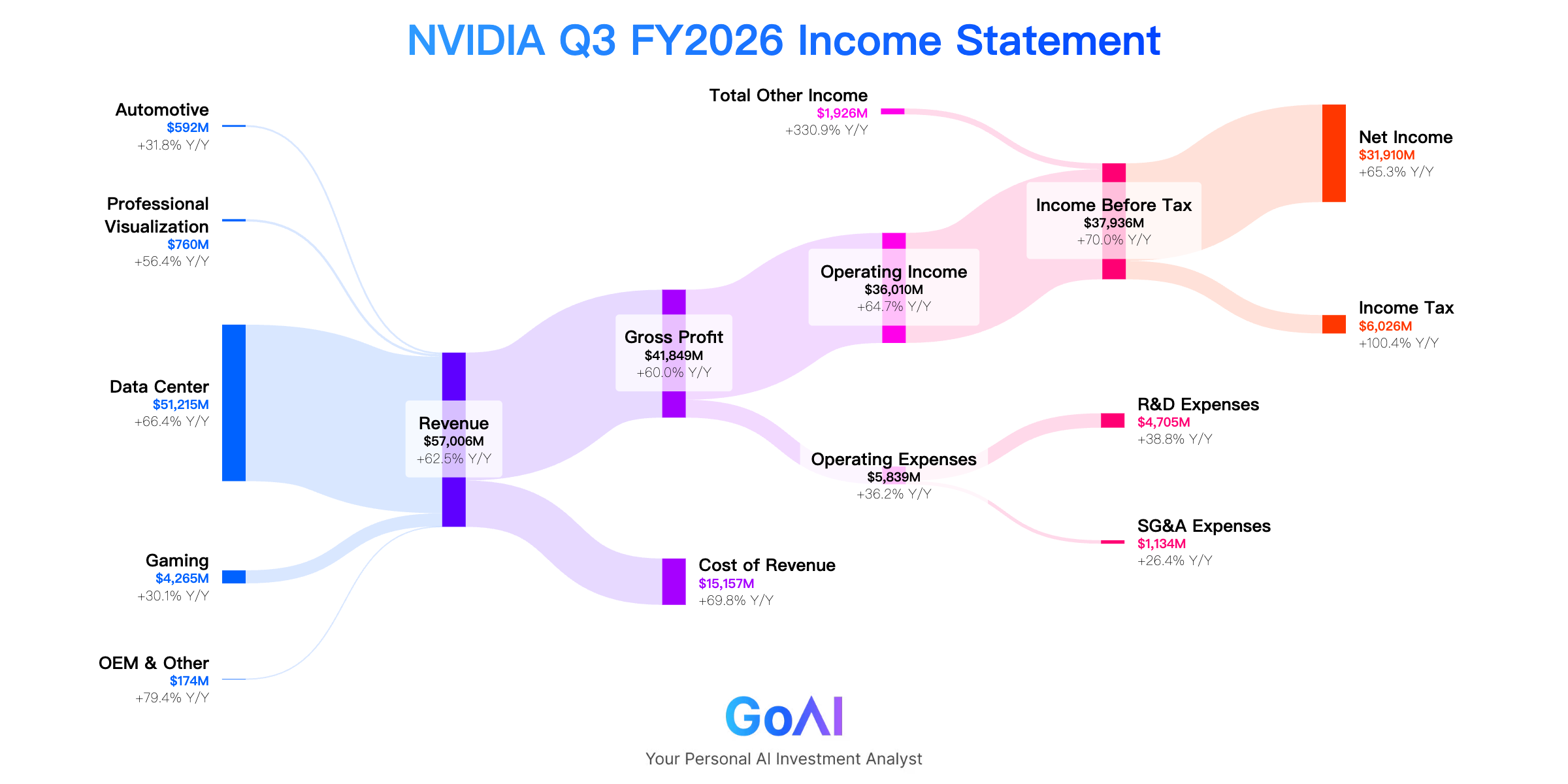
NVIDIA (NVDA.US) reported exceptional financial results for the third quarter of fiscal year 2026, with revenue reaching $57.0 billion, marking a significant 62% year-over-year increase. This figure substantially surpassed the analyst estimate of $54.91 billion. Diluted net income per share for the quarter stood at $1.30, exceeding the analyst estimate of $1.26 per share, demonstrating robust profitability. The company's strong performance was primarily driven by its Compute & Networking segment, particularly the Data Center business.
Strong Segment Performance
The Compute & Networking segment was a key driver of growth, with revenue surging to $50.91 billion, a 64% increase year-over-year. This was fueled by accelerated computing, powerful AI models, and agentic applications, with Blackwell Ultra platforms constituting the majority of Data Center revenue.
Data Center compute revenue reached $43.03 billion, up 56% from the prior year, while Networking revenue soared by 162% year-over-year to $8.19 billion. This networking growth was attributed to the introduction and continued expansion of NVLink compute fabric for GB200 and GB300 systems, as well as increased adoption of XDR InfiniBand products and Ethernet for AI solutions. Gaming revenue also saw a healthy increase of 30% year-over-year, reaching $4.27 billion, driven by continued demand for Blackwell architecture products.
Management Outlook and Strategic Focus
Management highlighted the critical importance of data centers, energy, and capital availability to support the expansion of NVIDIA AI infrastructure by customers. The company continues to advance its Data Center compute product introductions, moving to a one-year product cadence for new advanced architectures.
NVIDIA is actively increasing its U.S.-based manufacturing capabilities and investing in specialized equipment to bolster domestic production, aiming to strengthen its supply chain and meet rising demand for AI infrastructure. The company also disclosed significant investment commitments, including a letter of intent to invest in OpenAI and an agreement to invest up to $10 billion in Anthropic, pending closing conditions.
Operational and Regulatory Landscape
Operating expenses increased 36% year-over-year to $5.84 billion, primarily due to higher compensation and benefits from employee growth and increases, alongside increased compute and infrastructure costs and engineering development for new products. Gross margin saw a slight decrease to 73.4% compared to 74.6% in the prior year, reflecting a business model transition from Hopper HGX systems to Blackwell full-scale data center solutions.
The company acknowledged ongoing uncertainties related to global trade policies, including export controls and tariffs, which introduce complexity and increased costs throughout the supply chain. New U.S. government regulations, such as those concerning the H20 product and the rescinded AI Diffusion Interim Final Rule, continue to impact the company's ability to serve certain markets, particularly China, potentially affecting future revenue and financial performance.