
Walmart Q3 Earnings Preview: Revenue Growth, Margin Focus and Market Expectations Ahead of Results

Shearing sheep
November 20, 2025
GoGPT Summarizes Articles
Walmart ($WMT), the world’s largest retailer, will report results for the quarter ending October 2025 before the market opens on November 20.
With the U.S. consumer economy still in a complicated phase—characterized by steady spending, shifting household budgets, and rising competition in digital retail—investors are watching Walmart’s upcoming report as an indicator not only of the company’s performance but of broader retail sector health.
The market is cautiously optimistic, and recent revisions to analyst expectations suggest confidence is improving as the earnings date approaches.
Analysts expect third-quarter earnings per share to come in at 60 cents, representing growth of approximately 3.4 percent from last year. Revenue is projected to reach 175.2 billion dollars, an increase of about 4.3 percent.
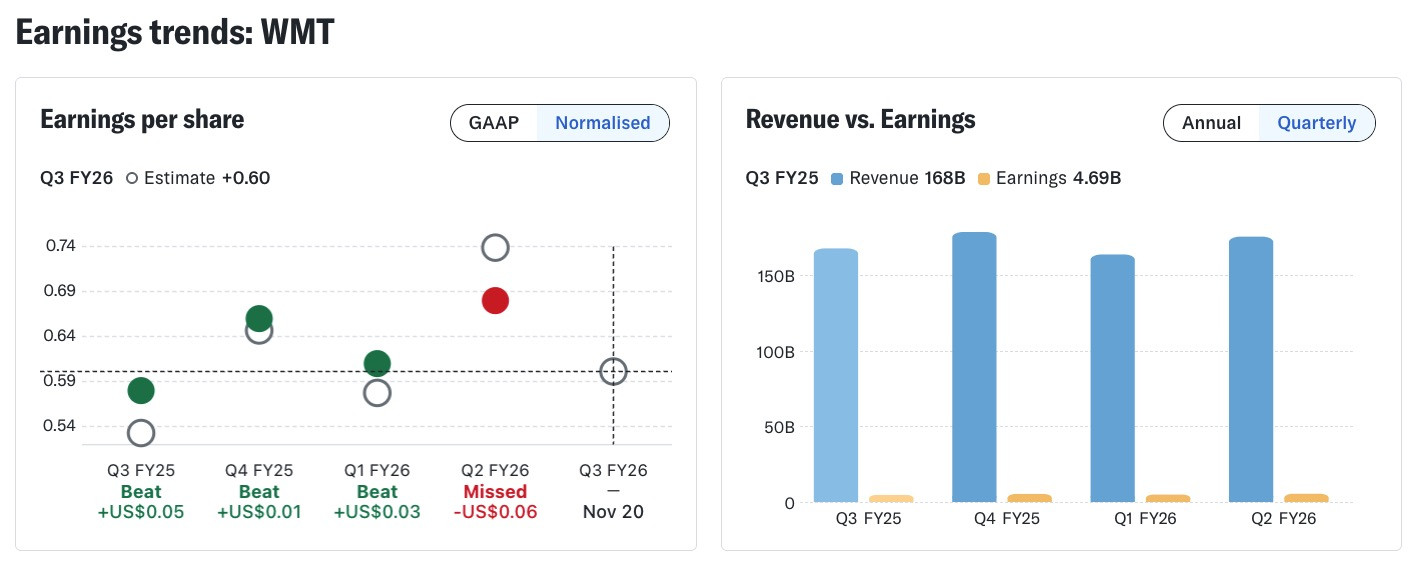
These estimates reflect the ongoing belief that Walmart’s scale, strong grocery business, and increasingly efficient operations allow it to weather shifts in consumer spending more effectively than many competitors.
That said, the company’s earnings track record also provides a note of caution. Walmart has surpassed Wall Street expectations in three of the past four quarters, but the most recent quarter was a reminder that no trend is guaranteed, with earnings coming in slightly below expectations at 0.68 dollars versus the 0.73-dollar market forecast.
One miss does not shake the company’s long-term leadership position, but it highlights the fact that even stable giants can feel the effects of cost volatility, inventory adjustments, or consumer uncertainty.
While the headlines often focus on same-store sales and earnings figures, the far more interesting storyline in recent years is the quiet transformation of Walmart’s business model. The company has been gradually but steadily building what management refers to as the “flywheel” of higher-margin revenue streams outside of traditional retail.
Advertising segment Walmart Connect, new digital commerce solutions, logistics services, and data-driven platform initiatives have all been generating strong double-digit growth.
Although Walmart has not disclosed exactly what percentage of total revenue these businesses now represent, their contribution is becoming increasingly important. If these initiatives continue scaling at the current pace, they could meaningfully lift operating margins over the next few years, easing the reliance on high-volume, low-margin merchandise sales.
The challenge for investors at the moment is that the company provides growth rates but not enough transparency to calculate the long-term earnings impact precisely. Greater disclosure during this earnings cycle would likely be well received.
From a valuation standpoint, Walmart continues to trade like a premium consumer staple stock. The company rarely appears cheap on traditional earnings multiples, and the current price in the 100 to 102-dollar range reflects this typical profile.
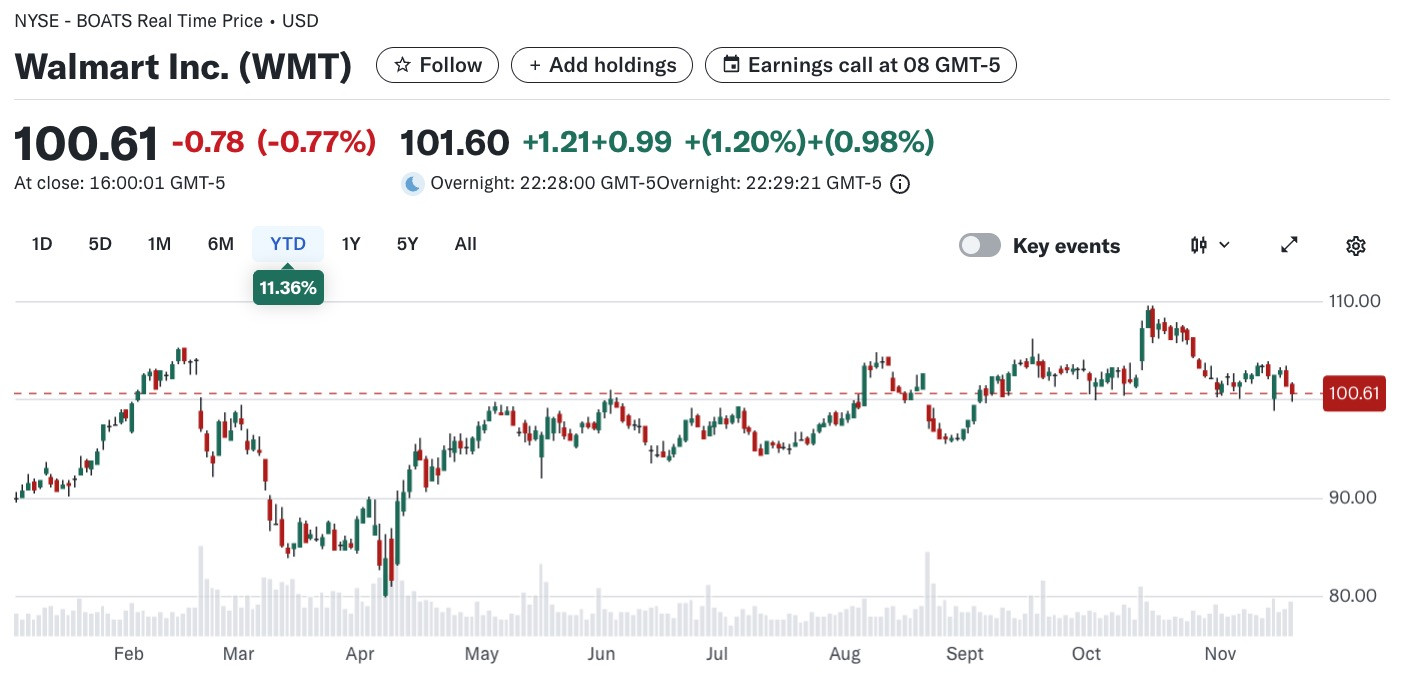
Based on fiscal 2026 estimates, Walmart is priced around 38 times projected earnings, and around 35 times expected 2027 earnings. For a company posting mid-single-digit profit growth, these multiples can appear demanding.
However, large defensive retail businesses with stable revenue streams, predictable cash flows, and exposure to essential categories like food tend to command above-market valuations.
On a cash-flow basis, Walmart trades at roughly 18 times trailing operating cash flow, a level consistent with other major consumer staples but not one that would be classified as a discount opportunity.
The analyst community generally sees limited but positive upside at current levels. The average 12-month target price among 39 analysts stands around 113 dollars, implying roughly 10 percent appreciation from current prices.
As always, earnings reactions depend on more than whether the company beats estimates by a penny or two. Investors will be watching several key areas closely. Margin trends are critical, as logistics, labor costs, e-commerce fulfillment expenses, and digital investments continue to influence profitability.
The performance of Walmart’s online business remains a central focus as the company competes with Amazon, Uber, DoorDash, and a growing field of digital retail challengers. Changes in inventory levels and buying patterns could provide insight into consumer demand heading into the holiday quarter.
Additional attention will likely be paid to how tariffs and import costs are impacting Walmart’s financial outlook. The company experienced some downward pressure on estimates earlier in the year, but forecasts have since stabilized, suggesting that the tariff overhang may be fading. Finally, with Walmart serving a significant rural population, changes in SNAP payments and related government support programs could influence short-term purchasing patterns in specific regions.
Despite the scrutiny, the company’s scale continues to deliver headline-worthy milestones. If third-quarter results come in as expected, Walmart will cross more than 700 billion dollars in revenue on a trailing-twelve-month basis, equivalent to roughly 2.1 percent of U.S. GDP. While revenue is not directly comparable to value-added GDP, this figure serves as an astonishing indicator of the company’s sheer velocity and its unparalleled reach into American households.
As the earnings release approaches, the market’s expectation is not for a dramatic upside surprise but for confirmation that Walmart’s transformation is progressing as planned. If the company shows ongoing growth in digital revenue streams, stable consumer demand, and a path toward gradual margin expansion, the existing valuation framework will likely remain intact. If guidance weakens, or cost pressures intensify, even a headline earnings beat may not support the share price.
Either way, Walmart’s results this week will offer one of the clearest snapshots of U.S. consumer behavior heading into the final stretch of the year. For investors watching the sector, this report is less about one quarter and more about how a retail giant evolves in real time while balancing scale, competition and shifting market expectations.

#Q3 Earnings Season: Key Insights and Market Movers#$Walmart Inc.(WMT)